
Date: 2026-03-07
You know that feeling when you're sourcing boards for a new product and you're not entirely sure you're asking the right questions? There are so many types, materials, and specifications out there—it's easy to get lost.
Here's the thing about PCB circuit boards: they're not all the same. The board inside your smartphone is completely different from the one inside a car's engine control unit. And if you're manufacturing electronic products, understanding those differences matters.
Let's cut through the jargon and talk about what you actually need to know.
A printed circuit board (PCB) is the physical foundation that holds and connects electronic components . Think of it as the skeleton and nervous system combined—it mechanically supports everything while providing the electrical pathways that make circuits work.
In simple terms, it's a flat board made of insulating material with copper traces etched onto its surface . Those copper traces act like wires, connecting components so signals and power can flow where they need to go.
The basic structure hasn't changed in decades: you have an insulating base (usually fiberglass with epoxy resin), copper layers that carry signals, a protective solder mask (that's the green stuff), and silkscreen markings that show where components go .
What has changed is how advanced these boards have become. Today's PCBs can have 30+ layers, traces thinner than a human hair, and materials engineered for frequencies you can't even see.
Not all PCB circuit boards are created equal. Here's a practical breakdown of what's out there:
Single-sided PCBs have copper on just one side. They're simple, cheap, and perfect for basic electronics like power supplies and calculators .
Double-sided PCBs have copper on both sides, connected by vias (small plated holes). This gives you more routing space for circuits like audio equipment or industrial controls .
Multilayer PCBs stack three or more copper layers together. These are the workhorses of modern electronics—think smartphones, servers, medical devices . A typical phone might use an 8-layer HDI stack-up to pack all that processing power into a thin package.
Rigid PCBs are what most people picture—stiff, flat boards made of FR-4 fiberglass. They're everywhere: computers, TVs, industrial gear .
Flexible PCBs (flex circuits) use bendable plastic substrates like polyimide . They can fold, twist, and fit into spaces where rigid boards can't go. Perfect for wearables, medical devices, and anything that needs to move.
Rigid-flex PCBs combine both worlds: rigid sections connected by flexible tails . You get the stability of rigid boards where components need support, and flexibility where the design requires movement. These are common in camera modules, military gear, and compact consumer products.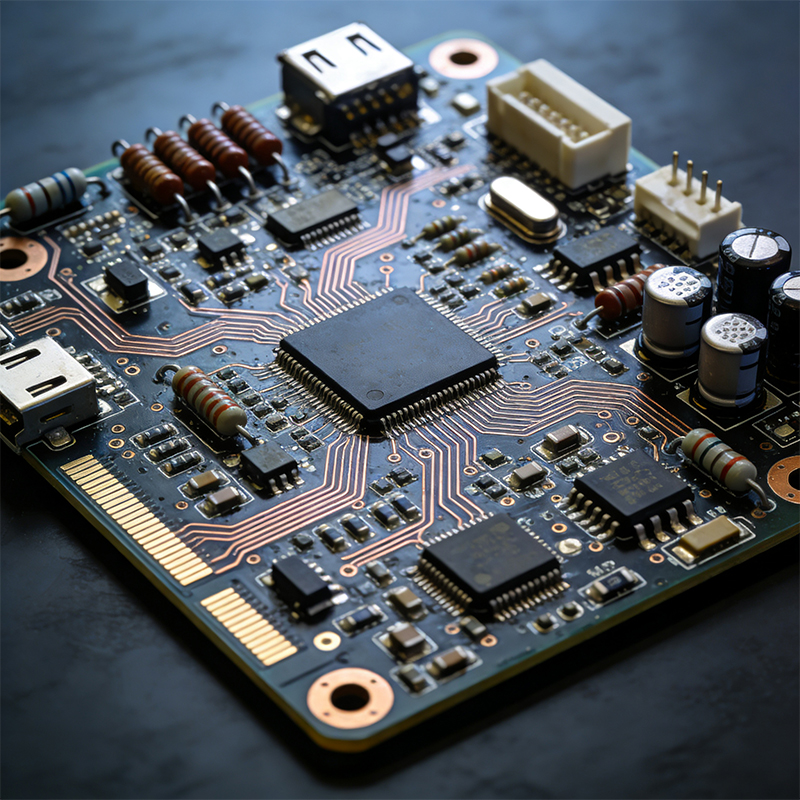
High-Density Interconnect (HDI) PCBs use microvias (laser-drilled holes) and ultra-fine traces to pack incredible density . When you're dealing with BGAs that have 0.4mm pitch or multi-gigabit processors, HDI isn't optional—it's required.
High-frequency PCBs use low-loss materials like Rogers or PTFE for RF applications . 5G base stations, radar systems, and satellite communications all depend on these.
Metal-core PCBs (MCPCBs) have an aluminum or copper base that acts like a heatsink . LED lighting and power electronics use these to keep components from cooking themselves.
Thick-copper PCBs carry serious current—3 to 20 ounces of copper per layer means they can handle 30 amps or more without burning up . Think EV chargers and motor drives.
Ceramic PCBs use alumina or aluminum nitride substrates for extreme thermal and high-frequency performance . You'll find them in high-power LED modules and aerospace applications.
When you're ordering PCB circuit boards, the difference between "it works" and "it keeps failing" often comes down to quality standards.
IPC Class 2 is for dedicated service electronics—computers, telecom gear, industrial controls. Minor cosmetic imperfections are acceptable .
IPC Class 3 is for high-performance electronics where failure isn't an option—aerospace, medical life support, critical automotive safety systems . Tolerances are tighter, inspections are stricter, and reliability is non-negotiable.
A smartphone PCB might be Class 2. An aircraft control computer is definitely Class 3 .
UL 94V-0 is the flammability rating virtually all PCBs aim for. It means the board self-extinguishes within 10 seconds in vertical burn tests .
IPC-4101 covers laminate material specifications—the characteristics of substrates, prepreg, and cores .
RoHS 3 restricts hazardous substances like lead, mercury, and cadmium . If you're selling into Europe, this matters.
Sometimes your design itself decides what kind of board you need.
BGA and fine-pitch components force you into HDI. If you're using a 0.5mm-pitch BGA or a multi-gigabit processor, you need microvias and fine traces to route those connections .
High current means thick copper or metal-core boards. A 30A motor controller on standard 1oz copper would fry—literally .
High voltage requires special materials with high dielectric strength and increased creepage/clearance distances .
Here's what actually matters when you're picking a partner to build your boards:
Technical match. Can they actually build what you need? Layer count, minimum features, specialty materials—do they have real experience, or just marketing claims?
Quality systems. Certifications matter, but so do daily practices. Ask about inspection points, yield data, how they handle non-conforming material.
Design support. Do they review your files before production? Flag potential issues? Suggest improvements? This feedback is free expertise—use it.
Transparency. Are they open about their capabilities and limitations? Will they let you visit?
At Kaboer, we've been building custom PCB circuit boards since 2009. Sixteen years of experience, headquartered in Shenzhen—right in the heart of global electronics manufacturing.
What we make:
Flexible PCBs (FPC) : 1-20 layers, 0.075mm to 0.4mm thick
Rigid-Flex Boards: 2-30 layers, combining rigid stability with flexible interconnects
Rigid PCBs: 1-30 layers, from standard FR-4 to high-performance materials
HDI High-Density Boards: Microvias, fine lines, advanced stackups
High-Frequency Boards: Low-loss materials including Rogers and PTFE
Metal-Core Boards: For LED and power applications needing excellent heat dissipation
What sets us apart:
We don't just make boards—we assemble them too. Our in-house PCBA facility means you get fully assembled, tested modules ready for integration. One partner, one quality standard, no finger-pointing between fab and assembly.
We're certified to ISO 9001, IATF 16949, ISO 14001, UL, RoHS. IPC Class 2 and Class 3 when you need the highest reliability.
But more than the equipment list, we actually talk to you. We review your design before production. We flag potential issues. We suggest improvements. We're honest about what we can and can't do.
And we're in Shenzhen. If you want to see how your boards are made, you're welcome to visit. Walk the floor, meet the team, ask whatever you want.
PCB circuit boards don't have to be complicated. The right partner makes all the difference.
If you need custom PCB circuit boards or have questions about your project, send us your Gerber files or requirements. We'll get back to you with a free quote within 2 hours.
Better yet—come visit us in Shenzhen. See for yourself how we turn designs into real, working boards.

Kaboer manufacturing PCBs since 2009. Professional technology and high-precision Printed Circuit Boards involved in Medical, IOT, UAV, Aviation, Automotive, Aerospace, Industrial Control, Artificial Intelligence, Consumer Electronics etc..


 English



 Wechat
 +86 13670210335
 +86 13670210335
 E-mail