
Date: 2026-03-07
You know that moment when you finish a PCB design and send it off to a fabricator? There's a mix of excitement and nervousness—will it come back right? Will it work? Will there be some manufacturing issue that turns your perfect design into a headache?
Here's the thing: understanding what happens after you hit "send" makes a huge difference. When you know the circuit board manufacturing process, you can design smarter, spot potential problems before they happen, and have much better conversations with your fabricator.
Let's walk through how a bare laminate becomes a finished circuit board—and what you need to know at each step.
Your design files (Gerbers, drill files, fabrication drawings) arrive at the factory. First thing that happens? A Design for Manufacturability (DFM) review .
This isn't just a formality. Experienced engineers check your design against their process capabilities:
Are trace widths and spaces within limits?
Do hole sizes match available tooling?
Is the copper distribution balanced?
Will the stackup work for impedance control?
This review catches issues before they cost you time and money. A good fabricator will flag problems and suggest fixes—not just run your files blindly .
Every PCB starts as copper-clad laminate (CCL) —sheets of insulating material (usually FR-4 fiberglass) with copper foil bonded to one or both sides . These sheets get cut into panels sized for the production line.
Before anything else, panels go through cleaning. Chemical baths remove oxidation and contaminants—think of it as prepping the canvas so the paint sticks properly .
For multilayer boards, inner layers come first. The process has evolved significantly. While old-school methods used photographic film, modern fabrication relies on Laser Direct Imaging (LDI) .
Here's how it works:
A light-sensitive photoresist coats the copper surface. The LDI machine reads your digital files directly and uses a precision laser to expose the circuit pattern. Where the laser hits, the resist hardens. Where it doesn't, it stays soft .
This method eliminates the registration errors and wear issues of physical film. It also handles finer features—down to 2mil lines or smaller for advanced designs .
Now the panel enters chemical baths. The unhardened photoresist washes away first, exposing copper. Then etchant removes that exposed copper, leaving only the traces protected by hardened resist .
After etching, the remaining resist gets stripped off. What's left? Your circuit pattern, precisely rendered in copper .
Automated Optical Inspection (AOI) happens right after etching. High-resolution cameras scan every trace, comparing the actual board to your design data, catching opens, shorts, or thin spots .
For multilayer boards, individual inner layers need to become one solid panel. They're stacked with sheets of prepreg—partially cured resin-impregnated fiberglass—between them .
The stack goes into a laminating press under high heat and pressure. The prepreg melts, flows, and bonds everything together. Temperature and pressure profiles matter tremendously—wrong parameters mean voids, delamination, or warped boards .
For advanced HDI boards, this process can repeat multiple times (sequential lamination), building up complex structures with buried and blind vias .
Holes serve two purposes: mounting holes for assembly, and vias that connect different layers electrically .
CNC drilling machines use tiny, high-speed bits (down to 0.2mm or smaller) to create thousands of holes per panel, positioned with micron-level accuracy . For HDI boards, laser drilling creates the smallest holes—microvias as tiny as 0.075mm .
Drill quality matters. Worn bits, wrong speeds, or poor chip evacuation can cause rough hole walls or misregistration .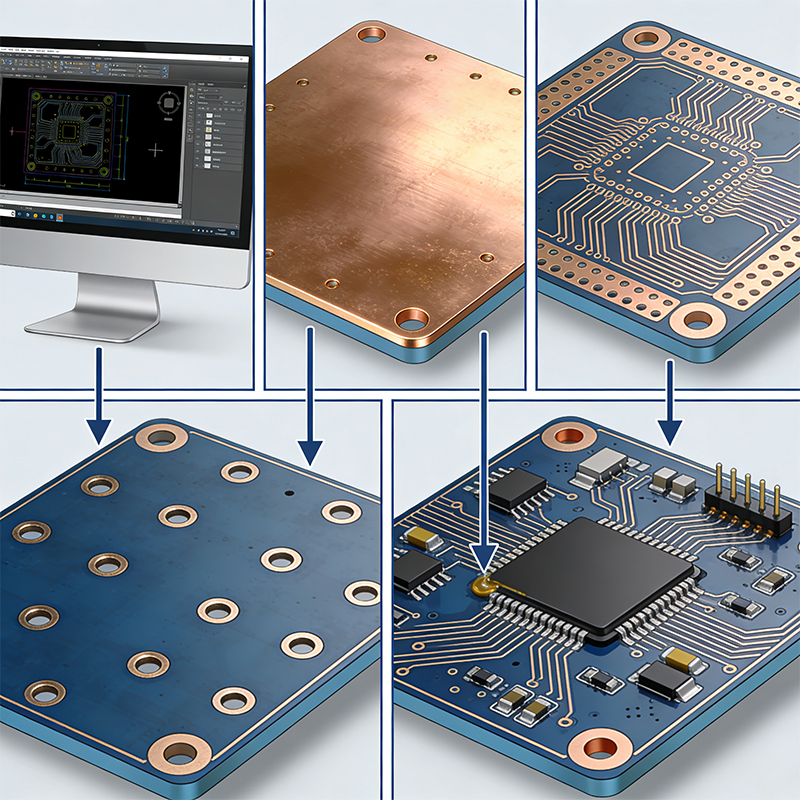
Freshly drilled holes are just holes in insulating material. They need to become conductive pathways.
Electroless copper plating deposits a thin layer of copper on all surfaces—including inside every hole . Then electrolytic plating builds up copper thickness to specification (typically 20-35 microns in holes, more for heavy-copper designs) .
This creates solid conductive tubes—vias—that electrically connect all the layers.
Now it's the outer layers' turn. Same basic process as inner layers—photoresist, imaging, development—but with an extra step: pattern plating .
After imaging, the exposed areas get additional copper plating, then a thin layer of tin or tin-lead as an etch resist. After etching away unprotected copper, the tin gets stripped, leaving clean outer layer traces .
That familiar green coating (or other colors) is solder mask. It protects copper from oxidation, prevents solder bridges during assembly, and provides electrical insulation between closely spaced traces .
Liquid photoimageable (LPI) mask is applied over the entire board, then exposed through a phototool. Unexposed areas wash away, leaving openings exactly where components will solder. A final thermal cure hardens the mask permanently .
White lettering and symbols get printed onto the board—component outlines, reference designators (R1, C5), logos, test points. This "map" guides assembly and troubleshooting .
Bare copper pads need protection to stay solderable. Common finishes include:
HASL (Hot Air Solder Leveling) – Cost-effective, good solderability
ENIG (Electroless Nickel Immersion Gold) – Flat surface, excellent for fine-pitch components and long shelf life
OSP (Organic Solderability Preservative) – Simple, low-cost, water-based
Immersion Silver/Tin – Alternative finishes for specific needs
Every board gets tested for shorts and opens. Flying probe testers use moving probes to check every net—ideal for prototypes and complex boards. For high volume, dedicated test fixtures test boards in parallel .
Impedance testing verifies controlled impedance lines meet specifications—critical for high-speed designs .
Individual boards are separated from the manufacturing panel using CNC routers (for complex shapes) or V-scoring (for simple rectangles) .
After a final visual inspection (FQC), boards get cleaned, packaged in anti-static bags, and shipped .
Understanding the process is one thing. Finding a partner who executes it consistently is another. Here's what separates good fabricators:
Rigorous process control. They monitor critical parameters—etching rates, plating thickness, lamination temperature—and use statistical process control (SPC) to maintain consistency .
Multiple inspection points. AOI at inner and outer layers, X-ray for hidden structures, electrical test for every board. They catch defects early, not after boards are finished .
Clear communication. They give DFM feedback, explain tradeoffs, and don't promise what they can't deliver.
Transparency. They'll let you visit, show you their equipment and workflows, and answer your questions honestly.
At Kaboer, we've been manufacturing circuit boards since 2009—sixteen years of experience turning designs into reality for companies around the world. We're based in Shenzhen, at the heart of global electronics manufacturing, with a factory equipped for the full spectrum of work.
What we make:
Flexible PCBs (FPC) : 1-20 layers, 0.075mm to 0.4mm thick
Rigid-Flex Boards: 2-30 layers, combining rigid stability with flexible interconnects
Rigid PCBs: 1-30 layers, from standard FR-4 to high-performance materials
HDI High-Density Boards: Microvias, fine lines, advanced stackups
High-Frequency Boards: Low-loss materials including Rogers and PTFE
Metal-Core Boards: For LED and power applications needing excellent heat dissipation
What sets us apart:
We don't just make boards—we assemble them too. Our in-house PCBA facility means you get fully assembled, tested modules ready for integration. One partner, one quality standard, no finger-pointing between fab and assembly.
We're certified to ISO 9001, IATF 16949, ISO 14001, UL, RoHS. IPC Class 2 and Class 3 when you need the highest reliability.
But more than the equipment list, we actually talk to you. We review your design before production. We flag potential issues. We suggest improvements. We're honest about what we can and can't do.
And we're in Shenzhen. If you want to see how your boards are made, you're welcome to visit. Walk the floor, meet the team, ask whatever you want.
Understanding the circuit board manufacturing process helps you design smarter and avoid costly mistakes. The right partner makes all the difference.
If you need custom PCBs or have questions about your design, send us your Gerber files or requirements. We'll get back to you with a free quote within 2 hours.
Better yet—come visit us in Shenzhen. See for yourself how we turn designs into real, working boards.

Kaboer manufacturing PCBs since 2009. Professional technology and high-precision Printed Circuit Boards involved in Medical, IOT, UAV, Aviation, Automotive, Aerospace, Industrial Control, Artificial Intelligence, Consumer Electronics etc..


 English



 Wechat
 +86 13670210335
 +86 13670210335
 E-mail