
Date: 2026-02-26
Have you ever opened a computer and noticed how the graphics card, memory sticks, and SSD just slide into place, making perfect electrical contact without any wires? That's the magic of PCB edge connectors.
Also known as gold fingers, these are the rows of gold-plated pads you see along the edge of many circuit boards . They're designed to slide directly into matching slots on a motherboard or backplane, creating a reliable connection without needing cables or separate connectors .
Think of it like a wall outlet in your home. You don't wire your lamp directly into the house—you just plug it into the socket. PCB edge connectors work the same way. They make circuit boards modular, replaceable, and easy to upgrade .
In simple terms, a PCB edge connector is the part of a circuit board that plugs into a connector on another board. The board itself becomes the plug .
You've definitely seen them before:
The golden contacts on a memory stick (DIMM) that slide into your computer's motherboard
The edge of a graphics card that fits into the PCI Express slot
The tiny connector on an M.2 SSD that plugs into modern laptops
These connectors are called "gold fingers" because they're plated with gold—and for good reason. Gold doesn't tarnish, it conducts electricity beautifully, and it can withstand repeated plugging and unplugging .
Edge connectors solve a fundamental problem in electronics: how do you connect things that might need to be changed later?
Without edge connectors, everything would have to be soldered directly. Want to upgrade your graphics card? You'd need a soldering iron. A component fails? The whole board goes in the trash.
Edge connectors change that. They make electronics:
Modular: Different function cards can plug into a standard backplane. Need more processing power? Swap the card. Want better graphics? Upgrade it. This modularity is why your computer can be customized .
Serviceable: When something breaks, you replace just the faulty card—not the whole system. Field technicians can swap modules in minutes instead of hours .
Manufacturable: Instead of building one giant complex board, manufacturers build smaller function-specific boards that plug together. This often improves yield and reduces cost .
Upgradable: Technology moves fast. With edge connectors, you can keep your main system and upgrade individual components as better ones become available .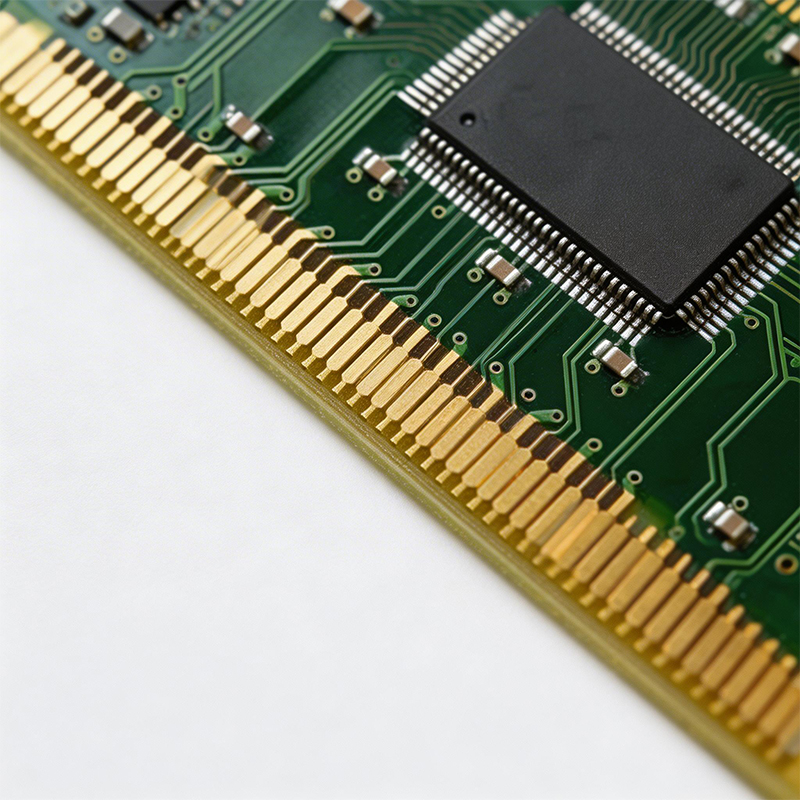
Designing a board with edge connectors isn't just about putting pads along the edge. Several critical details make the difference between a board that works for years and one that fails after a few insertions.
The contact pads are typically arranged along one edge of the PCB. They can be on one side only (for simpler connections) or on both sides (doubling the number of contacts) . Common pitches (spacing between pads) include 1.0 mm for PCIe cards, 0.8 mm for memory modules, and even finer 0.5 mm for compact applications like MXM graphics modules .
You might wonder why we use expensive gold instead of cheaper copper or tin. The answer is simple: gold is the best material for contacts that must survive repeated use .
Edge connectors use hard gold—gold alloyed with small amounts of cobalt or nickel to make it tougher . This is different from the soft gold used for soldering (like ENIG). Hard gold can withstand hundreds or even thousands of insertion cycles without wearing away .
Typical gold thickness ranges from 0.5 to 1.5 microns (about 20-60 micro-inches). Thicker gold means more insertion cycles—applications needing 500+ cycles often specify the higher end .
Under the gold is a nickel barrier layer, typically 3-7 microns thick. Nickel prevents the gold from diffusing into the copper and provides mechanical strength .
Look closely at a memory stick or graphics card. Notice how the edge with the gold fingers is angled? That's called beveling or chamfering .
Beveling serves several crucial purposes:
It guides the board smoothly into the connector socket
It reduces insertion force, making assembly easier
It prevents damage to both the gold fingers and the connector contacts
It reduces wear over repeated insertions
Common bevel angles are 30° or 45°, though some designs use 20° . The bevel depth must be carefully controlled—if it cuts into the gold fingers, they'll be damaged. That's why there's a required clearance between the fingers and the board edge, typically 0.5-0.6 mm minimum .
You can't just place components anywhere near gold fingers. There are strict keep-out zones:
No solder mask on the fingers themselves (they must be bare for contact)
No vias or pads within about 1-2 mm of the fingers
No copper on inner layers in the bevel area (or it will be exposed when beveling)
No surface traces near the fingers that could short
Making a board with gold fingers requires extra steps beyond standard PCB fabrication. Here's what happens:
Standard fabrication up to the point where the outer layer is etched
Solder mask application everywhere except the gold finger areas
Nickel plating on the exposed finger pads
Hard gold electroplating selectively on the fingers
Beveling the edge at the specified angle
Final inspection including XRF to verify gold thickness
Because gold fingers require electroplating (not just immersion), they need plating leads—temporary copper traces that carry current to the fingers during plating. These are later removed, which is why you might see small notches or marks near the fingers on finished boards .
PCB edge connectors appear everywhere in modern electronics:
Computers and Servers: PCIe slots for graphics cards, DIMM sockets for memory, M.2 connectors for SSDs and Wi-Fi cards
Industrial Equipment: Eurocard form factors, CompactPCI, VMEbus systems where cards slide into backplanes
Telecommunications: Line cards in switches and routers that plug into midplanes or backplanes
Test and Measurement: Modular instruments with interchangeable function cards
Consumer Devices: Game cartridges, some camera memory formats, expansion modules
Aerospace and Defense: Ruggedized systems where cards must withstand vibration yet remain serviceable
If you're designing a board with edge connectors, here are the key numbers to remember:
| Parameter | Typical Requirement |
|---|---|
| Gold thickness | 0.5-1.5 µm (hard gold) |
| Nickel underlayer | ≥3 µm |
| Finger-to-board-edge clearance | ≥0.5 mm |
| Bevel angle | 30° or 45° typical |
| Keep-out from fingers (vias/pads) | ≥1 mm |
| Minimum finger pitch | 0.5 mm for high-density |
| Plating leads | Required for electroplating |
Always check the specifications of the mating connector. Different standards (PCIe, DIMM, custom) have different requirements for dimensions, tolerances, and plating .
PCB edge connectors are one of those technologies that make modern electronics possible. They turn circuit boards into plug-in modules, enabling the modular, upgradeable, serviceable devices we take for granted.
Whether you're designing a simple expansion card or a complex backplane system, understanding how edge connectors work—and how to design them correctly—will save you headaches down the road.
And remember: when it comes to gold fingers, the gold isn't just for show. It's the difference between a connection that lasts and one that wears out after a few insertions .

Kaboer manufacturing PCBs since 2009. Professional technology and high-precision Printed Circuit Boards involved in Medical, IOT, UAV, Aviation, Automotive, Aerospace, Industrial Control, Artificial Intelligence, Consumer Electronics etc..


 English



 Wechat
 +86 13670210335
 +86 13670210335
 E-mail