
Date: 2025-12-13
If you think all circuit boards are made like layer cakes—where everything is laminated together in one go—you’re only half right. In the world of electronics, where performance is pushed to the extreme, there exists a far more precise and flexible “architectural” process that allows for mind-boggling complexity and density. This is SBU technology.
SBU stands for Sequential Build-Up. Think of it as a layer-by-layer manufacturing process for circuit boards. To understand why it’s special, let’s first look at how traditional multilayer boards are made.
Traditional Multilayer Fabrication (Core Method or Mass Lam):
Imagine binding a hardcover book. You print all the inner pages (the circuit layers), stack them in order, and then bind and glue them together in one press. That’s the logic of traditional boards: make all inner-layer cores, laminate them all at once in a massive press, and then drill and plate through-holes. This method is mature, cost-effective, and perfect for most general-purpose needs.
SBU Sequential Build-Up Process:
Now, imagine constructing a super-tall skyscraper. You don’t pour concrete for all floors at once. Instead, you start with the core structure and build upward, one floor at a time. You complete one floor, do the intricate wiring and finishes, then add the next. This is the essence of SBU: starting with a completed core board, you sequentially “grow” new circuit layers by adding dielectric insulation, laser-drilling micro-vias, and plating copper, one layer (or a couple of layers) at a time.
The most fundamental difference lies in the timing of drilling and interconnection:
Traditional: Drill through all layers after they are laminated together.
SBU: After adding each new layer, drill and plate micro-vias that connect only that new layer to the one(s) directly beneath it—a precise, localized connection.
SBU emerged to meet the eternal electronics challenge: lighter, thinner, smaller, more powerful. It becomes essential when traditional processes hit these walls:
1. Enabling Ultra-High-Density Interconnect (HDI)
This is SBU’s primary purpose. As chip pin counts exploded (think BGAs with thousands of solder balls), the routing channels to connect them needed to become incredibly dense. SBU allows for the use of extremely small blind and buried vias (typically <150µm, even down to 50µm). These micro-vias only penetrate specific layers, freeing up immense routing real estate. Traces can weave between vias, achieving much higher routing density than possible with through-holes.
2. Supporting Finer Lines and Spaces
Because layers are built sequentially, each can employ more advanced patterning. SBU processes routinely achieve smaller trace widths and spacings (e.g., 2/2 mil or less), which is critical for high-speed signals (like PCIe, DDR) and reducing chip package size.
3. Enhancing High-Frequency and High-Speed Signal Integrity
In high-frequency applications, a through-hole acts like a stub on the signal path, causing reflections and impedance discontinuities. SBU’s short blind/buried vias have far lower parasitic inductance and capacitance than full-board through-holes, providing a cleaner, more controlled signal path. This is vital for 5G, radar, and high-speed servers.
4. Meeting Ultra-Thin and Complex Structural Needs
Since SBU doesn’t require through-hole channels, the board can be designed thinner in the Z-axis. It also allows for adding layers only in specific areas (asymmetric stack-ups) or building high-density zones on flexible circuits, which is invaluable in space-constrained wearables and advanced packaging.
Simple Analogy: Traditional PCB is like building a house with standard LEGO blocks. SBU PCB is like using advanced micro-modeling and 3D printing to meticulously craft, layer by layer, a miniature castle with an incredibly complex, multi-level internal maze of passages.
A typical SBU flow involves repeating the following cycle. Here’s how to add two layers to a core:
Step 1: Core Preparation
Start with a finished traditional multilayer core or double-sided board—the “foundation.”
Step 2: Lamination of Dielectric
Laminate a thin layer of photosensitive dielectric insulation (like epoxy-based Ajinomoto Build-up Film, ABF) onto the core surface. This layer will carry the new circuit pattern.
Step 3: Laser Drilling
Use a high-precision UV or CO2 laser to drill micro-blind vias through the new dielectric, exposing the pads on the layer below (the core). Laser precision is key to micro-via formation.
Step 4: Metallization & Plating
A thin copper “seed layer” is chemically deposited (electroless plating) onto the via walls and the entire dielectric surface. Then, electrolytic copper plating fills or coats the vias, creating a solid electrical connection between the new layer and the core.
Step 5: Patterning & Etching
Using standard photolithography (expose, develop, etch), the desired circuit pattern is formed in the new copper layer.
Step 6: Repeat the Cycle
For the next dielectric layer (on the same side or the opposite side), repeat Steps 2-5. Continue until the design layer count is reached.
Throughout this process, layer-to-layer registration accuracy is critical, achieved by lasers reading alignment targets from previous layers.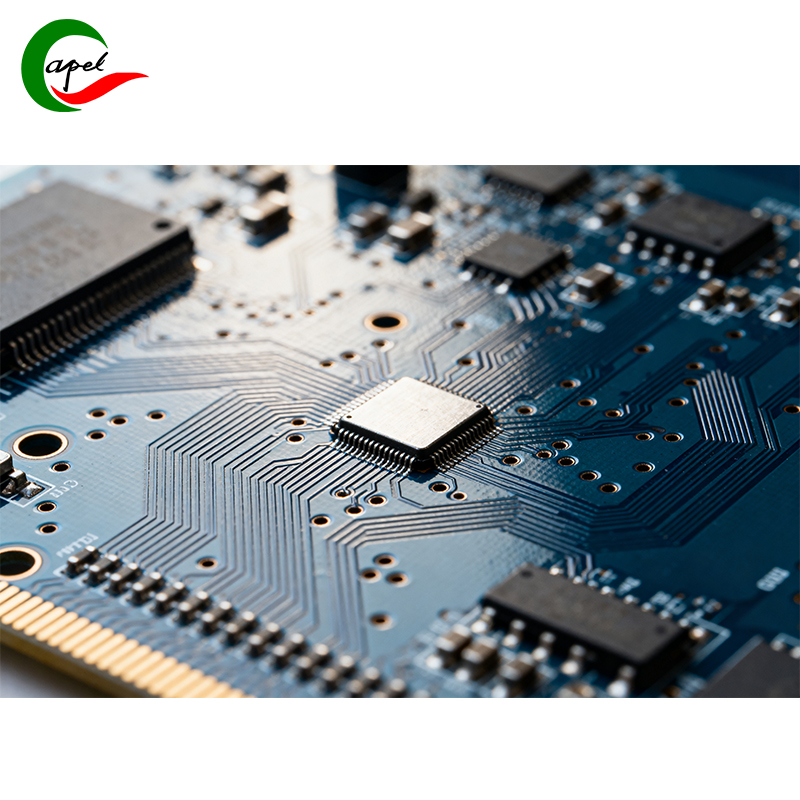
SBU PCBs, due to their superior performance, are essentially the “backbone” or a strict requirement for all high-end electronics:
High-End Smartphones & Mobile Devices: Where motherboard space is at a premium, connecting the application processor, memory, and other high-density chips. SBU is foundational for miniaturization and integration.
High-Performance Computing & Data Centers: CPU/GPU sockets, DDR5 memory modules, server motherboards, network switch cores. These handle massive data flows, demanding top signal integrity and density—SBU provides the physical foundation.
5G & Network Infrastructure: 5G base station AAUs, mmWave antenna modules, high-speed optical transceivers. Operating at very high frequencies, SBU’s micro-vias and fine lines minimize signal loss and interference.
Advanced Semiconductor Packaging: In FC-BGA, SiP (System-in-Package) substrates, SBU is the core technology. It connects the silicon die to the outside world; its density and performance directly impact overall chip performance.
Automotive ADAS: Vehicle radar (especially 77GHz), LiDAR control boards, high-resolution infotainment. These require reliable high-frequency performance in compact designs.
High-End Medical & Test Equipment: Medical imaging probes, high-end oscilloscope and spectrum analyzer front-ends, where signal fidelity is paramount.
As powerful as SBU is, it’s not for every product due to significant challenges:
Higher Manufacturing Cost: Complex, multi-cycle process, expensive laser drillers, and special materials (like ABF) make it costlier than traditional PCB.
Longer Lead Times: The sequential nature inherently means longer fabrication cycles.
Higher Technical Barrier & Risk: Demands extreme precision in material handling, process control, and layer registration. A flaw in any single layer can scrap the entire board, making yield management tough.
Stringent Design Rules: Designers must deeply understand SBU constraints to plan stack-ups, via types, and routing—requiring advanced tools and experience.
Therefore, choosing SBU is a trade-off decision. It’s the right choice only when product performance, density, or size requirements exceed traditional PCB capabilities, and the budget and timeline can support it.
At Kaboer, we understand the high stakes behind SBU technology—it’s often the key to our clients’ flagship products. While we don’t engage in front-end design, we specialize in transforming the most complex and demanding SBU design blueprints into stable, reliable, high-performance circuit boards through our superior manufacturing capabilities.
1. Mastery of and Investment in Advanced Processes
We have invested in industry-leading high-precision UV laser drillers, vacuum laminating presses, and supporting inspection equipment (like cross-section microscopes for via quality and high-accuracy alignment systems). Our process engineering team has deep, practical experience in every SBU step—from dielectric lamination control and laser parameter optimization to plating uniformity management.
2. Process Control Centered on Manufacturing Reliability
SBU success is in the details. We’ve implemented a comprehensive data-monitoring and process control system. We rigorously track and control everything from dielectric thickness and laser via morphology to plated copper crystal quality. This ensures unwavering inter-layer adhesion, via reliability, and final electrical performance.
3. Focused on Efficient, Seamless Design-to-Manufacture Handoff
While we don’t design, we excel at understanding manufacturing intent and communicating efficiently. Upon receiving a client’s SBU design files (Gerber and stack-up notes), our CAM engineering team conducts an in-depth Manufacturability Review. Leveraging our process capability database, we quickly identify potential fabrication risks in the design (e.g., dielectric too thin leading to delamination, vias too close affecting reliability) and provide clear, professional feedback. We collaborate with the client’s design team to optimize for a smooth, efficient production ramp.
4. A Reliable Partner from Prototyping to Mid-Volume Production
We support collaboration starting at the critical engineering prototype phase. Through small-batch pilot production, we can jointly validate the process-design fit, paving the way for potential future scaling. We specialize in delivering high-quality, highly consistent low to mid-volume SBU board manufacturing, serving as a dependable backbone for innovative companies during R&D and new product introduction.
SBU PCBs represent the pinnacle of PCB fabrication technology. Choosing Kaboer means partnering with a team that possesses solid technical expertise, a rigorous approach, and reliable execution in the precision manufacturing arena. When your design needs SBU technology to break new ground, we are ready to bring it to life with professional craftsmanship.

Kaboer manufacturing PCBs since 2009. Professional technology and high-precision Printed Circuit Boards involved in Medical, IOT, UAV, Aviation, Automotive, Aerospace, Industrial Control, Artificial Intelligence, Consumer Electronics etc..


 English



 Wechat
 +86 13670210335
 +86 13670210335
 E-mail