
Date: 2026-04-25
If you’ve ever peeked inside a broken remote or a high-end gaming PC, you’ve seen them: a complex web of thin, golden or silver lines crisscrossing the green board. These are PCB traces.
Think of a circuit board as a miniature city. If the chips and resistors are the buildings, then the PCB traces are the highways and local streets that connect everything. Without them, your device is just a collection of lonely parts with no way to talk to each other.
At its simplest, a PCB trace is a path made of copper that allows electricity to flow between components. Instead of using messy bundles of wires, we "print" these paths directly onto the board. It’s cleaner, way more reliable, and allows us to fit a supercomputer into your pocket.
In the world of PCB design, size really does matter. I like to tell people to think of traces like water pipes.
High Power: If you’re moving a lot of "water" (current) to a motor or a processor, you need a thick pipe. If the trace is too thin, it will struggle, heat up, and eventually burn out.
Signals: For simple "yes/no" data signals, the trace can be as thin as a human hair.
In 2026, with AI chips drawing more power than ever, getting the trace width right is the difference between a cool-running device and a fire hazard.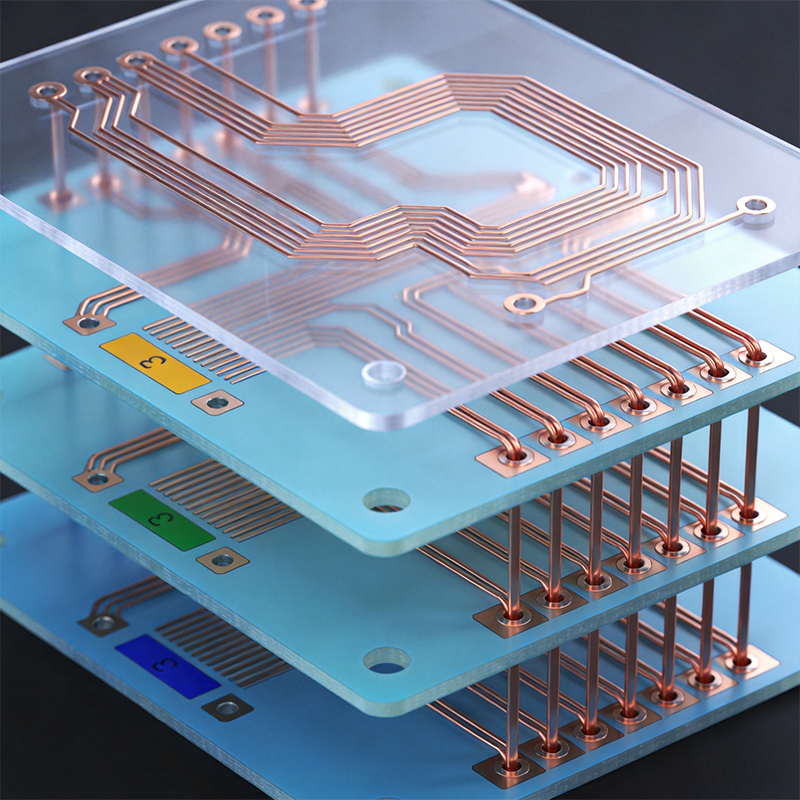
You might notice that PCB traces rarely make 90-degree "L" turns. They usually turn at 45 degrees or have smooth curves. Why? It’s not just for aesthetics. At high speeds, electrons are like speeding cars—they don't handle sharp corners well. A 90-degree turn can cause "signal reflection," which is basically the electronic version of a traffic jam that messes up your data.
When two traces are squeezed too close together, they can interfere with each other. This is called crosstalk. Imagine trying to have a private conversation while someone is shouting right next to your ear. To prevent this, engineers use "spacing" and sometimes even "shielding" to make sure the signals stay in their own lanes.
As we push into 2026, pcb traces are becoming high-tech marvels. We are now dealing with "impedance control," where the physical shape of the trace is tuned to match the speed of the signal. With 6G and advanced AI, these traces have to be perfect. Even a tiny microscopic scratch can ruin the signal integrity of a high-frequency board.
Next time you look at a circuit board, don’t just see a "green plate." See the incredible engineering of the PCB traces. They are the silent veins and nerves of our digital world, working at light speed to keep our lives connected.

Kaboer manufacturing PCBs since 2009. Professional technology and high-precision Printed Circuit Boards involved in Medical, IOT, UAV, Aviation, Automotive, Aerospace, Industrial Control, Artificial Intelligence, Consumer Electronics etc..


 English



 Wechat
 +86 13670210335
 +86 13670210335
 E-mail