
Date: 2026-04-25
If you’ve ever looked at the inside of a broken smartphone or a laptop, you’ve seen thousands of tiny, colorful dots and rectangles scattered across a green board. These are circuit components. To a beginner, they look like random crumbs of metal. But in reality, they are a highly organized team, each with a very specific "personality."
In 2026, as devices get smarter and smaller, understanding these building blocks is like learning how to read the DNA of modern technology.
In the world of circuit components, we generally divide everyone into two camps:
Passive Components: These are the "followers." They don't need a separate power source to do their job. They just react to the electricity flowing through them. Think of them like the pipes and valves in your house.
Active Components: These are the "bosses." They can control the flow of electricity and need power to function. They can amplify signals or switch things on and off. They are the brains and the muscles of the operation.
If a circuit were a water park, these three would be the most important parts:
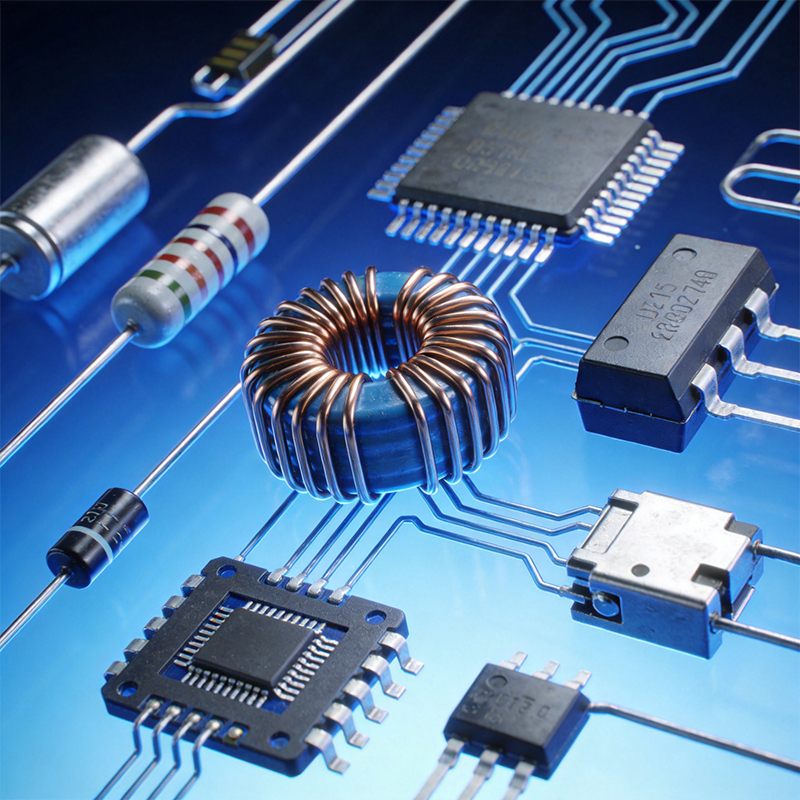
Resistors (The Brake Pedals): A resistor's job is to slow down the current. Too much electricity can fry a sensitive chip, so resistors act like "traffic calming" measures to keep things safe.
Capacitors (The Storage Tanks): These store energy temporarily and then release it. They are great for smoothing out "spikes" in power. If your house lights flickered for a millisecond, a big capacitor would keep your TV from turning off.
Inductors (The Flywheels): These store energy in a magnetic field. They hate change—if the current suddenly stops, the inductor tries to keep it going. They are the "inertia" of the electrical world.
This is where things get interesting.
Diodes: Imagine a turnstile at a stadium. You can go in, but you can't go out. A diode lets electricity flow in one direction and blocks it from going backward. This protects your gadgets if you accidentally put the batteries in the wrong way.
Transistors: These are the real MVPs. A transistor is basically a tiny switch with no moving parts. By turning on and off billions of times a second, they create the "1s and 0s" that make your AI and apps work.
Eventually, engineers got tired of soldering thousands of individual parts. So, they shrunk them down and packed them into a single black box called an Integrated Circuit (IC). Inside a modern IC, there might be billions of transistors. It’s like taking an entire city and shrinking it down to the size of a fingernail. This is what powers the "smart" in your smartphone.
With the rise of AI processors and high-speed 6G, the margin for error is shrinking. A cheap, low-quality capacitor can "leak" or fail under heat, causing your high-end PC to crash for no apparent reason. In 2026, we don't just look for "functional" components; we look for thermal stability and low noise.
Circuit components are the unsung heroes of our digital lives. They work in silence, billions of times per second, ensuring your messages get sent and your videos play smoothly. Understanding them isn't just for "geeks"—it’s for anyone curious about how our future is being built.

Kaboer manufacturing PCBs since 2009. Professional technology and high-precision Printed Circuit Boards involved in Medical, IOT, UAV, Aviation, Automotive, Aerospace, Industrial Control, Artificial Intelligence, Consumer Electronics etc..


 English



 Wechat
 +86 13670210335
 +86 13670210335
 E-mail