
Date: 2026-03-31
Let’s be real—choosing the number of printed circuit board layers for your new hardware isn’t as simple as picking a number out of a hat. If you’re an electronic device manufacturer, you know that the "layer count" is where cost meets performance.
Go too low, and you face nightmare-level signal interference (EMI). Go too high without a plan, and you’re just throwing money away on fabrication costs. So, how do you find that "sweet spot" for your custom design?
In the early days, one or two layers were enough. But today? If you’re building anything smarter than a toaster, you’re looking at multi-layer PCBs.
1 & 2 Layers: Fine for simple power supplies or basic toys. But they have zero protection against noise.
4 & 6 Layers: The "workhorses" of the industry. This is where we start seeing dedicated ground and power planes, which are lifesavers for signal integrity.
8+ Layers: This is the playground for high-speed data, complex medical devices, and server tech.
This is where we usually see our clients run into trouble. You aren't just stacking layers; you're managing density.
HDI (High Density Interconnect): When you're using 10+ layers in a tiny space (like a smartwatch), you can’t use traditional drills. We use laser-drilled microvias to connect these printed circuit board layers. If your manufacturer doesn't have the precision for this, your yield rate will tank.
Rigid-Flex Boards: Imagine a 6-layer rigid section transitioning into a 2-layer flexible section. Managing the "layer transition" is an art form. If the stack-up isn't balanced, the board will warp or the traces will crack during assembly.
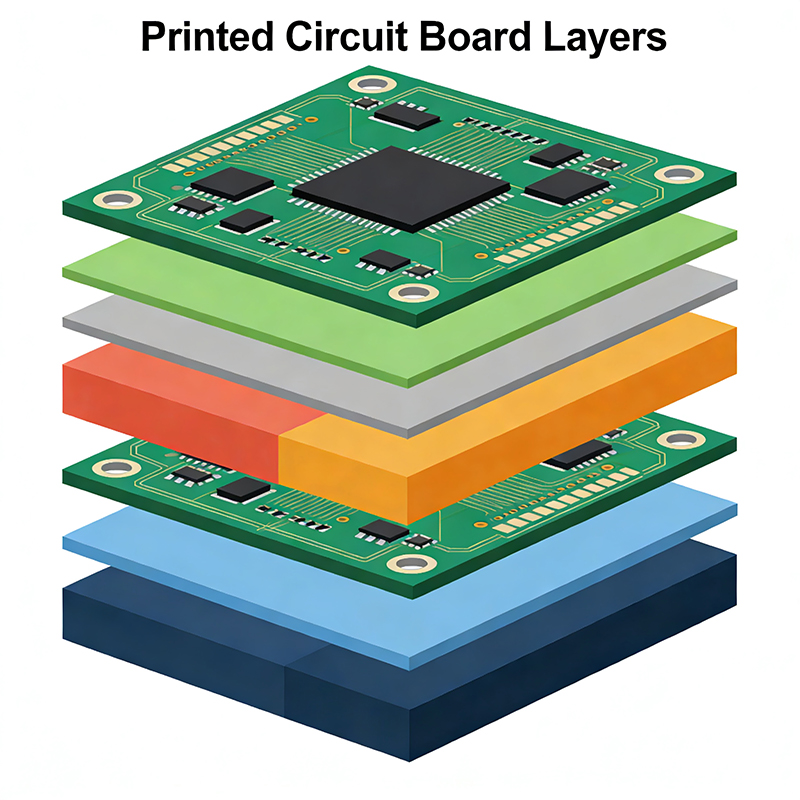
When you send us your Gerber files, our engineering team doesn't just look at the count. We look at the symmetry.
An unbalanced layer stack-up is the #1 reason for warped boards. We help you design a stack-up that stays flat during reflow and keeps your high-speed signals (like DDR4 or 5G) running clean. Whether it's a custom flexible PCB or a high-frequency HDI board, the way those layers are arranged is the difference between a successful launch and a massive recall.
We know that for many manufacturers in the US, Europe, or Australia, the biggest fear is the "black box" of overseas production. You want to know that the printed circuit board layers you designed are exactly what get delivered.
At our facility, we specialize in the "hard stuff."
Customization: We don't just do standard 1.6mm boards. We do ultra-thin flex, complex rigid-flex, and high-layer-count HDI.
DFM (Design for Manufacturing): We provide feedback before we start. If we see a way to reduce your layer count (and your cost) without hurting performance, we’ll tell you.
Full PCBA Service: We take those layers and turn them into a working product, handling the sourcing and assembly under one roof.
Are you stuck between a 6-layer or an 8-layer design? Or are you trying to figure out how to integrate a flex layer into your rigid board?
Send us your draft or Gerber files. Let’s have a real conversation about your project’s needs, and we’ll provide a quote that respects both your budget and your technical specs.

Kaboer manufacturing PCBs since 2009. Professional technology and high-precision Printed Circuit Boards involved in Medical, IOT, UAV, Aviation, Automotive, Aerospace, Industrial Control, Artificial Intelligence, Consumer Electronics etc..


 English



 Wechat
 +86 13670210335
 +86 13670210335
 E-mail