
Date: 2026-03-31
Let’s be honest—when you’re designing a high-speed HDI board or a complex rigid-flex circuit, you aren’t just fighting for space; you’re fighting for signal integrity. And in that fight, there is an invisible enemy: Contact Resistance.
If you’ve ever had a batch of boards pass continuity tests but fail in the field due to mysterious voltage drops or heat buildup, you know exactly what I’m talking about. This is where the cross-bridge kelvin resistor layer (CBKR) comes into play. It’s not just a "nice-to-have" feature; for high-end electronic manufacturers, it’s the gold standard for precision.
In plain English, a cross-bridge kelvin resistor is a specific test structure we build into the PCB layers (usually in the coupon area) to measure the resistance of an interface—like where a via meets a copper trace—with insane accuracy.
Most shops use a simple two-wire test. The problem? The test leads themselves have resistance, which skews the results. When you’re dealing with high-performance HDI or high-frequency boards, even a 0.01-ohm error can be the difference between a high-performing device and a piece of e-waste.
By using the four-terminal (Kelvin) sensing method, the CBKR structure cancels out the lead resistance. It gives us the "naked" truth about how well your layers are bonded.
If you are manufacturing outside your home country, you need to know your partner in China isn't just "printing and shipping." You need proof of quality.
Flex & Rigid-Flex Reliability: Flexible circuits move. Those movements stress the junctions between layers. By using kelvin structures during fabrication, we can verify that the bonding is robust enough to survive millions of bends.
HDI Vias: In HDI designs, vias are microscopic. Measuring the contact resistance of a laser-drilled microvia is tough. The CBKR layer allows us to monitor the plating quality inside those tiny holes to ensure they won't fail under thermal stress.
High-Speed Data: At high frequencies, any unexpected resistance causes signal reflections and data loss. We use these layers to validate that the copper traces meet your exact specifications before the boards ever leave our facility.
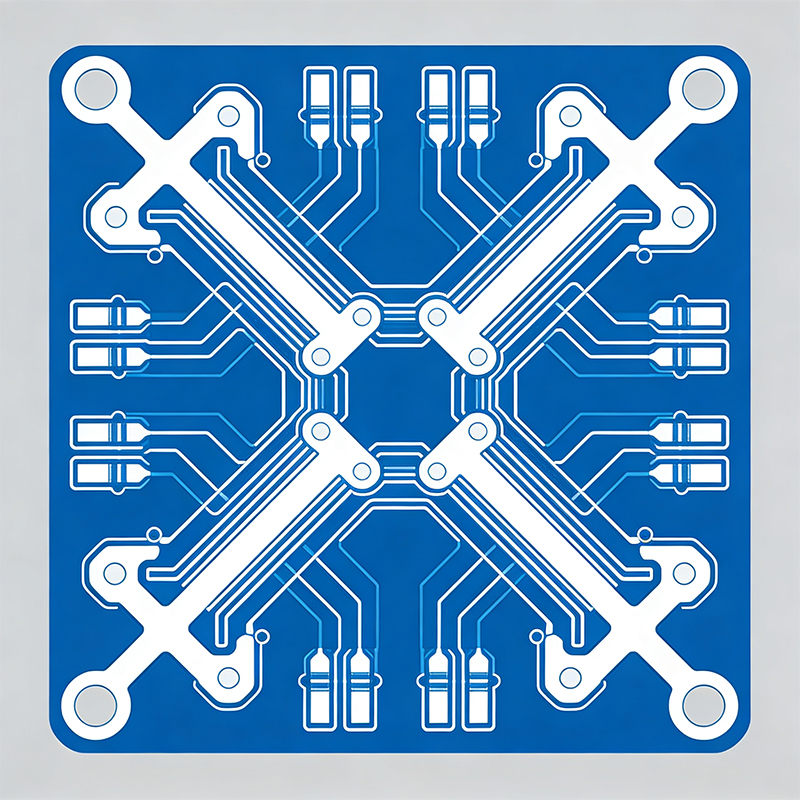
Most "cheap" factories won't even mention the cross-bridge kelvin resistor layer. Why? Because it requires extra design work and high-precision testing equipment. They’d rather just hope for the best.
That’s not how we work. As a specialist in custom flexible PCBs and high-speed PCBA, we treat resistance as a critical metric. When you work with us, you’re getting:
Expert DFM Reviews: We’ll help you place kelvin structures where they actually provide useful data.
Precision Fabrication: Our HDI lines are calibrated for the tightest tolerances in the industry.
Transparent Reporting: We don't just say "it's good." We show you the data.
If you are tired of "good enough" and want a manufacturing partner that understands the physics behind the board, let’s talk. Whether it's a high-frequency HDI project or a rugged rigid-flex design, we can help you integrate the precision of kelvin sensing into your workflow.
Send us your Gerber files today. Let our engineers look at your layer stack-up and show you how we can guarantee the reliability your customers demand.

Kaboer manufacturing PCBs since 2009. Professional technology and high-precision Printed Circuit Boards involved in Medical, IOT, UAV, Aviation, Automotive, Aerospace, Industrial Control, Artificial Intelligence, Consumer Electronics etc..


 English



 Wechat
 +86 13670210335
 +86 13670210335
 E-mail