
Date: 2026-03-03
Got a circuit design that you're itching to test? Before you commit to thousands of boards, before you invest in a full production run, there's an essential step: the prototype circuit board.
Think of a prototype as the dress rehearsal for your product. It's your chance to see if your design actually works, to catch mistakes while they're still cheap to fix, and to prove that your idea deserves to become a real product.
This guide covers everything you need to know about prototype circuit boards—what they are, why they matter, the different types available, and how to get yours made without unnecessary headaches.
A prototype circuit board is a sample version of your PCB, made in small quantities to test and validate your design before mass production . It's proof that your schematic translates into working hardware.
Prototypes serve several purposes:
Functional testing: Does the circuit actually do what you designed it to do?
Fit checking: Does the board fit in its enclosure? Do connectors line up?
Performance validation: Does it meet speed, power, and signal integrity requirements?
Design verification: Are there any errors in your schematic or layout?
Software development: Give your firmware team hardware to code against
Early demonstrations: Show investors or stakeholders a working model
The beauty of prototypes is that they're forgiving. If something's wrong, you haven't wasted much time or money. You fix the design and try again. That's infinitely better than discovering a fatal flaw after you've bought components for ten thousand boards.
Mistakes are expensive—especially late in the game. A study by the Center for Advanced Life Cycle Engineering found that the cost of fixing a defect increases exponentially the later it's found . A problem caught during prototyping might cost a few dollars and a week of time. The same problem caught after full production could cost thousands and delay your product launch indefinitely.
Prototyping gives you:
Confidence: Proof that your design works before committing to volume
Learning: Real-world feedback that simulations can't provide
Risk reduction: Catch issues when they're cheap and easy to fix
Speed: Parallel development—hardware and software teams can work together
Investor appeal: Nothing convinces like a working model
Not all prototypes are the same. Depending on where you are in development, you might need different kinds:
Early in the design phase, you might breadboard critical sections or use development kits to prove a concept. These aren't custom PCBs—they're quick-and-dirty setups to validate that your core idea works .
These are the first real PCBs made from your design files. They're typically 5-20 boards, just enough to verify functionality, test performance, and start software development . Expect to find issues—that's the point.
Once your design is validated, you might order a small batch (50-200 boards) made with the exact materials and processes intended for production . These verify that your design is manufacturable at scale and that yields will be acceptable.
When you need boards fast—sometimes in 24-48 hours—rapid prototyping services prioritize speed . They might use specialized processes and charge a premium, but when you're racing a deadline, it's worth it.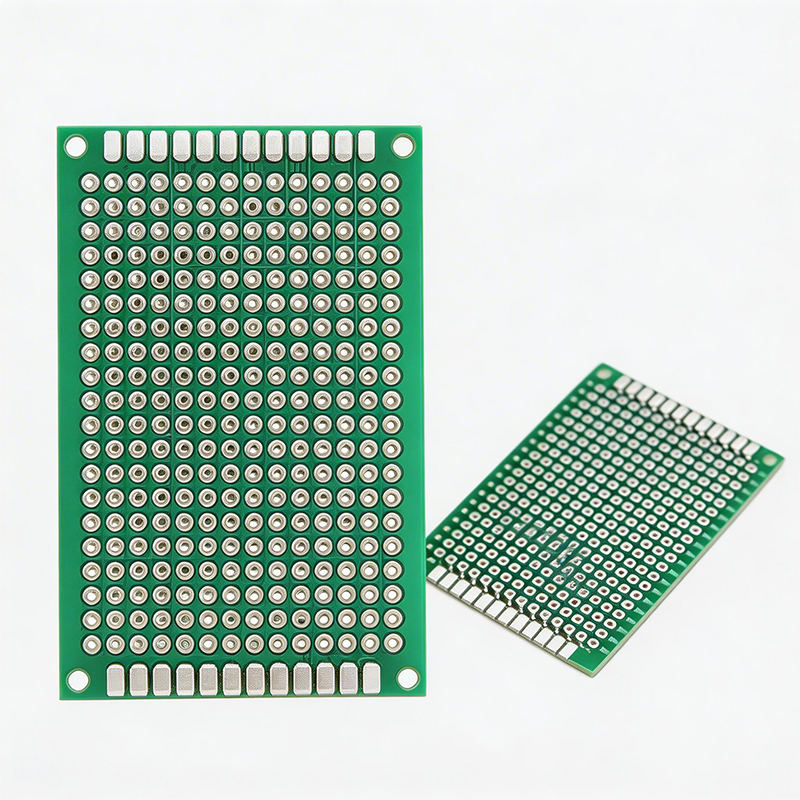
Prototype fabrication isn't just production on a smaller scale. There are important differences :
| Aspect | Prototype | Production |
|---|---|---|
| Quantity | 1-50 boards | Hundreds to millions |
| Lead time | Days to a week | Weeks to months |
| Cost per board | Higher | Lower |
| Setup costs | Minimal (panelization, tooling) | Significant (stencils, fixtures) |
| Process optimization | Minimal | Extensive (yield improvement) |
| Testing | Basic electrical verification | Comprehensive (AOI, X-ray, functional) |
| Documentation | Design files only | Full manufacturing package |
The goal of prototyping isn't to minimize per-board cost—it's to get working boards fast so you can validate and iterate.
Here's how a typical prototype run works with a good manufacturer:
You provide your Gerber files, drill files, and fabrication notes. Include any special requirements: impedance control, specific materials, surface finish preferences .
The manufacturer's engineers review your design for manufacturability. They check:
Trace widths and spacing against their process limits
Drill sizes and aspect ratios
Clearances and annular rings
Solder mask and silkscreen registration
Stackup and impedance requirements
This is where a good manufacturer earns their keep. They'll flag potential problems before anything is made, saving you from wasted time and money .
You receive a quote with lead time. If everything looks good, you approve and the order goes into production.
Your boards move through the standard PCB manufacturing process, but optimized for speed:
Materials are pulled from stock
Production is scheduled immediately
Multiple steps may be accelerated
Even prototypes need testing. Most manufacturers perform:
AOI to catch visual defects
Flying probe testing to verify connectivity
Impedance testing if required
Finished boards are packaged and shipped. For international customers, expect 3-5 days for shipping unless you pay for express.
For most projects, 5-10 boards is a good starting point. Enough to test multiple configurations, share with software engineers, and have spares in case something gets damaged. If your design has high-risk sections, you might want 20-30 to thoroughly test variations .
Standard prototype lead times are 3-7 business days for fabrication, plus shipping . Many manufacturers offer expedited options—24-48 hours—for a premium.
For a typical 2-layer board, prototype pricing starts around $50-100 for 10 boards . More layers, tighter tolerances, and special materials increase cost. Expect 4-layer boards to cost 2-3x more, and 6-layer another jump.
At minimum:
Gerber files (RS-274X format preferred)
Drill files (Excellon format)
Fabrication drawing with dimensions, materials, and special requirements
Many manufacturers accept native files from common PCB software, but Gerbers are the universal standard .
Yes—this is called prototype PCBA. You provide components (or have the manufacturer source them), and they assemble your boards. This adds time and cost but gives you ready-to-test modules .
Not all prototype services are created equal. Here's what matters:
Some shops specialize in "quick-turn" prototypes—boards in 24 hours. They're great when you're in a hurry, but sometimes quality suffers. Look for manufacturers who balance speed with consistent quality.
The best prototype services don't just take your files and run them. They review your design, flag potential issues, and suggest improvements . This feedback is invaluable, especially if you're new to PCB design.
Prototyping often involves back-and-forth—questions about your design, confirmation of requirements, shipping details. A manufacturer who communicates clearly saves you time and prevents misunderstandings.
Your prototype needs might be simple today, but what about next time? A manufacturer who can handle everything from basic 2-layer boards to complex HDI and rigid-flex grows with you.
Hidden costs are frustrating. Good prototype services give clear, upfront pricing with no surprises.
A successful prototype is just the beginning. Once your design is validated, you'll need to scale to production. This transition matters :
What worked for 10 boards might need adjustment for 10,000. A good prototyping partner helps you identify changes that improve yield and reduce cost at volume.
Prototypes often use whatever components are available. Production requires reliable supply chains. Your manufacturer can help with component selection and long-term availability.
Prototype testing might be manual. Production needs automated test fixtures and procedures. Plan for this early.
Production requires complete documentation: fabrication drawings, assembly drawings, BOMs, test specifications. Your prototype manufacturer can guide you on what's needed.
"I'm sure it'll work—let's just go straight to production." This is how careers end. Always prototype. Always.
A few boards that light up doesn't mean your design is ready. Test edge cases, temperature ranges, power variations. Be thorough.
Your manufacturer flags an issue. You ignore it because "it worked in simulation." Don't. They know their process better than anyone.
Yes, prototypes cost more per board than production. That's fine. The goal is speed and learning, not minimizing unit cost.
Vague fabrication notes lead to misunderstandings. Be clear, be specific, and provide complete files.
At Kaboer, we've been helping engineers turn ideas into working hardware since 2009. Based in Shenzhen, we combine 16 years of experience with a deep understanding of what prototype customers need: speed, quality, and clear communication.
We handle the full spectrum of circuit boards:
Rigid PCBs: 1-30 layers, from simple to complex
Flexible PCBs (FPC) : 1-20 layers, 0.075mm to 0.4mm thickness
Rigid-Flex Boards: 2-30 layers, combining rigid stability with flexible interconnects
HDI High-Density Boards: Microvias, fine lines, advanced stackups
High-Frequency Boards: Low-loss materials for 5G, radar, and RF
Metal-Core Boards: For excellent heat dissipation
Need boards fast? We offer expedited prototyping with lead times as short as 24-48 hours for qualified designs.
Before we build, our engineers review your design. We flag potential issues, suggest improvements, and help you avoid problems that could delay your project . This feedback is free—and invaluable.
Don't just want bare boards? We'll assemble them too. Provide components (or let us source them), and you'll get fully assembled, tested modules ready to integrate.
We know that prototype customers have questions. Our team responds promptly, explains technical details in plain language, and keeps you informed throughout the process.
No hidden fees, no surprises. You'll know the cost upfront, and we'll stick to it.
Your prototype is just the start. When you're ready for production, we'll be here—same team, same quality standards, ready to grow with you.
Prototype circuit boards are the most important step in bringing a new product to life. They're where theory meets reality, where you prove your design works, and where you catch mistakes while they're still cheap to fix.
Choose your prototype partner carefully. Look for technical capability, honest communication, and a willingness to help you succeed—not just take your order.
Ready to bring your idea to life? Contact Kaboer today for a prototype quote. Better yet—send us your design, and let's see what we can build together.

Kaboer manufacturing PCBs since 2009. Professional technology and high-precision Printed Circuit Boards involved in Medical, IOT, UAV, Aviation, Automotive, Aerospace, Industrial Control, Artificial Intelligence, Consumer Electronics etc..


 English



 Wechat
 +86 13670210335
 +86 13670210335
 E-mail