
Date: 2026-02-28
Ever wondered how hundreds of tiny components on a circuit board get soldered all at once, perfectly aligned, without anyone touching them with a soldering iron? The answer is a clever process called reflow soldering.
Think of it as the "baking" step in electronics manufacturing. Just like you put cookie dough in the oven and it comes out as cookies, you put a circuit board with components stuck in place into a reflow oven, and it comes out with everything permanently soldered. The heat melts the solder, and when it cools, you've got solid, reliable connections.
This guide breaks down everything you need to know about reflow soldering—how it works, the different stages, what temperatures to use, and how to avoid common problems.
Reflow soldering is the standard method for attaching surface-mount components to printed circuit boards . It's called "reflow" because the solder melts and "flows" again to form the joint.
Here's the simple version of how it works:
Apply solder paste to the pads on the board (that grayish paste contains tiny solder balls mixed with flux)
Place components onto the paste—they stick because the paste is tacky
Heat the whole board in a special oven following a precise temperature recipe
Cool it down so the solder solidifies into permanent joints
The magic is that everything happens at once. In a matter of minutes, hundreds or even thousands of connections are made simultaneously .
A reflow oven isn't just one hot box. It's divided into multiple zones, each with a different temperature. The board travels through these zones on a conveyor belt, following what engineers call a temperature profile.
Think of it as a carefully planned journey through four distinct stages :
Temperature range: Room temperature to about 150°C
Ramp rate: 1-3°C per second
Duration: 60-120 seconds
The board starts warming up gradually. This slow, gentle heating prevents thermal shock—imagine throwing a cold glass into boiling water and watching it crack. Components need time to adjust .
If you heat too fast (more than 3°C per second), solvents in the solder paste can explode, causing solder to spatter everywhere .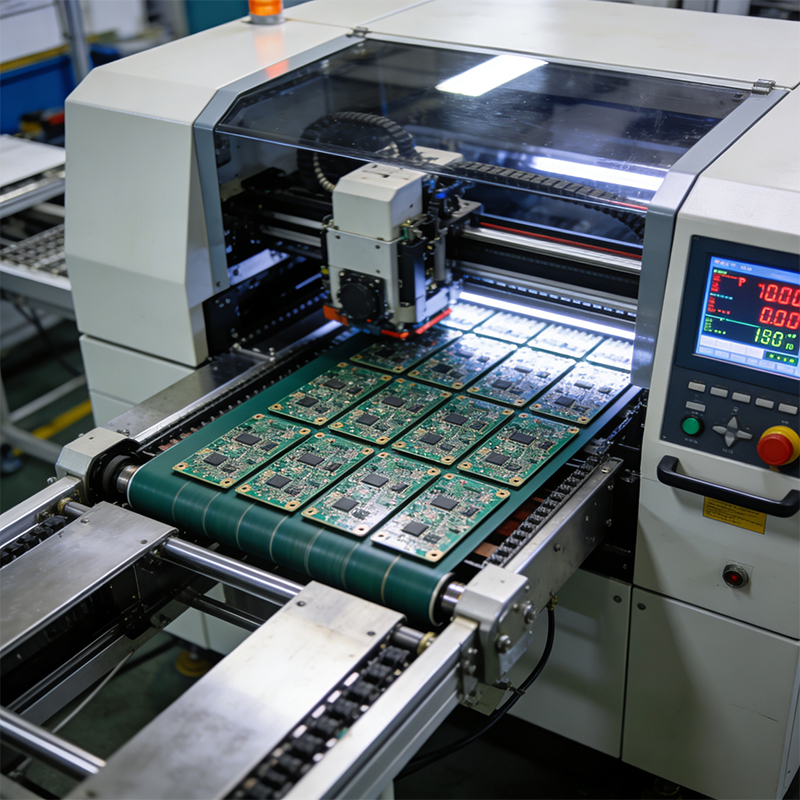
Temperature range: 150°C to about 180-200°C
Duration: 60-120 seconds
This stage serves two critical purposes :
First, it lets the whole board catch up temperature-wise. Big components with lots of metal (like connectors) heat up slower than tiny resistors. The soak stage gives the "slow" parts time to reach the same temperature as the "fast" parts. By the end of soak, the temperature across the entire board should be nearly uniform.
Second, the flux in the solder paste activates. Flux is a chemical cleaner that removes oxidation from metal surfaces, ensuring the solder can form a good bond .
Peak temperature: 235-250°C for lead-free solder
Time above liquidus (TAL): 45-90 seconds
This is the main event. The temperature climbs above the solder's melting point (217°C for common lead-free alloys) .
The solder melts and forms metallurgical bonds with the component leads and PCB pads. A thin layer of intermetallic compound forms—this is the actual "glue" that holds everything together .
Here's the tricky part: you need enough heat and time to form good bonds, but too much can damage components or create thick, brittle intermetallic layers that crack easily. It's the "Goldilocks" zone—just right .
Cooling rate: 2-4°C per second
After peak temperature, the board needs to cool down in a controlled way. Fast cooling creates a fine grain structure in the solder, which is stronger and more reliable .
But too fast (quenching) can cause thermal stress and crack components. Too slow, and you get large, weak grains .
Different solder alloys need different temperatures. Here are the key numbers :
| Solder Type | Alloy | Melting Point | Typical Peak |
|---|---|---|---|
| Leaded | Sn63/Pb37 | 183°C | 210-220°C |
| Lead-Free | SAC305 (Sn/Ag/Cu) | 217-220°C | 235-250°C |
| Low-Temp | BiSnAg | 138°C | 170-180°C |
For lead-free reflow, the industry standard SAC305 alloy needs a peak between 235°C and 250°C, with 45-90 seconds above 217°C .
The maximum temperature most components can survive is around 260°C. That's your upper limit .
Reflow soldering looks simple, but plenty can go wrong. Here are the most common defects and what causes them :
What it looks like: A small component (usually a resistor or capacitor) stands up on one end like a grave marker.
What causes it: Uneven heating or uneven solder paste on the two pads. One side melts and wets before the other, pulling the component upright .
How to fix it: Check pad design symmetry, ensure even paste deposition, and optimize your temperature profile for balanced heating.
What it looks like: Solder connects two adjacent pads or pins that should be separate, creating a short circuit.
What causes it: Too much solder paste, misaligned printing, or pads spaced too closely .
How to fix it: Check stencil aperture design, ensure proper alignment during printing, and verify pad spacing in your design.
What it looks like: Dull, grainy, or cracked joints instead of smooth and shiny.
What causes it: Insufficient heat—the solder never fully melted, or it didn't stay molten long enough .
How to fix it: Increase peak temperature or time above liquidus. Verify your profile with thermocouples on actual boards.
What it looks like: Hidden empty spaces inside solder joints, especially under BGAs. You need X-ray to see them .
What causes it: Flux gets trapped during solidification, or solvents outgas without escaping .
How to fix it: Optimize your soak stage to let volatiles escape before reflow. Consider vacuum reflow for critical applications .
What it looks like: Tiny balls of solder scattered around the board, not attached to any pad.
What causes it: Solder paste spattering during rapid heating, or contamination .
How to fix it: Control preheat ramp rate, check paste quality, and ensure proper cleaning.
What it looks like: A BGA ball that touched the pad but didn't fully merge—looks like a head resting on a pillow.
What causes it: Oxidation on the ball or pad surface prevents proper coalescence. Often happens when the soak stage is too aggressive, exhausting the flux before reflow .
How to fix it: Reduce soak time/temperature, use nitrogen atmosphere, or try more active flux .
You can't just set your oven to 250°C and call it done. The board's actual temperature depends on many factors: board thickness, copper coverage, component density, and oven characteristics .
Here's how professionals do it:
Attach fine thermocouple wires to critical spots on a test board—the hottest spot (usually a small component at the board edge) and the coldest spot (often a large BGA or connector) .
Run the board through the oven and measure what temperatures it actually experiences. Compare this thermal profile to your solder paste's recommended profile .
You're aiming to keep every point on the board within the "process window"—above the solder's melting point long enough to form good joints, but below the maximum temperature any component can survive .
Using nitrogen in the oven instead of air reduces oxidation, improves wetting, and can give you cleaner, stronger joints—especially important for fine-pitch components .
Wave soldering is for through-hole components. The board passes over a fountain ("wave") of molten solder. It's faster for simple boards but causes more thermal stress and can't handle fine-pitch SMT .
Reflow is gentler, more precise, and can handle both sides of the board in sequence .
Hand soldering is fine for prototypes and repairs. But for production, reflow wins on consistency, speed, and the ability to handle tiny components that would be impossible to solder by hand .
Reflow soldering is the heart of modern electronics manufacturing. It's how we attach thousands of components to boards quickly, reliably, and consistently.
The key takeaways:
Four stages—preheat, soak, reflow, cool—each with a purpose
Temperature matters—too cold gives cold joints, too hot damages components
Profile is everything—the oven setting isn't the board temperature; measure with thermocouples
Defects have causes—tombstoning, bridging, voids can all be fixed with proper design and process control
Get the profile right, and your boards will have strong, reliable joints that last. Get it wrong, and you'll chase defects forever.

Kaboer manufacturing PCBs since 2009. Professional technology and high-precision Printed Circuit Boards involved in Medical, IOT, UAV, Aviation, Automotive, Aerospace, Industrial Control, Artificial Intelligence, Consumer Electronics etc..


 English



 Wechat
 +86 13670210335
 +86 13670210335
 E-mail