
Date: 2026-02-05
Imagine following a new recipe—it lists all required ingredients, exact amounts, preparation steps, and even recommends specific kitchenware brands. In electronics manufacturing, the Bill of Materials (BOM) is this "recipe," and the sample BOM is the special version you use when trying the dish for the first time.
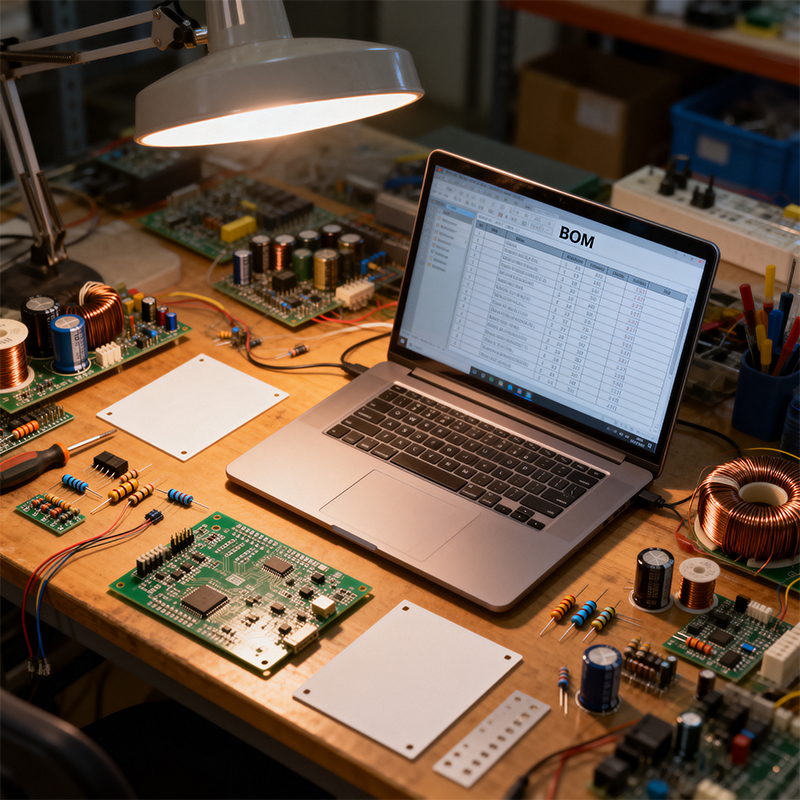
Simply put, a BOM is a detailed list of all materials, components, and parts needed to build a product. It tells the manufacturing team: "To make this product, we need these specific things, in these quantities, combined in this way." The sample BOM is a version specifically prepared for creating the first prototypes or test samples.
While sample BOMs and production BOMs may look similar, they serve completely different purposes:
Characteristics of Sample BOM:
Flexibility prioritized: Allows alternative components for testing
Small-quantity procurement: Components may come from distributor stock rather than directly from factories
Design-oriented: Focus on function verification rather than cost optimization
Frequent changes: Rapid iteration based on test results
Potentially simplified documentation: Some manufacturing details may not yet be finalized
Characteristics of Production BOM:
Cost-optimized: Value-engineered to select the most cost-effective components
Stable supply chain: Long-term relationships with qualified suppliers ensure steady supply
Manufacturing-optimized: Considers production efficiency, testing processes, and manufacturability
Strict change control: Any modifications require formal engineering change processes
Complete, precise documentation: Includes all manufacturing, testing, and compliance details
Key difference example: In the sample phase, you might use a standard development board module (like an Arduino) to quickly test concepts, while in production, you'd design a custom PCB and use a lower-cost microcontroller chip.
A complete sample BOM is like a detailed product "ID card" and "instruction manual," typically containing:
1. Basic Project Information
Product name and model number
BOM version and date
Creator and review status
Sample purpose description (functional verification, certification testing, etc.)
2. Main Bill of Materials
This is the core table of the BOM, usually including:
Item number: Unique identifier for each component (1, 2, 3...)
Component number/Part number: Manufacturer's or internal unique identifier
Description: Clear explanation of what the component is
Quantity: How many are needed per sample
Reference designator: Location on the circuit diagram (e.g., R1, C5, U3)
Package/Specifications: Physical dimensions and technical specifications
Manufacturer and manufacturer part number: Specific source information
Supplier and supplier part number: Procurement source information
Notes/Alternatives: Important notes or alternative options
3. Additional Information
Special assembly instructions
Testing requirements and procedures
Safety and compliance considerations
Version history record
1. Design Verification Roadmap
The sample BOM is the first physical representation of the design team's ideas. It ensures that all theoretical designs have corresponding actually available components. For example, a "5V voltage regulator" in the design would be specified as "Texas Instruments TPS7A4700RGWR 5V 1A Low Dropout Regulator" in the BOM.
2. Procurement Guide
For the procurement team, the sample BOM is a precise shopping list. It clearly indicates what needs to be purchased, in what quantities, and from which reliable sources. A good sample BOM also provides alternative component options in case the preferred components are unavailable.
3. Cost Estimation Foundation
Through the sample BOM, teams can preliminarily understand the product cost structure. Although component prices in the sample phase may be relatively high (small quantity purchases), this provides a cost baseline, helping to identify expensive components that could be cost-reduced in the future.
4. Manufacturing Preparation
The sample BOM is the production team's first step in preparing manufacturing processes. It helps identify components requiring special handling or tools, such as miniature components needing manual soldering or heat sinks requiring specific installation procedures.
5. Testing and Certification Framework
For products requiring certification (such as FCC, CE), the sample BOM ensures test samples match the final product. Certification bodies typically require the BOM as part of the test documentation.
Step 1: Start with Design Files
Most sample BOMs originate from Electronic Design Automation (EDA) tool outputs. After schematic design is complete, EDA software can generate an initial BOM listing all circuit components. But this is just the starting point—significant manual addition of critical information is needed.
Step 2: Fill in Component Details
For each component in the BOM, supplement with:
Complete manufacturer name and accurate part number
Preferred supplier information
Package and specification details
Any special requirements or considerations
Step 3: Consider Alternatives
During the sample phase, supply chain flexibility is crucial. Identify 2-3 alternative options for critical components and document them in the BOM. This prevents entire sample production from stalling due to a single component shortage.
Step 4: Review and Verification
Invite representatives from design, procurement, and manufacturing teams to jointly review the sample BOM. This cross-checking process can uncover potential issues such as:
Designs using discontinued components
Extremely long lead times for certain components
Compatibility issues between components
Underestimated manufacturing difficulties
Step 5: Version Control and Distribution
The sample BOM is a "living document" that will be frequently updated during testing and iteration. Establishing a clear version control system is crucial:
Update version numbers with each change
Record what changed, why, and when
Ensure all team members use the same version
Pitfall 1: Incomplete Information
Problem: BOM only lists component types, missing specific manufacturer part numbers.
Consequence: Procurement team may order wrong components, delaying sample production.
Solution: Establish a BOM review checklist ensuring each entry has complete information.
Pitfall 2: Ignoring Supply Chain Realities
Problem: Some components in the BOM have lead times as long as 20 weeks.
Consequence: Significant delays in sample production.
Solution: Early involvement of procurement team to provide component availability feedback.
Pitfall 3: Version Confusion
Problem: Team members use different BOM versions.
Consequence: Manufactured samples don't match the design.
Solution: Use centralized BOM management systems ensuring a single source of truth.
Pitfall 4: Lack of Alternatives
Problem: Critical components have only one option.
Consequence: When that component is unavailable, the entire project stalls.
Solution: Identify at least one alternative for each critical component.
Pitfall 5: Overlooking Manufacturing Feasibility
Problem: BOM includes miniature components extremely difficult to hand-solder.
Consequence: Poor sample production quality, unreliable test results.
Solution: Early manufacturing team involvement in BOM reviews.
Intelligent BOM Systems
Future BOM systems will integrate artificial intelligence and machine learning capabilities, able to:
Automatically identify component compatibility issues
Predict component supply risks based on historical data
Recommend alternative components based on design parameters
Update cost and lead time information in real-time
Sustainability Integration
2026 sample BOMs will pay more attention to environmental and social responsibility:
Marking components' environmental certification status
Identifying conflict mineral usage
Assessing carbon footprint and recyclability
Tracking supply chain transparency
Cloud Collaboration Platforms
Cloud-based BOM management systems will support real-time collaboration for global teams:
Multi-location simultaneous access and editing
Automatic change synchronization
Integrated chat and comment features
Direct connections to supplier systems
Digital Twin Integration
Sample BOMs will be tightly connected to products' digital twin models:
BOM changes automatically update virtual prototypes
Virtual testing validates BOM selections
Predicting product performance with different BOM scenarios
A sample BOM is much more than a shopping list—it's the first detailed map in the product development journey. It connects design concepts with physical reality, theoretical calculations with actual performance, team vision with market acceptance.
Creating a good sample BOM requires multidisciplinary collaboration: the technical vision of design teams, the supply chain wisdom of procurement teams, the practical knowledge of manufacturing teams, and the overall coordination of project management. When these perspectives merge into a clear, complete, and practical sample BOM, the chances of product success increase significantly.
Remember, in electronics product development, problems discovered and resolved during the sample phase are 10 to 100 times cheaper than those found during production. The sample BOM is one of your most important tools in this critical phase—worth investing time to get right.
Whether you're creating your first sample BOM or have managed dozens, continuously improving your BOM process can bring faster time-to-market, lower development costs, and higher final quality to your products. In this sense, a sample BOM is not just a list—it's the first cornerstone of product excellence.

Kaboer manufacturing PCBs since 2009. Professional technology and high-precision Printed Circuit Boards involved in Medical, IOT, UAV, Aviation, Automotive, Aerospace, Industrial Control, Artificial Intelligence, Consumer Electronics etc..


 English



 Wechat
 +86 13670210335
 +86 13670210335
 E-mail