
Date: 2026-07-24
You've definitely seen solder wire before — that silver metal spool with a small hollow channel running through it, filled with a clear, syrupy substance. When you solder, the wire melts and a puff of smoke appears, and the solder flows smoothly and sticks perfectly. That solder wire is actually solder and flux working together as a team.
Solder is the "glue." Flux is the "cleaner." You need both. In this guide, I'll explain what solder and flux are, how they work together, what types exist, and how to choose the right ones. Plain English, no fluff.
Solder is a metal alloy used to join metal parts together. Its melting point is lower than the metals being joined — when heated, it melts and wets the metal surfaces, then solidifies to form a strong electrical and mechanical connection.
The two most common solders in electronics are:
1. Leaded Solder (63/37)
63% tin + 37% lead, melting at 183°C. It's eutectic — it melts and solidifies sharply with no "mushy" phase. Leaded solder wets beautifully, produces shiny joints, is easy to work with, and is cheap. The downside: it contains lead, which is environmentally harmful.
2. Lead-Free Solder (SAC305)
96.5% tin + 3% silver + 0.5% copper, melting at 217-221°C. Lead-free solder is the mainstream choice driven by RoHS regulations. It melts about 30°C higher than leaded solder, wets less readily, and produces dull, matte joints. The upside: it's RoHS-compliant. Soldering temperatures need to be 30-50°C higher than for leaded solder.
Solder comes in three main forms: solder wire (for hand soldering), solder paste (for SMT reflow), and solder bar (for wave soldering).
Flux is a chemical agent used during soldering to remove oxides from metal surfaces, prevent re-oxidation, and help solder wet and spread.
Metal surfaces exposed to air form a thin oxide layer. This oxide is non-conductive and solder won't stick to it. Flux becomes active when heated — it "eats" away the oxide, exposing clean metal for the solder to bond with.
The main flux types are:
1. Rosin Flux
The classic flux, made from natural rosin dissolved in alcohol. Rosin flux has moderate activity, is non-corrosive, and its residue is electrically insulating. It's perfect for most electronics soldering. It comes in three activity levels:
R (Rosin) : Lowest activity — for clean boards
RMA (Rosin Mildly Activated) : The most common — great soldering results
RA (Rosin Activated) : Highest activity — requires post-soldering cleaning
2. No-Clean Flux
Flux residue that doesn't need to be cleaned off — it's non-corrosive and non-conductive. This is what's used in high-volume SMT production, eliminating a cleaning step.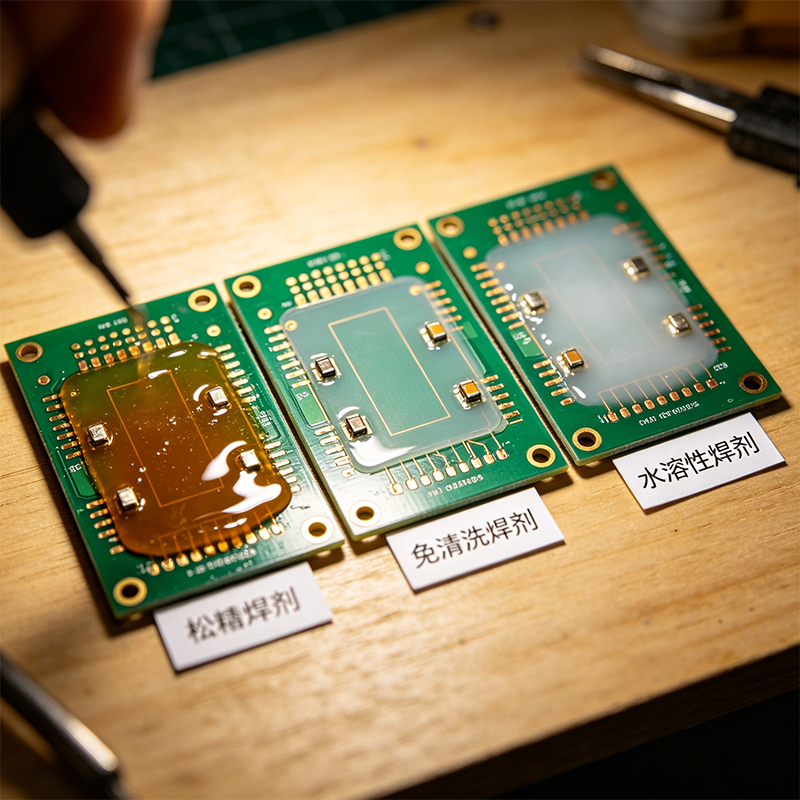
3. Water-Soluble Flux
Highly active and produces excellent soldering results — but the residue is corrosive. You must wash it off with hot water or deionized water after soldering, or it will damage the board.
The solder wire you use already contains flux inside — typically one or more hollow channels filled with rosin-based flux. When the wire melts during soldering, the flux is released automatically to clean the pad and lead.
When you might need extra flux:
Repairing old boards: Pads are heavily oxidized and the built-in flux isn't enough
Precision soldering (BGA/QFN): Extra flux ensures proper wetting
Drag soldering: Multi-pin chips need plenty of flux for drag soldering
Lead-free soldering: Lead-free solder wets poorly — extra flux is a must
Choosing solder:
For learning and DIY: Leaded 63/37 solder, 0.6-0.8mm diameter — easiest to work with
For export products or RoHS compliance: Lead-free SAC305 — set your iron to 360-380°C
Choosing flux:
Daily soldering: No-clean flux pen or RMA-core solder wire — hassle-free
Precision rework: Liquid flux (syringe) — precise application
When post-solder cleaning is possible: Water-soluble flux
Ventilation: Flux fumes can irritate your respiratory system — work in a well-ventilated area, preferably with a fume extractor
Don't eat or drink while soldering: Leaded solder contains lead — wash your hands before eating
Don't touch the iron tip: It's over 300°C — put it back on the stand when not in use
Don't use too much flux: Excessive residue can affect testing or cause leakage
Solder is the "glue" — it joins metal parts together. Flux is the "cleaner" — it removes surface oxides so the glue can stick.
Leaded solder: Melts at 183°C — easy to use but contains lead — best for learning and DIY
Lead-free solder: Melts at 217-221°C — RoHS-compliant but harder to use — best for export products
Flux: Removes oxides, prevents re-oxidation, and helps wetting — rosin-based is the standard

Kaboer manufacturing PCBs since 2009. Professional technology and high-precision Printed Circuit Boards involved in Medical, IOT, UAV, Aviation, Automotive, Aerospace, Industrial Control, Artificial Intelligence, Consumer Electronics etc..


 English



 Wechat
 +86 13670210335
 +86 13670210335
 E-mail