
Date: 2026-07-22
You've definitely seen a circuit board before. Green, covered in copper traces and solder points. But have you ever wondered: what happens if this board ends up in a humid place, a dusty factory, or a device that gets splashed? The answer is — it fails fast. Copper oxidizes. Solder joints corrode. Dust absorbs moisture and causes leakage. Mold can even “move in” and set up camp on the board.
So how do you protect it? You put a thin, invisible “raincoat” on it. That raincoat is called conformal coating.
Conformal coating is a special protective coating that forms a transparent or translucent film on the surface of a circuit board. The film is thin — typically 25 to 50 micrometers, thinner than a sheet of paper — but it does a lot.
Its core job is to isolate the circuit board from the outside environment. Think of it as a “raincoat” for your PCB — moisture can't get in, dust can't settle, chemicals can't touch it.
The reason it's called “conformal” coating is that it's not just “painting on a layer of varnish.” It perfectly conforms to the irregular surface of the circuit board — wrapping around component leads, covering pad edges, and seeping into tiny gaps. Once it's on, the board still works perfectly, but it's now “bulletproof” against the elements.
Conformal coatings come in five main chemistries, each with its own personality:
1. Acrylic (AR) — The Most Common, Easiest to Rework
Acrylic conformal coating is the most common type. It's transparent, dries quickly, and is easy to apply and remove. It's cheap and provides decent basic protection — moisture resistance and UV resistance are both solid. The biggest advantage is reworkability — you can strip it off with special solvents and recoat it. Great for most everyday electronics.
2. Polyurethane (UR) — Tough and Chemical-Resistant
Polyurethane is harder, more abrasion-resistant, and more chemical-resistant than acrylic. But it's hard to remove — once it's on, reworking the board is difficult, and removal can damage the board itself. Best for industrial equipment, automotive electronics, and other demanding applications.
3. Silicone (SR) — Heat-Resistant and Flexible
Silicone's biggest strength is extreme temperature resistance — it can handle -65°C to 200°C. It's also flexible, absorbing vibration and thermal expansion stress. But it's not scratch-resistant. Best for aerospace, automotive, LED lighting, and other applications with wide temperature swings.
4. Epoxy (EP) — The Hardest, Most Durable
Epoxy is the hardest, most wear-resistant, and most durable. But like polyurethane, it's nearly impossible to rework — once it's on, it's “welded” in place. Best for military, aerospace, and extreme environments where boards are never opened again.
5. Parylene — Vapor-Deposited, The Ultimate Protection
Parylene is completely different from the other four — it's not “painted” on, it's vapor-deposited, growing onto the board surface. It penetrates the tiniest gaps and forms an extremely thin, extremely uniform protective layer. But the equipment is expensive, the process is complex, and the cost is high. Best for medical implants, aerospace, and other “failure is not an option” applications.
There are four main application methods, and the choice depends on volume, precision, and cost:
1. Brush Coating — Simplest, Cheapest
Take a small brush, dip it in conformal coating, and paint it on like varnish. Advantages: low cost, minimal waste, easy masking. Disadvantages: low efficiency, uneven thickness. Best for low volume, prototyping, or spot repairs.
2. Spray Coating — Most Common, High Efficiency
Use a spray gun or automated spray machine to apply the coating. Advantages: high efficiency, uniform coating, great for high-volume production. Disadvantages: needs masking for areas that shouldn't be coated.
3. Dip Coating — Full Coverage, No Dead Spots
Dip the entire circuit board into a tank of conformal coating and pull it out to dry. Advantages: every corner gets covered. Disadvantages: material waste, poor thickness control, and both sides get coated. Best for high-volume, complex-shaped boards.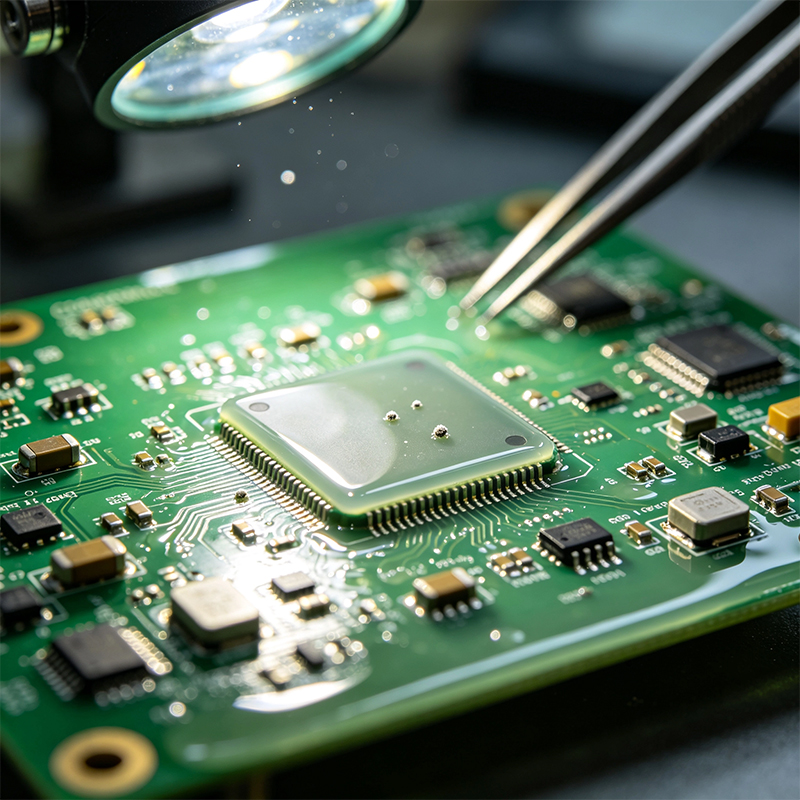
4. Selective Coating — Most Precise, Most Expensive
Use a specialized selective coating machine to spray only the areas that need protection. Highest precision, most material-efficient, but equipment is expensive. Best for high-value, high-precision products.
Conformal coating is used wherever “bare boards can't survive”:
Automotive Electronics: Engine control units, sensors — high heat, high humidity, high vibration
Medical Devices: Patient monitors, diagnostic equipment — frequent disinfection and cleaning
Aerospace: Flight controls, navigation — extreme temperatures, low pressure
Industrial Equipment: Factory controllers, instruments — dust, humidity, chemicals
LED Lighting: Outdoor fixtures — rain, sun, temperature swings
Appliances: Washing machines, refrigerators, air conditioners — humid environments
Marine Equipment: On-board electronics — salt spray corrosion
The global conformal coatings market was valued at $1.41 billion in 2025** and is projected to reach **$2.72 billion by 2033, growing at an 8.55% CAGR. Other estimates put it at $1.12 billion in 2025**, crossing **$2.04 billion by 2035. Either way, it's growing fast.
Conformal coating is useful, but you can't just slap it on. A few critical points:
1. The Board Must Be Clean Before Coating
If there's flux residue, oil, or dust on the board, the coating won't adhere properly — bubbles, peeling, delamination, worse than not coating at all. Use a specialized cleaner to thoroughly clean the board before coating.
2. Mask Areas That Shouldn't Be Coated
Connectors, test points, button contacts, heat sinks, battery contacts — these areas absolutely must not be coated. Coating them causes poor electrical contact, reduced heat dissipation, and non-functional buttons. Use masking tape or protective covers.
3. Thickness Must Be Uniform
Too thin, and protection is inadequate. Too thick, and it cracks. Generally, 25-75 micrometers is the sweet spot. Too thick also hurts heat dissipation and component insertion.
4. Curing Conditions Must Match the Material
Different coatings need different curing methods — some air-dry at room temperature, some need heat baking, some need UV exposure. Follow the manufacturer's instructions exactly.
In electronics manufacturing, conformal coating quality is judged by IPC-A-610. IPC-A-610 is the most widely used electronic assembly acceptance standard in the world. It has specific requirements for conformal coating application — uniform coverage, no bubbles, no peeling, no cracks.
Beyond IPC-A-610, there's also IPC-HDBK-830, a handbook covering design, selection, and application of conformal coatings.
Yes, but it's much harder than a bare board.
Conformal coating is designed to “stick tight,” so removing it is difficult. If you need to replace a component, you have to strip the coating in that area first. Common methods:
Chemical removal: Specialized conformal coating strippers
Mechanical removal: Micro-abrasion, scraping, brushing
Thermal removal: Hot air to soften the coating
But no matter which method you use, there's a real risk of damaging the board. So think ahead: if this board will need frequent repairs, use acrylic (easy to remove); if it's “sealed forever,” use epoxy or polyurethane (better protection).
Conformal coating is the circuit board's “invisible raincoat” — it forms a thin film on the board surface, isolating the circuit from moisture, dust, chemicals, and mold.
It comes in five main types: acrylic, polyurethane, silicone, epoxy, and parylene — each with its own strengths and weaknesses. Application methods include brushing, spraying, dipping, and selective coating. Before coating, the board must be clean, areas that shouldn't be coated must be masked, thickness must be uniform, and curing must be done properly.

Kaboer manufacturing PCBs since 2009. Professional technology and high-precision Printed Circuit Boards involved in Medical, IOT, UAV, Aviation, Automotive, Aerospace, Industrial Control, Artificial Intelligence, Consumer Electronics etc..


 English



 Wechat
 +86 13670210335
 +86 13670210335
 E-mail