
Date: 2026-01-13
If you've ever looked closely at a circuit board, you've probably seen the white lettering that labels components and shows the manufacturer's logo. That's typically done with silkscreen. But sometimes, especially on very dense or high-reliability boards, you might see lettering that looks like it's been etched or engraved into the board itself. That process is called text milling.
Let's walk through what it is, why it's used, and how it differs from the standard methods.
Text milling is a mechanical engraving process used in PCB manufacturing. A computer-controlled (CNC) milling machine uses a very fine, spinning cutting tool to physically remove a thin layer of copper and sometimes a tiny amount of the underlying substrate. This creates recessed text, logos, or codes directly in the board's surface.
The result is text that appears as the color of the exposed substrate—often that familiar PCB green or beige—set against the surrounding copper. Because it's carved in, it’s part of the board's structure.
Most text on boards is applied via silkscreen, which is basically a specialized ink printed on the surface. So, when do you use one over the other?
Silkscreen (Legend Printing) is great when:
Cost is a primary concern.
You have plenty of board space for legible text.
You need a white (or other color) contrast on dark solder mask.
The board won't face extreme abrasion or chemicals.
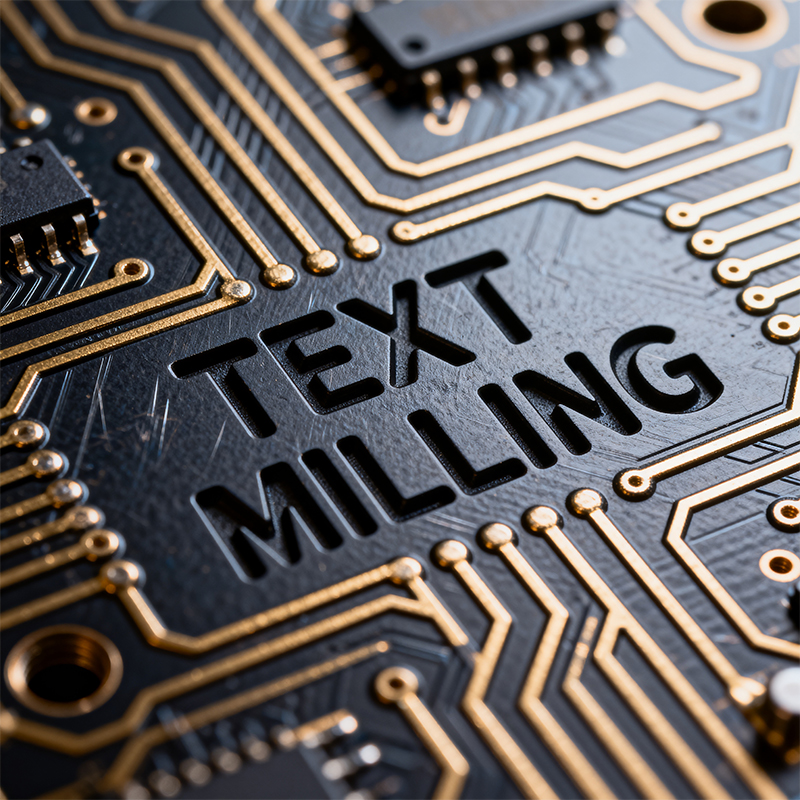
Text milling becomes the better choice when:
Space is extremely limited: It can create much smaller, sharper characters than silkscreen, down to font sizes around 0.8mm or even less.
Permanence is critical: The markings are physically engraved and cannot chip, peel, or fade over time. This is vital for serial numbers, lot codes, or safety certifications that must last the life of the product.
You're marking on bare copper: If you have a large exposed copper pad or ground plane, silkscreen ink doesn't always adhere well. Milling into the copper creates a perfect, durable mark.
The environment is harsh: For boards exposed to solvents, abrasion, or high temperatures, milled text will survive where ink might degrade.
If you're designing a board that might use text milling, keeping these points in mind will help ensure a good result:
File Preparation: Milling data is typically supplied as part of the copper layer artwork in your Gerber files. You define the text as vector outlines (lines), not as filled shapes. Clear communication with your fabricator about which layers contain milling data is essential.
Size and Spacing Limits: The milling tool has a physical diameter (often as small as 0.1mm or 0.2mm). Your text strokes must be wider than this tool size to be cleanly cut. Your fabricator can provide their specific capabilities for minimum line width and spacing.
Depth and Board Integrity: The process only removes a small amount of material, but it's still a mechanical cut. Avoid designing dense milled text in very thin sections of the board where it could affect mechanical strength.
It's an Added Manufacturing Step: Because it requires a separate machining operation after the main etching and plating processes, text milling adds time and cost to board fabrication. It's used selectively where its benefits are needed.
Text milling isn't for every board, but it's common in several areas:
Medical and Aerospace Electronics: Where traceability and permanent identification are non-negotiable requirements.
Miniaturized Electronics: Such as compact IoT modules, hearing aids, or wearable devices where every square millimeter counts.
High-Value or Low-Volume Boards: Where the added cost is justified by the need for a premium, durable finish or critical permanent marking.
Prototypes and Development Kits: Sometimes used for clear, wear-resistant labels that won't rub off during frequent handling.
Not all PCB manufacturers offer text milling, and capabilities vary. When you need it, it's helpful to ask a few questions:
What are your minimum line width and font size for milling?
What file format and layer designation do you prefer for milling data?
Can you provide an example of the milling depth and finish?
A clear understanding upfront helps prevent misunderstandings and ensures the final board matches your expectations for these critical markings.

Kaboer manufacturing PCBs since 2009. Professional technology and high-precision Printed Circuit Boards involved in Medical, IOT, UAV, Aviation, Automotive, Aerospace, Industrial Control, Artificial Intelligence, Consumer Electronics etc..


 English


 Wechat
 +86 13670210335
 +86 13670210335
 E-mail