
Date: 2026-06-10
Have you ever picked up a circuit board and wondered what people mean when they say "4‑layer board" or "6‑layer board"? You stare at it, it still looks like one piece of green plastic. Where are those extra layers hiding?
Don't worry — I had the exact same question when I started. In this guide, I'll explain everything about PCB layers (the proper name for circuit board layers) in plain, everyday language. No confusing jargon. No engineering degree required. Just a friendly chat about how these magical boards are built.
Before we dive in, let’s clear up one thing. “BCP board” isn’t a standard term in the electronics industry. What you’re probably looking for is PCB (Printed Circuit Board) — or sometimes Bare Board, meaning the empty board before any components are soldered on. That’s what we’ll talk about below.
When we talk about the number of layers on a PCB, we’re talking about how many copper sheets are stacked inside the board. The copper is what carries electrical signals and power — those tiny, hair‑thin lines you see on the surface.
So why can’t designers just put all those lines on one layer? Simple: space. Modern electronics are incredibly complex. A smartphone processor has thousands of connections that need to be routed. If you tried to put all those wires on a single layer, they’d cross over each other, take up too much space, and cause electrical interference. Engineers solve this by building “upwards” — multiple layers of copper separated by insulating material, with tiny drilled holes (called vias) acting like elevators between floors.
Think of a multi‑layer PCB like a compact office building. Each floor has a different job:
Top layer: The main lobby — holds the biggest chips and the most important signal traces.
Middle layers: Can be “signal floors” for routing wires, or full‑sheet “power” and “ground” floors that distribute electricity and shield noise.
Bottom layer: Another signal floor, often holding additional components.
Insulating layers: The concrete slabs between floors — made of fiberglass (usually FR‑4 material) that keeps everything from shorting out.
PCBs are grouped by how many copper layers they have. The most common types are double‑layer and 4‑layer boards.
Single‑sided (1 layer)
The simplest board — copper on one side, bare fiberglass on the other. Cheap and perfect for very basic circuits like TV remotes and kid's toys. But you run out of routing space very quickly.
Double‑sided (2 layers)
This is the workhorse of electronics. Both the top and bottom have copper, so you can route signals on both sides. When a trace on the top needs to connect to something on the bottom, you drill a small plated hole called a via. Think of a via as a set of stairs between floors. This doubles your wiring space at very low cost, and it's used in the majority of everyday electronics.
Multi‑layer (4 layers and up)
When circuits get too dense for two layers, or when signals need to be protected from interference, designers go multi‑layer. The “layer count” is the number of copper planes. It’s almost always an even number — because an even stack stays flatter and more mechanically stable when it’s pressed together at high temperature.
Let’s look at the most common multi‑layer stackup: a 4‑layer board. From top to bottom, here is what each layer does:
Top Layer (Signal) — Holds the main components and routes the most important signals.
Layer 2 (Ground Plane) — A nearly solid sheet of copper that acts as the “0 volt” reference for the whole board. Any component that needs grounding can drop a via straight down to this floor.
Layer 3 (Power Plane) — Another solid copper sheet, this time distributing the main power supply voltage. Separating power and ground into dedicated inner layers dramatically reduces electrical noise and electromagnetic interference.
Bottom Layer (Signal) — Also routes signals and can hold additional components.
A key rule in high‑speed design is that signal layers should be placed next to a power or ground plane — this keeps the signals clean and stable.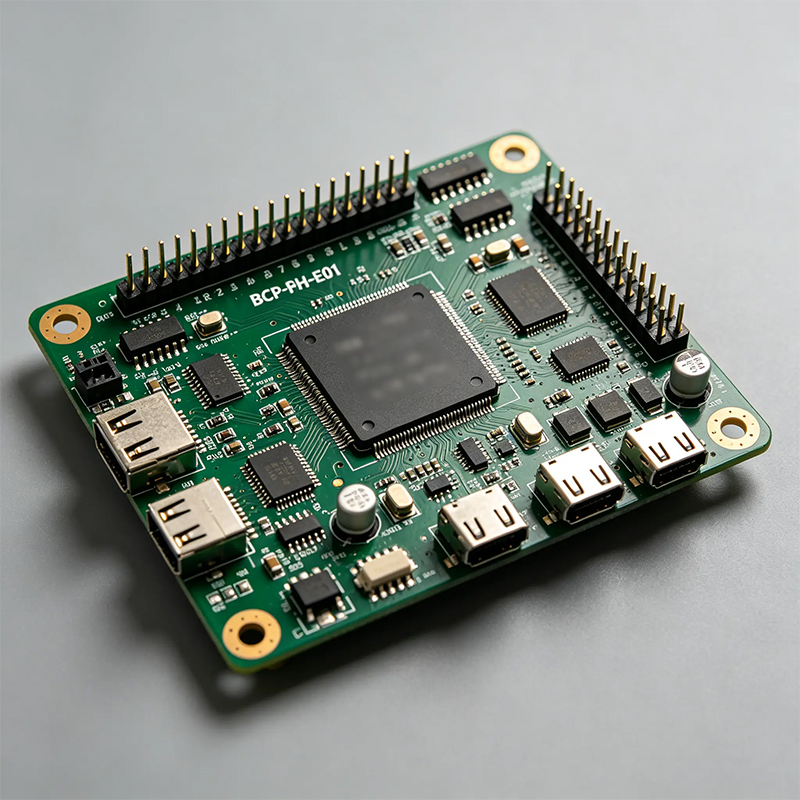
For most consumer products, 4 layers are plenty. But as products get smaller, faster, and more feature‑packed, designers need even more wiring channels and better noise protection. Take a modern smartphone motherboard. It has to integrate the baseband processor, RF transceiver, power management chips, Wi‑Fi/Bluetooth modules, display drivers, and multiple camera and sensor interfaces. That extreme density usually requires 6 to 8 layers of high‑density interconnect technology — and top‑end flagship phones can go to 10 or 12 layers or more. In those dense boards, critical high‑speed signals (like USB or memory buses) are often sandwiched between two ground planes, which acts like a noise‑blocking shield.
If 8 or 10 layers already sounds like a lot, HDI technology pushes the boundaries even further. HDI stands for High Density Interconnect. Instead of traditional through‑hole vias that drill through the entire board, HDI uses microvias and buried vias — tiny laser‑drilled holes that only connect adjacent layers. The “order” of HDI refers to how many laser drilling steps connect the outer layers to inner layers.
Common HDI types include 1‑order HDI (microvias from the outer layer to the second layer), 2‑order HDI, and any‑layer HDI — where every layer can be directly connected to its neighbors, representing the highest level of HDI capability. For ultra‑thin smartphones, smartwatches, and AI‑chip interposer boards, any‑layer HDI structures are pretty much the standard.
Of course, all those extra layers come with a downside: cost. Every additional pair of layers adds material, manufacturing time, and complexity. Engineers always weigh the performance benefits against the budget. For a simple sensor board, 2 or 4 layers is perfect. For a high‑end graphics card or a networking switch, 8 or 10 layers might be the right fit. The goal is to pick the minimum number of layers that can successfully route all signals with good signal integrity — not just to pile on as many as possible.
So, what are the layers of a circuit board? Now you know: they’re the multiple “floors” of copper that carry signals and distribute power, separated by insulating fiberglass sheets. Single‑layer boards are a single floor. Double‑sided boards are a ground floor and a basement. Multi‑layer boards add more intermediate levels — each one carefully designed to keep signals flowing cleanly, power stable, and components talking to each other.
Next time you look at a bare PCB, you’ll see more than just a green slab. You’ll see a carefully engineered stack of planes, traces, and vias, all working together to make modern electronics possible.

Kaboer manufacturing PCBs since 2009. Professional technology and high-precision Printed Circuit Boards involved in Medical, IOT, UAV, Aviation, Automotive, Aerospace, Industrial Control, Artificial Intelligence, Consumer Electronics etc..


 English



 Wechat
 +86 13670210335
 +86 13670210335
 E-mail