
Date: 2026-06-10
Have you ever looked closely at a circuit board and noticed that some have shiny gold pads, others are silver, and some just look like bare copper? You might have wondered: what's the difference? Is gold better than silver?
Those different colors come from the PCB surface finish – the final protective coating applied to the copper pads before components are soldered on. In this guide, I'll walk you through the most common types of PCB surface finishes in plain English. By the end, you'll know which one is best for your project – whether you're a hobbyist or a professional buyer.
The bare copper on a circuit board oxidizes very quickly when exposed to air. Within days, a non‑conductive oxide layer forms that solder won't stick to. So manufacturers apply a thin protective layer over the copper. This layer prevents oxidation and ensures that solder can wet the pad properly during assembly.
Different surface finishes have different costs, solderability, shelf life, and flatness. Let me break them down.
Appearance: Silver‑gray, slightly uneven surface.
How it's made: The board is dipped into molten solder, then hot air knives blow off the excess, leaving a thin solder coating on the pads.
Pros:
Very cheap
Excellent solderability
Works well for hand soldering and wave soldering
Cons:
Uneven surface – not suitable for fine‑pitch components (below 0.5mm)
Short shelf life (a few months before oxidation)
Leaded versions are not RoHS compliant (lead‑free HASL exists but requires higher temperature)
Best for: Low‑cost consumer electronics, industrial control boards, designs with large components.
Appearance: Bright gold, very flat surface.
How it's made: A layer of nickel (4‑8µm) is deposited on the copper, then a thin layer of gold (0.05‑0.1µm) is swapped onto the nickel via a chemical displacement reaction. The nickel acts as a barrier, and the gold protects the nickel from oxidation.
Pros:
Extremely flat – perfect for BGA, fine‑pitch QFP, and 0201 resistors
Long shelf life (over 12 months)
Excellent solderability, survives multiple reflow cycles
Looks professional
Cons:
Expensive (gold costs money)
Complex process – can suffer from “black nickel” defect if not controlled
Too thick gold can cause brittle joints (so the gold layer is kept very thin)
Best for: Smartphones, computer motherboards, medical devices, aerospace, any high‑reliability product.
Appearance: Invisible or faint bluish/greenish tint; pads look like bare copper.
How it's made: A thin organic coating is applied over the copper. During soldering, the flux in the solder paste dissolves the coating, exposing fresh copper.
Pros:
Very cheap (often cheaper than HASL)
Perfectly flat – great for fine‑pitch components
Environmentally friendly – no heavy metals
Cons:
Short shelf life (3‑6 months)
Not tolerant of multiple reflow cycles – the coating degrades with heat
Cannot be used on contact pads or edge connectors (it's non‑conductive)
Requires careful handling and vacuum packaging
Best for: High‑volume consumer electronics (TVs, set‑top boxes), disposable products, cost‑sensitive projects.
Appearance: Silver‑white, flat surface.
How it's made: A layer of pure silver (0.1‑0.5µm) is deposited directly onto the copper.
Pros:
Flat surface – good for fine‑pitch components
Excellent solderability
Cheaper than ENIG
Cons:
Silver tarnishes (reacts with sulfur in the air) – must be vacuum packed
Shorter shelf life than ENIG (6‑12 months)
Risk of “silver migration” (silver ions moving under high humidity and voltage, causing shorts)
Best for: Telecommunications equipment, some automotive electronics, designs needing flatness but with a tighter budget.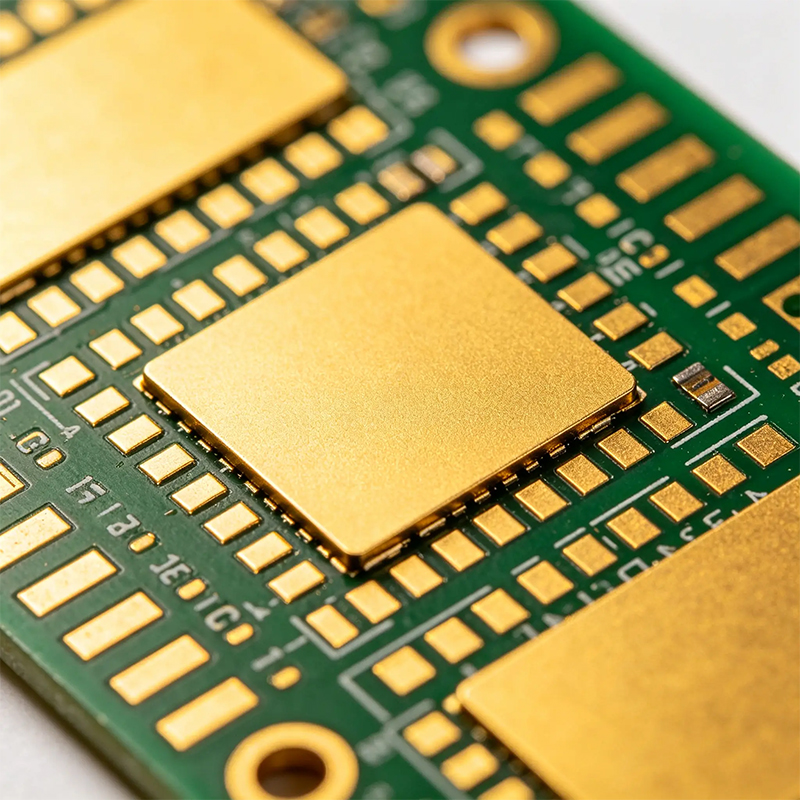
Appearance: Silver‑white, flat surface.
How it's made: A layer of pure tin (0.8‑1.2µm) is deposited onto the copper.
Pros:
Very good solderability (tin is the ideal soldering surface)
Flat surface
Moderate cost
Cons:
Risk of “tin whiskers” (tiny conductive hairs that can grow and cause shorts)
Short shelf life (about 6 months)
Sensitive to humidity and temperature
Best for: Some automotive and industrial applications; less common in consumer electronics.
| Finish | Color | Flatness | Shelf Life | Cost | Fine‑pitch friendly | Hand soldering |
|---|---|---|---|---|---|---|
| HASL | Silver‑gray | Poor | 3‑6 mo | Very low | No | Easy |
| ENIG | Bright gold | Excellent | >12 mo | High | Yes | Easy |
| OSP | Copper | Excellent | 3‑6 mo | Very low | Yes | Harder (needs flux) |
| Immersion Silver | Silver‑white | Excellent | 6‑12 mo | Medium | Yes | Easy |
| Immersion Tin | Silver‑white | Excellent | ~6 mo | Medium | Yes | Easy |
For hobbyist / DIY (one‑off boards) : Choose HASL (leaded if available – it solders beautifully) or ENIG if you have the budget. OSP can be tricky for beginners.
For high‑volume consumer electronics : It depends on your cost and component pitch. Fine‑pitch BGAs need ENIG or immersion silver. Standard SMT can use OSP (cheapest) or lead‑free HASL.
For products sold in the EU or US : Make sure you're RoHS compliant. Lead‑free HASL, ENIG, OSP, immersion silver, and immersion tin are all RoHS‑friendly.
For boards with edge connectors or keypad contacts : ENIG is your best bet – gold is hard, wear‑resistant, and conductive. OSP is non‑conductive, silver and tin will tarnish and wear.
For maximum reliability and long storage : ENIG is the king.
There's no single “best” PCB surface finish – it all depends on your product's needs, budget, and assembly process. HASL is cheap and easy to solder but rough. ENIG is flat, reliable, and beautiful but expensive. OSP saves money but is delicate. Immersion silver and tin sit somewhere in the middle.
Next time you see a board with gold pads, you'll know it's ENIG. Silver pads? Probably immersion silver or tin. Bare copper? That's likely OSP. And that rough, silver‑gray finish? Classic HASL.
If you're still unsure which finish to pick for your project, drop a comment with your requirements (component types, production volume, storage needs) – I'm happy to help you choose.

Kaboer manufacturing PCBs since 2009. Professional technology and high-precision Printed Circuit Boards involved in Medical, IOT, UAV, Aviation, Automotive, Aerospace, Industrial Control, Artificial Intelligence, Consumer Electronics etc..


 English



 Wechat
 +86 13670210335
 +86 13670210335
 E-mail