
Date: 2026-07-02
You’ve definitely seen a chip before — those little black squares sitting on a circuit board. But there’s a type of chip where you can’t see the pins at all. Underneath it, there’s a dense grid of tiny solder balls, arranged like a chessboard. Once soldered, the connections are completely hidden — you can’t see them with your eyes.
That package is called a Ball Grid Array (BGA) . A ball array is exactly that — the grid of solder balls on the bottom of the chip.
In this guide, I’ll explain what a ball array is, why we need it, what types exist, and why it’s so tricky to work with. Plain English, no fluff.
A Ball Grid Array (BGA) is a surface-mount chip package. Instead of having pins sticking out from the sides, it has hundreds or thousands of tiny solder balls arranged in a grid on the bottom of the package. The balls are laid out in rows and columns — that’s where the “grid” in Ball Grid Array comes from.
Think of it as a chip with lots of tiny “beads” on its underside. During assembly, the chip is placed on the PCB and heated. The solder balls melt and solidify, connecting the chip to the board. All signals and power flow through these tiny balls.
Before BGA, high-density chips used Quad Flat Packages (QFP) — pins sticking out from all four sides, like a centipede. As chips got more complex and needed more pins, QFP ran into problems:
Pins too dense — fine pitch caused bridging during soldering
Pins too fragile — they bent easily and were a nightmare to repair
Too much board space — pins around the perimeter, the bigger the chip, the more space it took
BGA solved all of this. It moved the pins from the edges to the bottom, using the entire underside of the chip for connections. For the same chip size, a BGA can pack twice as many connections as a QFP. And solder balls are much sturdier than fragile pins.
Simply put: BGA packs more pins into less space.
BGA comes in several varieties. By substrate material, there are three main types:
1. PBGA (Plastic Ball Grid Array)
The most common type. The substrate is plastic laminate. Cheap, mature process, widely used. Most consumer electronics use PBGA.
2. CBGA (Ceramic Ball Grid Array)
The substrate is ceramic. Ceramic has better thermal conductivity and a thermal expansion coefficient that matches silicon closely — more reliable. But expensive. Used in military, aerospace, and high-reliability applications.
3. TBGA (Tape Ball Grid Array)
The substrate is a flexible tape. Used in thin, lightweight, or flexible designs.
There’s also FCBGA (Flip Chip BGA) — the chip is flipped upside down and attached directly to the substrate, giving shorter signal paths and better performance. High-end CPUs and GPUs use FCBGA.
By ball arrangement, there are full array (balls everywhere), peripheral (balls only around the edges), and staggered. Full array gives the most pins but is the hardest to solder.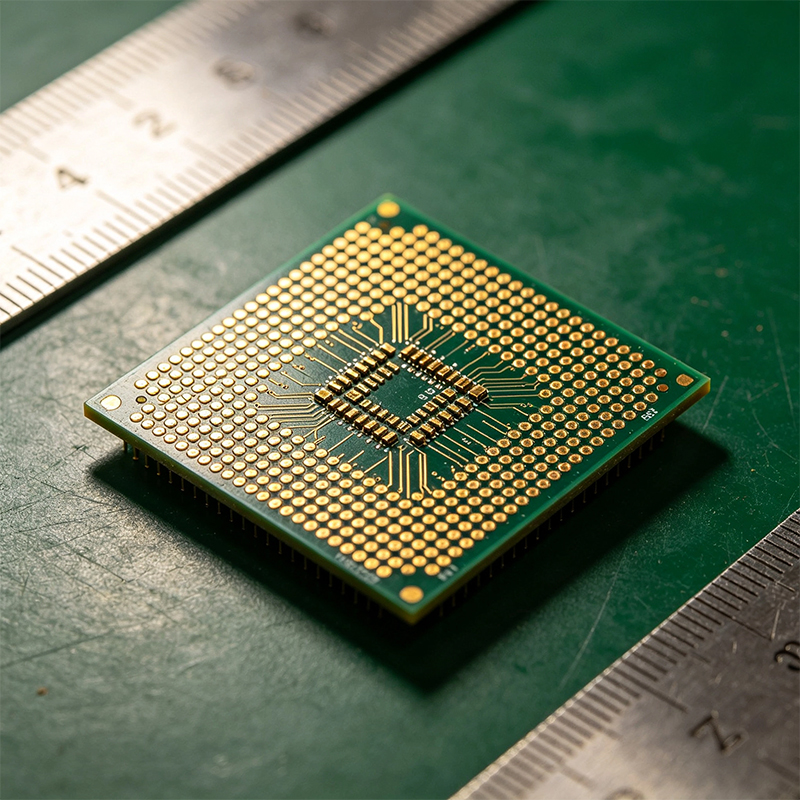
1. More pins, smaller footprint
For the same chip size, BGA packs twice as many connections as QFP. That’s why phones and laptops keep getting smaller.
2. Better signal quality
Solder balls are much shorter than long pins, reducing parasitic inductance and capacitance. High‑speed signals (DDR memory, USB, MIPI) perform better with BGA.
3. Better heat dissipation
Heat can travel directly through the solder balls to the PCB.
4. More robust
Solder balls don’t bend like fragile pins during shipping and handling.
1. Extremely difficult to solder
BGA solder joints are completely hidden under the chip. You can’t inspect them with a magnifying glass like you can with QFP. Voids, bridges, and cold joints — you have no idea until it’s too late. You need X‑ray inspection to see inside the joints.
2. Extremely difficult to rework
If a BGA chip fails, you need a specialized BGA rework station — heat it up, remove it, clean the pads, reball it, and solder it back on. Not a job for amateurs.
3. Susceptible to stress
BGA solder joints are brittle. Board flexing or thermal expansion can crack them. That’s why dropped phones sometimes develop “intermittent” faults — cracked BGA joints.
4. High PCB design requirements
BGA pads need precise matching and thermal vias. Bad design = terrible yield.
BGA is soldered using reflow soldering — the PCB with solder paste goes through a reflow oven, the temperature rises to melt the balls, then cools to solidify. The temperature profile must be precise — too low and joints don’t form; too high and the chip burns.
After soldering, X‑ray inspection is mandatory. X‑ray can see through the chip and PCB to check for voids and bridges. Without X‑ray, you’re soldering blind.
IPC has two key standards for BGA:
IPC-7095: Design and assembly implementation for BGA
IPC-7095E: Updated version covering inspection, repair, and reliability
A ball array (BGA) is a chip package with solder balls arranged in a grid on the underside.
It solved the problems of QFP — pins too dense, too fragile, too much space — by packing more connections into a smaller footprint. Phones, computers, graphics cards, routers — almost every high-performance chip uses BGA.
But it also brought challenges: difficult soldering, hidden joints, hard rework. Without X‑ray inspection and professional BGA rework capability, you can’t handle BGA properly.

Kaboer manufacturing PCBs since 2009. Professional technology and high-precision Printed Circuit Boards involved in Medical, IOT, UAV, Aviation, Automotive, Aerospace, Industrial Control, Artificial Intelligence, Consumer Electronics etc..


 English



 Wechat
 +86 13670210335
 +86 13670210335
 E-mail