
Date: 2026-07-02
You've definitely seen them. Those shiny little dots on a circuit board, connecting component leads to copper pads. These tiny things are called solder joints.
They might not look like much, but they do two crucial jobs: carry electricity (letting current flow from the component to the board) and hold things together (keeping components firmly attached). You could say solder joints are the hardest-working parts of any electronic device.
In this guide, I'll explain what solder joints are, what a good one looks like, what the common defects are, and how to tell the difference. Plain English, no fluff.
The process is simple: heat solder until it melts, let it flow onto the component lead and PCB pad, then let it cool and solidify.
Think of it like glue — molten solder is like liquid glue that hardens when it cools. Except solder joins metal, and it conducts electricity too.
A good solder joint looks like a neat little “volcano”:
Smooth and shiny — like a tiny mirror(note: lead-free solder is naturally a bit duller, but should still be uniform)
Concave shape — like a Hershey's Kiss, with a smooth inward curve
Wetting angle less than 90 degrees — the solder has spread nicely
No cracks or holes — the surface is intact
Simple rule: good joint = smooth + shiny + full shape.
There are several ways a solder joint can go wrong:
1. Cold Solder Joint
This is the most common solder defect. It happens when the solder doesn't fully melt because the temperature is too low.
What does a cold joint look like? Dull, grainy, and rough — like sandpaper instead of a mirror. It looks connected, but it's weak and can crack under stress.
Cold joints cause high resistance, intermittent signals, and eventually complete failure.
2. Dry Solder Joint
A dry joint happens when the solder fails to actually bond with the component lead or pad. The solder is there, but it didn't form a proper metallurgical bond.
Dry joints look like solder balls sitting on the pad instead of flowing smoothly, with a convex instead of concave shape. They break off easily.
3. Solder Bridge
When two pads that shouldn't be connected get linked by solder. This creates a short circuit and can burn out components. Bridges usually happen from too much solder or a tip that's too big.
4. Solder Balls / Beads
Tiny balls of solder that splatter onto the board. They might not cause immediate problems, but they can move around and cause shorts later.
Cold joints are the most common defect, and here's why they happen:
Not enough heat — iron too cold, or reflow profile too low
Heating too short — solder didn't have time to fully melt
Movement during cooling — bumped the board while solder was still molten
Dirty pads or leads — oxidation or oil prevents wetting
Speed too fast — in wave soldering, the board moved too quickly
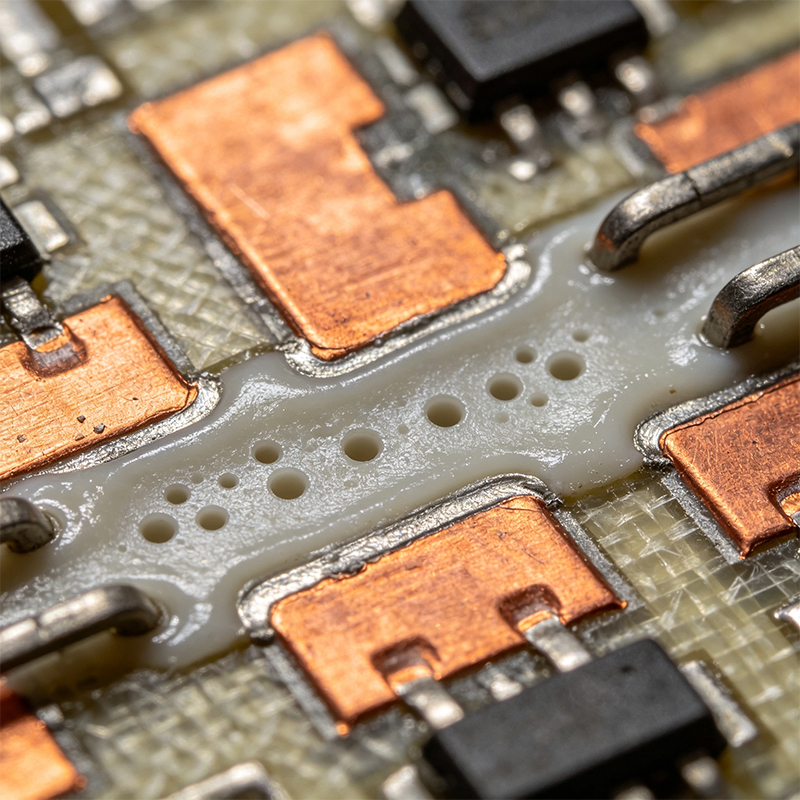
Three main methods:
1. Visual Inspection (with magnification)
Look at the joint — smooth? Shiny? Good shape? Any cracks?
2. Automated Optical Inspection (AOI)
High-res cameras compare the board to a standard image
3. X-Ray Inspection
For BGAs and other hidden joints — X-rays show voids and bridges inside the joint
In electronics manufacturing, solder joint quality is judged by IPC-A-610 standards. It divides products into three classes:
Class 1 — Toys, basic appliances. Function matters; cosmetic defects are acceptable
Class 2 — Phones, computers, telecom gear. Requires continuous reliable operation
Class 3 — Aerospace, medical, defense. No defects allowed
Your product's class determines how good the solder joints need to be.
A solder joint is the metal "joint" that connects electronic components to the circuit board — it carries current and holds things together. Good joints are shiny, smooth, and full-shaped. Bad joints are dull, rough, and prone to cracking. Cold solder joints are the most common defect, usually from insufficient heat. IPC-A-610 is the industry rulebook for judging solder joint quality.

Kaboer manufacturing PCBs since 2009. Professional technology and high-precision Printed Circuit Boards involved in Medical, IOT, UAV, Aviation, Automotive, Aerospace, Industrial Control, Artificial Intelligence, Consumer Electronics etc..


 English



 Wechat
 +86 13670210335
 +86 13670210335
 E-mail