
Date: 2026-06-17
You’ve definitely seen a circuit board before. Green, stiff, covered in silver traces and solder points. They’re inside your computer, your TV, your phone charger. But have you ever wondered: what if a circuit board could bend, fold, and roll up like a piece of paper?
That’s exactly what a flex PCB is.
A flex PCB — short for Flexible Printed Circuit Board, also called an FPC or flex circuit — is a circuit board built on a bendable material, allowing it to bend, fold, or twist during use. Unlike traditional rigid boards that crack when you bend them, a flex PCB can curve around corners, fold in half, and squeeze into spaces where a rigid board would never fit.
In this guide, I’ll walk you through what a flex PCB is, how it’s made, where it’s used, and how it compares to regular rigid boards. No engineering degree required — just plain English.
A regular rigid PCB uses fiberglass and epoxy (FR4) as its base material — stiff and strong like a thin piece of wood. A flex PCB uses polyimide (PI) or polyester (PET) film — the same kind of flexible plastic used in some tapes and films. The copper traces are bonded onto this flexible film.
Think of it this way: a rigid board is a wooden plank; a flex board is a thick piece of paper or a plastic card. The plank is strong but can’t bend. The paper can be rolled, folded, and stuffed into any gap.
Flex PCBs can be single-sided, double-sided, or multi-layer. More layers mean more routing capability, but also less flexibility and higher cost.
The manufacturing process for flex PCBs is similar to rigid boards in some ways, but the soft material requires special handling.
Step 1 – Material selection
The most common base material is polyimide (PI) because it withstands high temperatures, stays flexible, and resists chemicals. For the copper, there are two main types: rolled annealed (RA) copper is better for repeated bending; electrodeposited (ED) copper is cheaper and works for static bends (bend once and leave it).
Step 2 – Etching the circuit
A photosensitive layer is applied to the copper-clad film. UV light projects the circuit pattern onto it, then chemicals wash away the unwanted copper, leaving the traces. It’s similar to how old photographs were developed — hence the name “printed” circuit.
Step 3 – Drilling and plating
For multi-layer designs or through-holes, holes are drilled and plated with copper to connect different layers.
Step 4 – Coverlay application
Instead of the green solder mask used on rigid boards, flex boards use a coverlay — a polyimide film with adhesive that protects the copper traces from scratches and oxidation.
Step 5 – Surface finish
A surface finish (ENIG, OSP, or immersion silver) is applied to the pads to prevent oxidation and ensure good solderability.
Step 6 – Cutting to shape
The boards are cut into their final shape using a laser or die. Flex boards can’t be routed like rigid boards — routing would fray and tear the soft material.
Flex PCBs come in several varieties depending on layer count and structure:
Single-sided flex
One copper layer. Simplest and cheapest. Used for simple jumpers, keypads, and LED strips.
Double-sided flex
Two copper layers with insulation between them, connected by plated through-holes. Used for camera modules, sensors, and more complex routing.
Multi-layer flex
Three or more copper layers. Used for complex functions requiring high-density routing and shielding.
Rigid-flex
A hybrid board with rigid sections (FR4) and flexible sections (polyimide) laminated into one piece. Rigid sections hold heavy chips and connectors; flexible sections bend and connect. This is the most complex and highest-value type of flex PCB.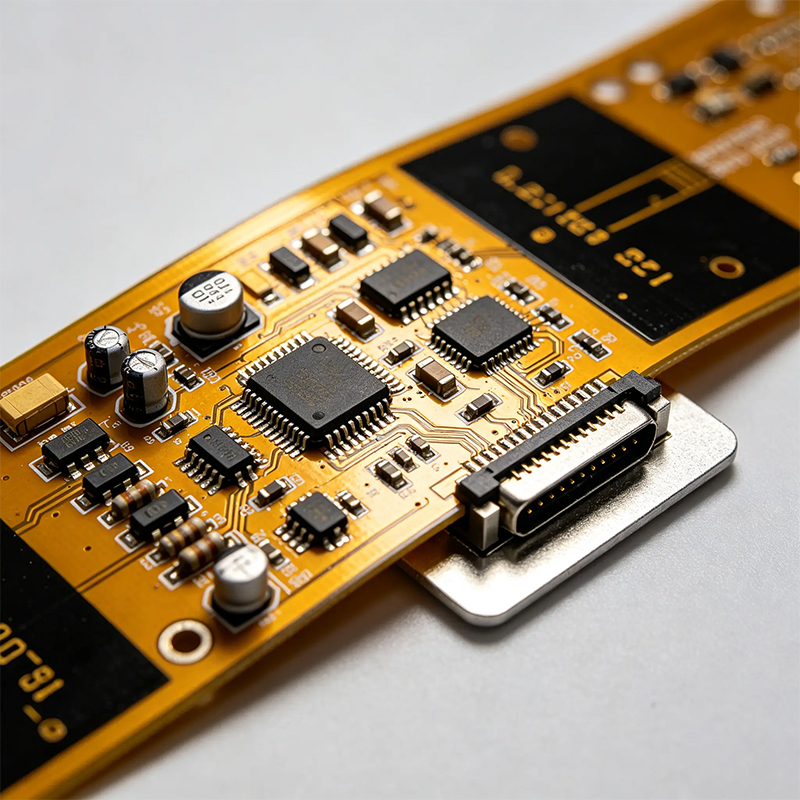
1. They bend
This is the big one. Rigid boards lie flat; flex boards can bend, fold, and wrap around curved surfaces.
2. They’re lighter and thinner
Flex boards can be as thin as 0.1mm — over 70% lighter than a rigid board of the same area. For drones, wearables, and implantable devices, that’s a game-changer.
3. Fewer connectors, more reliability
A traditional design might use several rigid boards connected by cables and connectors. Connectors are failure points. A flex board can replace the whole assembly — one piece, no connectors. Fewer connections mean fewer things that can break.
4. Better signal integrity
Rigid boards have fiberglass weave that can be uneven, affecting high-speed signal transmission. Flex boards have no glass weave, so signal performance is more consistent.
The downside? Flex boards are more expensive than rigid boards, and they’re harder to design and manufacture. That’s why you only use them when you actually need the flexibility or space savings.
Flex PCBs are a lot more common than you might think.
Smartphones
The display cables, camera flexes, and button boards inside your phone are all flex PCBs. Without flex, foldable phones wouldn’t exist.
Wearables
Smartwatches, fitness bands, TWS earbuds — they all need to be tiny, lightweight, and comfortable against the skin. Flex is the only way.
Cars
Modern cars are rolling computers with dozens of electronic control units. Many are mounted in tight, vibrating spaces. Flex and rigid-flex boards handle the vibration, heat, and tight packaging.
Medical devices
Pacemakers, hearing aids, endoscopes — these devices must be incredibly small and absolutely reliable. Flex PCBs are the standard.
Aerospace
Satellites and aircraft electronics demand extreme reliability and minimal weight. Flex and rigid-flex are widely used.
Printers and gaming consoles
Printer head cables bend thousands of times a day — only flex can survive that. Game controllers and portable consoles also use flex internally.
Designing a flex board is different from designing a rigid board. A few critical points:
1. Bend radius matters — a lot
When a flex board bends, the outside of the bend stretches and the inside compresses. Bend it too tight, and the copper traces crack. IPC-2223 guidelines say: for static bends (bend once and leave it), the bend radius should be at least 6 times the board thickness. For dynamic bends (repeated flexing), it should be at least 100 times the thickness.
2. No components or vias in bend areas
Solder joints and plated vias will crack under repeated bending. Keep them out of the flex zone.
3. Route traces perpendicular to the bend axis
Traces should run across the bend direction, not along it. This distributes stress more evenly.
4. Stiffeners are essential in some areas
Flex boards are too floppy to hold connectors or screws. In those areas, you need a stiffener — a piece of FR4, polyimide, or stainless steel laminated to the back.
There’s no single “best” option. It depends on your product:
No bending needed, plenty of space → rigid board. Cheapest.
Bends once, then stays → single or double-sided flex.
Repeated bending (printer cables, foldable hinges) → multi-layer flex with RA copper and generous bend radius.
Heavy chips plus bending → rigid-flex. Most expensive, but most reliable.
Extreme space or weight constraints → flex or rigid-flex.
A flex PCB is simply a circuit board made with flexible material instead of rigid fiberglass. It can bend, fold, and roll. That simple change has enabled smartphones to get thinner, wearables to get lighter, and medical devices to get smaller.
Flex boards cost more than rigid boards and are harder to manufacture. But in applications that require bending, tight spaces, or lightweight construction, they’re irreplaceable.

Kaboer manufacturing PCBs since 2009. Professional technology and high-precision Printed Circuit Boards involved in Medical, IOT, UAV, Aviation, Automotive, Aerospace, Industrial Control, Artificial Intelligence, Consumer Electronics etc..


 English



 Wechat
 +86 13670210335
 +86 13670210335
 E-mail