
Date: 2026-06-17
You’re an electronics manufacturer. You’re designing a new product — maybe a wearable, a foldable phone, an automotive sensor, or a medical device. You’re running into the same problem: rigid boards are too big, too heavy, and won’t fit into that curved enclosure. You need a circuit board that can bend, fold, and roll. You need electronic flex.
“Electronic flex” is the industry term for flexible circuit boards (flex PCBs) and related flexible electronics technology. It refers to electronic circuits that can bend, fold, and twist while still functioning properly. It’s not some futuristic concept — it’s inside the phone in your hand, the watch on your wrist, and the car in your driveway.
In this guide, I’ll explain what electronic flex is, what types exist, why manufacturers are adopting it, and how to choose a reliable supplier. Plain English, no fluff.
Simply put, a flexible circuit board (flex PCB) is a circuit board that bends. Traditional rigid PCBs use fiberglass (FR4) as their base material — stiff and strong like a wooden plank. Flex PCBs use polyimide (PI) or other flexible films as the base — bendable like a plastic card.
Key characteristics:
Bends, folds, twists — fits into spaces where rigid boards can’t go
Lightweight and thin — as thin as 0.1mm, over 70% lighter than rigid boards
No fiberglass — more consistent impedance and better signal integrity
Eliminates connectors — one flex board replaces multiple rigid boards + cables + connectors
Think of it this way: a rigid board is a wooden plank; a flex board is a thick piece of paper. The plank is strong but can’t bend. The paper can be rolled and stuffed into any gap.
Flexible circuit boards come in several varieties:
1. Single-layer Flex
One copper layer. Simplest and cheapest. Good for dynamic bending and tight spaces. Typical uses: jumpers, keypads, LED strips.
2. Double-sided Flex
Two copper layers with insulation between, connected by plated through-holes. Allows components on both sides. Typical uses: camera modules, sensors, shielded circuits.
3. Multi-layer Flex
Three or more copper layers. For high-density routing and complex signal processing. Typical uses: controlled impedance circuits, EMI/RFI shielding.
4. Rigid-Flex
The most advanced type. Rigid sections (FR4) and flexible sections (polyimide) laminated into one board. Rigid areas hold heavy chips and connectors; flex areas bend and connect. Typical uses: drone flight controllers, medical endoscopes, foldable phones, automotive sensors.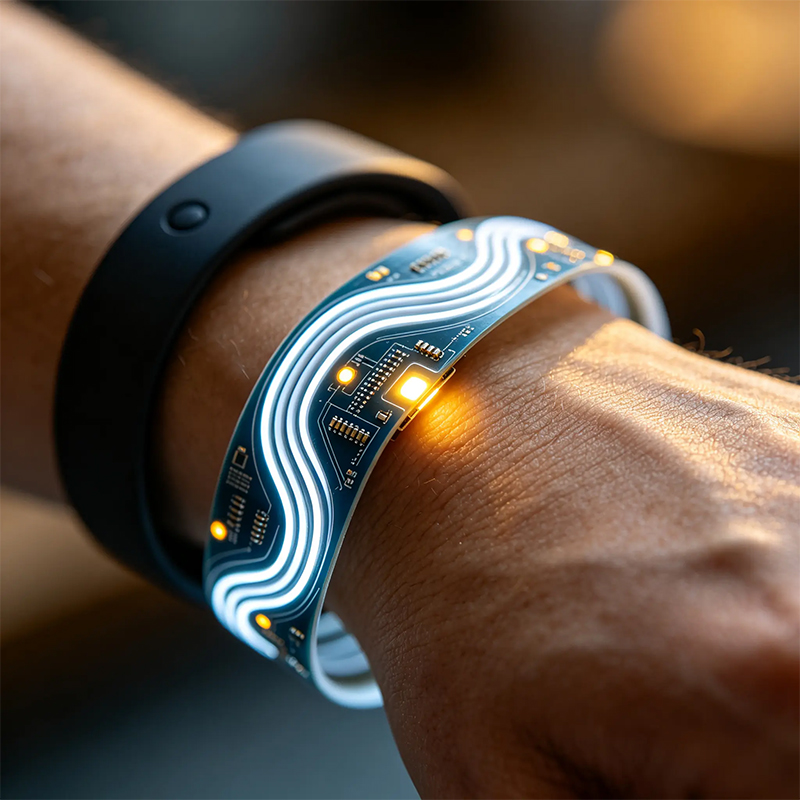
The flexible PCB market is growing fast. The global FPCB market was valued at $23.3 billion in 2025 and is projected to reach $41.7 billion by 2030. Consumer electronics accounts for nearly 40% of the market. Why the rapid growth? Because the advantages are too compelling to ignore:
1. Solves space constraints
This is the biggest advantage. Flex boards conform to the product’s shape, rather than forcing the product to fit the board. Foldable phone hinges, smartwatch curved displays — only flex can do it.
2. Lighter and thinner
Drones, wearables, implantable devices — every gram counts. Flex boards are over 70% lighter than rigid boards and as thin as 0.1mm.
3. Higher reliability
Traditional designs use multiple rigid boards + cables + connectors. Connectors are failure points. A single flex board replaces the whole assembly — fewer connections, fewer failures.
4. Better signal quality
Rigid boards have uneven glass weave that affects high-speed signals. Flex boards have no glass weave, so signal performance is more consistent.
5. 3D assembly
Flex boards can bend, fold, and wrap around components, enabling three-dimensional assembly that rigid boards can’t achieve.
Flexible circuit boards are everywhere:
Consumer Electronics
Smartphone display cables, camera flexes, and button boards are all flex. Foldable phones depend on them. TWS earbuds, smartwatches, and tablets also use them extensively.
Automotive Electronics
Modern cars have dozens of electronic control units mounted in tight, vibrating spaces. Flex and rigid-flex handle the vibration, heat, and tight packaging. Electric vehicles (EVs) use flex PCBs in Battery Management Systems (BMS) to replace heavy wire harnesses, saving weight and space.
Medical Devices
Pacemakers, hearing aids, endoscopes, continuous glucose monitors — these devices must be incredibly small and absolutely reliable. Flex PCBs are the standard. Flex conforms to the human body, making it ideal for wearable medical devices.
Aerospace
Satellites, aircraft, and Mars rovers demand extreme reliability and minimal weight. Rigid-flex is widely used.
Communications
5G mmWave antennas require low-loss materials like LCP and MPI — flex PCBs are the go-to choice.
Industrial and Robotics
Soft robotics, environmental sensors, smart packaging — emerging fields are also adopting flexible electronics.
Designing flex boards is different from rigid boards. A few critical points:
1. Bend radius matters — a lot
When a flex board bends, the outside stretches and the inside compresses. Bend it too tight, and the copper cracks. Industry guidelines: for static bends (bend once and leave it), the bend radius should be at least 6 times the board thickness. For dynamic bends (repeated flexing), at least 100 times the thickness.
2. No components or vias in bend areas
Solder joints and plated vias crack under repeated bending. Keep them out of the flex zone.
3. Choose the right copper type
For repeated bending, use rolled annealed (RA) copper — it’s more fatigue-resistant. For static bends, electrodeposited (ED) copper is cheaper and sufficient.
4. Coverlay instead of solder mask
Flex boards use a coverlay — polyimide film with adhesive — instead of the green solder mask used on rigid boards.
5. Stiffeners are essential in some areas
Flex boards are too floppy to hold connectors or screws. In those areas, you need a stiffener — a piece of FR4, polyimide, or stainless steel laminated to the back.
We are not a standard rigid-only PCB shop. We are a one-stop manufacturer that designs and makes flexible PCBs, rigid-flex boards, HDI high-frequency boards, and then does full PCBA.
All in-house — Flex, rigid-flex, HDI fabrication and PCBA assembly under one roof. No hand-offs, better quality and lead time.
Flex/rigid-flex expertise — Over a decade of experience. We know how to avoid flex-to-rigid transition cracks, design proper stiffeners, and control impedance.
High-precision manufacturing — Minimum trace/space 0.05mm, minimum laser blind via 0.075mm. Supports 1-order to any-layer HDI.
High-frequency material experience — Rogers, PTFE, LCP — we’ve done them all for 5G and radar applications.
Turnkey PCBA — High-precision placement, X-ray inspection, functional testing, conformal coating — all available.
Free DFM review — Send your design files, get a DFM report within 24 hours with potential issues and optimization suggestions.
Projects we’ve served: consumer electronics (TWS earbuds, smartwatches, foldable phone FPCs), automotive (BMS, camera modules, radar high-frequency boards), medical (endoscopes, glucose monitors, hearing aids), aerospace (satellite rigid-flex boards), communications (5G antennas, optical modules).
Three steps:
Send your files — PCB design files (Gerber or source), BOM, special requirements (bend radius, impedance, materials, etc.).
We review and quote — Within 24 hours, you’ll receive a DFM report, stackup recommendation, and sample/volume pricing.
Sample, then scale — We build 10-20 samples. You test functionality and bend reliability. Then we move to volume.
Electronic flex isn’t future technology — it’s already inside every electronic device around you. From phones to cars, from medical devices to aerospace, flexible circuit boards are redefining how small, light, and reliable electronic products can be.
If you’re developing a product that bends, has tight space constraints, or demands lightweight construction, send us your requirements. We won’t push a contract — we’ll first run a free DFM review and let our expertise speak.
When you contact us, please include:
Product type and application
Whether bending is required (dynamic or static)
Estimated annual quantity (samples, small batch, or mass production)
We’ll give you an honest answer — what we can do, what we can’t, and how to modify your design to make it work.

Kaboer manufacturing PCBs since 2009. Professional technology and high-precision Printed Circuit Boards involved in Medical, IOT, UAV, Aviation, Automotive, Aerospace, Industrial Control, Artificial Intelligence, Consumer Electronics etc..


 English



 Wechat
 +86 13670210335
 +86 13670210335
 E-mail