
Date: 2026-06-08
Ever opened up a phone or a laptop and seen those thin, yellowish, bendable ribbons connecting the screen to the main board? That's a flexible printed circuit board (flex PCB) . Unlike the hard green fiberglass boards you're used to, a flex PCB can bend, twist, and fold without breaking.
Now, what about "drill flexible"? That simply means drilling holes in a flexible circuit board – and believe me, it's not as easy as drilling into a hard board. But you need holes to mount components or create vias, so it's a must-know topic.
In this beginner-friendly guide, I'll walk you through everything: what a flex PCB is, where it's used, how drilling works, and what to watch out for when ordering custom flexible boards. No engineering degree required – just plain talk.
Hard PCB (FR4) : The base material is fiberglass and epoxy. It's stiff, cheap, and great for most electronics – like a piece of plywood.
Flex PCB (Polyimide / PET) : The base is a thin, plastic-like film (Kapton). It bends like a thick piece of paper or a plastic card.
Hard boards are strong and cheap. Flex boards are more expensive but can be bent, rolled, or folded into tiny, odd-shaped spaces. Think of a hard board as a wooden plank and a flex board as a leather belt. You can't wrap a plank around your wrist, but a belt – easy.
Drilling holes in a flexible board is trickier than in a hard board. Why? Because the material is soft. When the drill bit pushes down, the board wants to bend and lift up. That gives you rough, fuzzy hole walls – or worse, a torn board.
Manufacturers use three main methods:
High-speed CNC drilling – They use extremely sharp carbide bits, spin them at 80,000+ RPM, and back the flex board with a solid aluminum or hardboard sheet to keep it flat.
Laser drilling – For tiny holes (<0.1mm) or high volume, they blast holes with CO2 or UV lasers. No contact means no deformation. Perfect but pricier.
Punching – For large, simple holes (like connector slots), they use a metal die to punch through, like a paper hole puncher.
So when you order a custom flex PCB, drilling is part of the cost – and not all factories do it well. You want a shop that specializes in flexible board drilling.
You've used them thousands of times without knowing it:
Smartphones & tablets – display cables, camera cables, button flexes.
Laptops – hinge cables, trackpad flex.
Printers – the moving print head rides on a long flex cable that bends constantly.
Medical devices – hearing aids, pacemakers, endoscopes (tiny and reliable).
Cars – airbag systems, steering wheel controls, LED headlights.
Wearables – smartwatches, fitness bands, smart rings.
Basically, anywhere the space is tight, curved, or moving – you'll find a flex PCB.
If you want to get a flex board made (and hey, we do that), come prepared with these five things:
Schematic (circuit diagram) – How should your components be connected? Use free tools like EasyEDA or KiCad.
Board outline & dimensions – Length, width, cutouts, corners. A DXF or Gerber file is ideal.
Bill of Materials (BOM) – List all the parts: chips, resistors, capacitors, connectors, etc.
Bending requirements – Do you need it to bend once (e.g., folded 90° into an enclosure) or constantly (like a printer cable moving back and forth thousands of times)? This changes the material and layer stack.
Drilling info – Hole locations, diameters, and whether they need copper plating (vias).
Send these to a fab shop, and they'll quote you a price and send you a sample.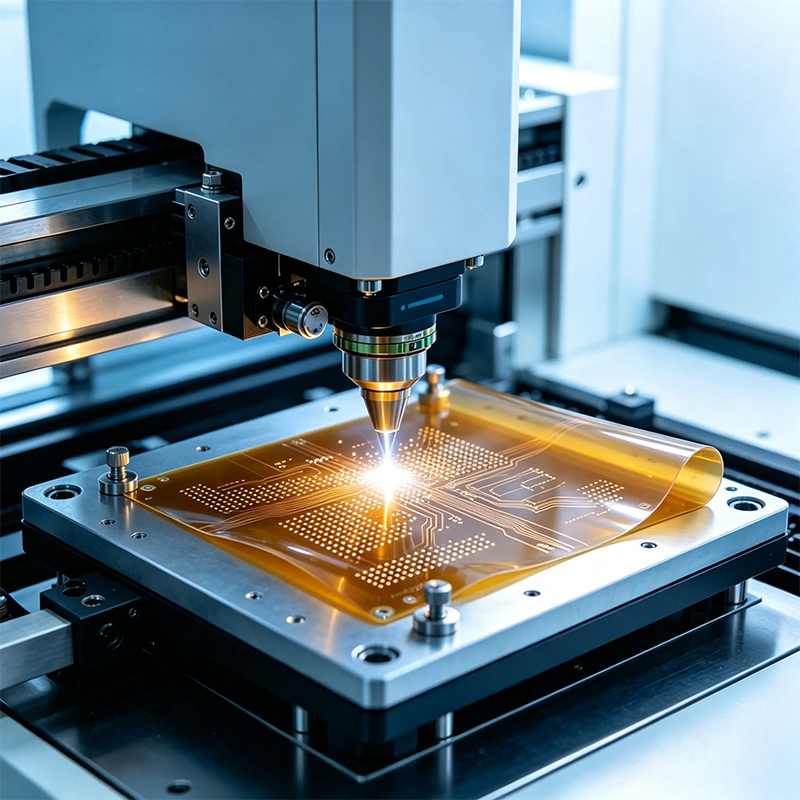
Holes too small – Minimum recommended hole size for flex is 0.2mm (0.008"). Smaller than that, and drill bits break or hole walls crack.
Holes too close together – Keep at least 0.3mm of material between holes. Otherwise, drilling will tear the web.
Holes in the bending area – Never put vias or component holes where the board will flex repeatedly. The copper around the hole will crack after a few bends. Keep holes out of bending zones.
Forgetting stiffeners – Where you plug in a connector or mount a screw, you need a stiffener (a piece of FR4 or steel glued to the back). Otherwise, the flex board will flop around and break solder joints.
Remember: Drilling a flex PCB is fine – but drilling in the wrong spot will kill your board.
Expect to pay 2 to 5 times more than a hard board of the same size. Reasons:
Material is more expensive (polyimide vs. FR4)
Process is slower (drilling, laminating coverlay, etc.)
Lower yield (soft boards wrinkle and get damaged more easily)
Typical turnaround for prototypes: 5–10 business days. Rush service can be 3 days but costs extra.
For your first project, order a small batch (5–10 pieces) to test before committing to hundreds or thousands. It's cheaper to scrap a few test boards than to rework a whole production run.
Sometimes, yes. If you just need to connect two hard boards that are far apart, a flat flexible cable (FFC) is cheaper. But there are situations where only a flex PCB works:
Curved space – A bracelet-style wearable needs the board to wrap around the wrist. No cable can do that.
Folding – Flip phones and foldable screens require the board to fold exactly in half.
Extreme thinness – Flex PCBs can be as thin as 0.1mm. Hard boards start at 0.4mm.
Dynamic flexing – Moving printer heads, robot joints – rigid cables break after a few cycles.
A flexible PCB is just a circuit board that bends. And drill flexible is the art of putting holes in it without ruining it. If you're designing a product that's small, curved, or moves, you probably need a flex board.
When you're ready to order, remember:
Tell the factory how and how often it will bend.
Keep holes away from bend areas.
Don't make holes too small or too crowded.
Add stiffeners where connectors attach.
We make custom flexible circuit boards every day – from simple flex cables to complex multi-layer bendable designs. Got an idea? Even a rough sketch? Send it over. We'll help you turn that bendy dream into a real board that works.

Kaboer manufacturing PCBs since 2009. Professional technology and high-precision Printed Circuit Boards involved in Medical, IOT, UAV, Aviation, Automotive, Aerospace, Industrial Control, Artificial Intelligence, Consumer Electronics etc..


 English



 Wechat
 +86 13670210335
 +86 13670210335
 E-mail