
Date: 2026-07-16
You've definitely seen a circuit board before. Green, stiff, covered in copper traces and solder points. But you might not have thought about this: the board itself could contain materials that are harmful to people and the environment.
The base material of a regular circuit board (FR4) typically contains halogenated flame retardants — mainly bromine (Br) and chlorine (Cl) . Their job is to stop the board from catching fire. The problem is: when they do burn or decompose at high temperatures, they release dioxins, furans, and other highly toxic gases — thick smoke, acrid smell, hazardous to humans and the environment.
That's exactly why halogen-free PCBs exist.
A halogen-free PCB is simply a circuit board manufactured with materials that do not contain halogens — no fluorine, no chlorine, no bromine, no iodine. Instead, it uses phosphorus (P) and nitrogen (N) compounds for flame retardancy. It still meets fire safety standards, but without releasing toxic gases. In this guide, I'll explain what halogen-free PCBs are, why they matter, what the standards are, and their pros and cons. Plain English, no fluff.
Halogens are a group of elements in Group 17 of the periodic table — fluorine (F), chlorine (Cl), bromine (Br), iodine (I), and others.
The flame retardants in regular FR4 are mostly brominated epoxy resins. They work by releasing bromine radicals when the board burns, interrupting the combustion chain reaction and putting out the fire. It works well and it's cheap.
The problem? When brominated flame retardants burn or undergo incomplete combustion, they release dioxins and furans — known carcinogens. Even without burning, at high soldering temperatures (>200°C), they release trace amounts of hydrogen bromide. The EU banned PBB and PBDE (the most harmful brominated flame retardants) in 2006. But other brominated flame retardants (like tetrabromobisphenol A) are still legal — they just can't be called "halogen-free".
A halogen-free PCB is a circuit board manufactured with halogen-free materials — no bromine in the substrate, no chlorine, with flame retardancy achieved through phosphorus or nitrogen compounds.
But "halogen-free" doesn't mean "zero halogens" — nothing in this world is 100% pure. It's a content standard: as long as halogen content stays below a certain limit, the board can be called "halogen-free."
According to IEC 61249-2-21 and JPCA-ES-01-2003 — the two international standards for halogen-free PCBs — a board must meet these limits:
Chlorine (Cl) ≤ 900 ppm (0.09%)
Bromine (Br) ≤ 900 ppm (0.09%)
Total Cl + Br ≤ 1500 ppm (0.15%)
Anything above these limits cannot be called halogen-free. JPCA-ES-01-2003 was first issued in November 1999 by the Japan Electronics Packaging and Circuits Association, and later adopted as an international standard by IEC.
Regular FR4 uses bromine for flame retardancy. Halogen-free FR4 uses phosphorus (P) and nitrogen (N) instead.
The mechanism is different. Bromine works in the gas phase — it releases bromine radicals that interrupt the flame chemistry. Phosphorus and nitrogen work in the solid phase — they form a phosphate char layer on the material's surface when burning, blocking oxygen from reaching the material, and the fire can't sustain itself.
Halogen-free materials still achieve UL94 V-0 flame retardancy — the same safety rating as conventional FR4. The difference: halogen-free materials do not release dioxins or furans when burned.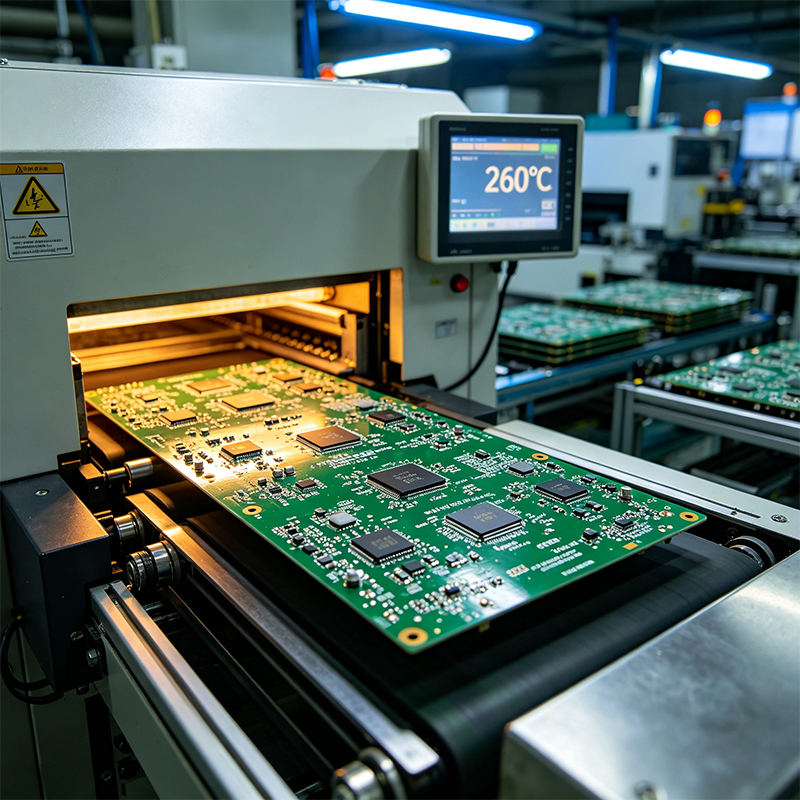
Here's a quick comparison:
| Feature | Standard FR4 | Halogen-Free FR4 |
|---|---|---|
| Flame retardant | Brominated compounds | Phosphorus/nitrogen compounds |
| Tg (Glass Transition Temp) | 130-140°C | 150-170°C |
| Dielectric constant (Dk) | 4.2-4.5 | 3.8-4.2 |
| Dissipation factor (Df) | 0.018-0.022 | 0.012-0.018 |
| Thermal conductivity | ~0.25 W/mK | ~0.30 W/mK |
| Relative cost | 1× (baseline) | 1.4-2.0× |
| Combustion byproducts | Toxic halogenated gases | Non-toxic or low-toxicity |
Halogen-free FR4 has a higher Tg (150-170°C) than standard FR4 (130-140°C) — better heat resistance. It also has lower Dk and Df — less signal loss at high frequencies. But it costs 40-100% more than standard FR4.
1. Environmentally safe
No halogens means no dioxins, no furans when burned. Fewer harmful substances are released during production and disposal.
2. Regulatory compliance
IEC 61249-2-21 and JPCA-ES-01-2003 are globally recognized halogen-free standards. Compliant with RoHS and REACH — no export barriers.
3. Better performance
Higher Tg (150-170°C vs. 130-140°C) — better heat resistance. Lower Dk and Df — less high-frequency signal loss. Lower water absorption — suitable for high-humidity environments.
4. Market trend
The global halogen-free CCL market was valued at approximately $3.275 billion in 2025** and is projected to reach **$4.465 billion by 2031, growing at a CAGR of 5.3%. More and more major customers require halogen-free materials from their suppliers.
1. Higher cost
Halogen-free materials cost 40-100% more than standard FR4. The gap is narrowing, but it's still significant.
2. Harder to process
Halogen-free boards are more brittle — they crack more easily during depaneling. They have poorer alkali resistance — during etching and solder mask rework, special attention is needed for immersion time in alkaline stripping solutions.
3. More moisture-sensitive
Halogen-free materials are more sensitive to moisture. Improper storage can lead to delamination during soldering.
4. Limited long-term reliability data
The long-term reliability of alternative flame retardants hasn't been fully qualified yet. Short-term performance is fine, but more data is needed for extreme environments.
Halogen-free PCB applications are growing rapidly:
Consumer electronics: Smartphones, tablets, laptops, wearables — more major brands require halogen-free materials
Telecommunications: Routers, switches, servers — high-performance equipment demands both reliability and environmental compliance
Automotive electronics: ECUs, sensors, BMS — stricter environmental and reliability requirements
Medical devices: Patient monitors, diagnostic equipment — material safety is critical
Industrial equipment: Control systems, instruments
Export products: For EU, Japanese, and other markets — halogen-free is almost standard
A halogen-free PCB is a circuit board that uses phosphorus and nitrogen instead of bromine and chlorine for flame retardancy. It still meets UL94 V-0 fire safety ratings, but without releasing dioxins and furans when burned.
According to IEC 61249-2-21 and JPCA-ES-01-2003, Cl ≤ 900ppm, Br ≤ 900ppm, and Cl+Br ≤ 1500ppm are required to call a board halogen-free. Halogen-free FR4 has higher Tg (150-170°C), lower Dk and Df, but costs 40-100% more than standard FR4.

Kaboer manufacturing PCBs since 2009. Professional technology and high-precision Printed Circuit Boards involved in Medical, IOT, UAV, Aviation, Automotive, Aerospace, Industrial Control, Artificial Intelligence, Consumer Electronics etc..


 English


 Wechat
 +86 13670210335
 +86 13670210335
 E-mail