
Date: 2026-07-16
You've definitely seen a circuit board before. Green, stiff, covered in copper traces and solder points. But you might not know that over 80% of circuit boards use the same base material — FR4.
FR4 is everywhere. Your computer motherboard, your phone charger, your smart speaker, your car's ECU — all use FR4. It's not expensive, not rare, not mysterious. But it became the industry standard for a reason — a combination of properties that are "just right" for most applications. In this guide, I'll explain what FR4 is, what its key properties are, and why the whole world uses it. Plain English, no fluff.
FR4 stands for Flame Retardant 4 — a grade designation for a glass-reinforced epoxy laminate. But it's not a single specific material — it's a class of materials: a composite of woven fiberglass cloth bonded with epoxy resin.
Think of it as "layers of fiberglass cloth glued together with resin and pressed into a solid sheet". The fiberglass cloth provides strength and rigidity. The epoxy resin bonds the layers together and provides insulation and heat resistance. Flame-retardant additives in the epoxy make it self-extinguishing.
The name FR4 was officially adopted by NEMA (National Electrical Manufacturers Association) in 1968, replacing older grades like G-10. It meets the UL94 V-0 flame retardant standard — meaning it won't easily catch fire and will self-extinguish if it does.
Whether an FR4 board works for your application comes down to five key parameters:
1. Glass Transition Temperature (Tg) — The Temperature Where the Board Starts to Soften
Tg is FR4's most important thermal property. Above Tg, the board transitions from a glassy state to a rubbery state — mechanical strength and dimensional stability drop significantly.
Standard FR4 has a Tg of 130-140°C. High-Tg FR4 can reach 150-180°C. If your product needs to go through lead-free reflow (peak temperatures around 235-245°C), high-Tg FR4 is strongly recommended — standard FR4 can delaminate or deform under the higher heat.
2. Decomposition Temperature (Td) — The Temperature Where the Board Starts to Break Down
Td is where the resin begins to chemically decompose. FR4's Td is typically 300-350°C. Beyond this, the resin starts to crack, smoke, and carbonize. Higher Td means better survival at extreme temperatures.
3. Coefficient of Thermal Expansion (CTE) — How Much the Board Expands When Heated
CTE measures how much the board expands when heated. FR4's CTE in the X/Y direction is about 12-17 ppm/°C, which matches copper (16-18 ppm/°C) well. But in the Z direction (through the board thickness), CTE can reach 50-70 ppm/°C — this is a major cause of via failure.
4. Dielectric Constant (Dk) — How Fast Signals Travel Through the Board
Dk determines how fast signals travel through the board. FR4's Dk ranges from 4.2 to 4.8, varying with frequency. At 1 MHz it's around 4.7, but drops to about 4.2 at 1 GHz. This frequency-dependent fluctuation makes precise impedance control difficult at higher frequencies — your carefully calculated 50Ω trace might behave like 45Ω at certain frequencies.
5. Dissipation Factor (Df) — How Much Signal Energy Is Lost
Df measures signal energy lost as heat during transmission. FR4's Df is about 0.015-0.020. At 10 GHz, FR4's signal loss becomes so significant that many high-frequency designs simply can't use it. By comparison, Rogers high-frequency materials have Df around 0.002-0.004 — roughly an 8× improvement.
Thermal Conductivity: FR4's thermal conductivity is only 0.25-0.4 W/mK. It's a thermal insulator. If your product has high-power components, FR4 alone won't dissipate heat well — you need copper planes, thermal vias, or metal-core boards to help.
Moisture Absorption: FR4 absorbs very little moisture — only 0.1-0.2%. This means stable performance in humid environments, with minimal changes to dielectric properties.
Mechanical Strength: FR4 has high mechanical strength and rigidity. It supports heavy components without deforming during assembly or use.
Copper Adhesion: FR4 has good adhesion to copper foil, ensuring copper traces stay attached to the substrate during use.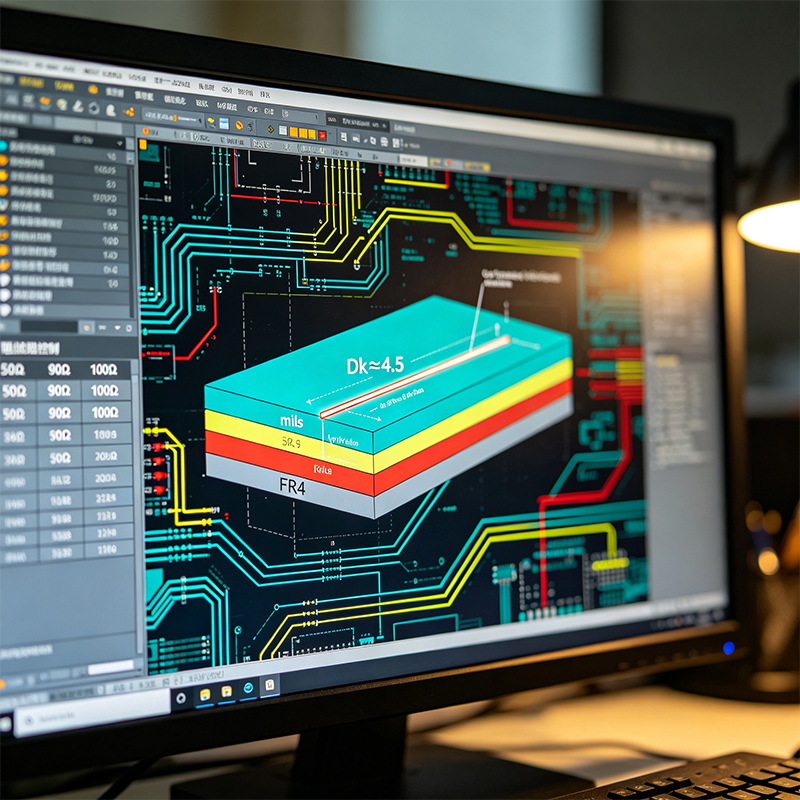
FR4 isn't a single material — it's a material family. Different grades exist for different performance needs:
Standard FR4: Tg 130-140°C, cheapest — for most everyday electronics
High-Tg FR4: Tg 150-180°C — for lead-free soldering and high-temperature environments
Halogen-Free FR4: Uses phosphorus or nitrogen-based flame retardants instead of bromine — more environmentally friendly
Low-Loss FR4: Lower Df — for higher-frequency applications
FR4 starts with fiberglass cloth — E-glass fibers woven into fabric. The cloth is impregnated with epoxy resin, then cured under high heat and pressure. This process can produce single-layer boards, or multi-layer boards using prepreg and core materials.
Standard FR4 thickness is typically 1.6mm, with variations from 0.5mm to 2.36mm. Copper foil thickness ranges from 18μm to 140μm.
FR4 is also easy to machine — it can be drilled, cut, and laminated, making it ideal for high-volume production.
FR4's sweet spot:
Digital circuits below 1GHz
Consumer electronics, home appliances, industrial control, automotive ECUs
General power circuits that don't need extreme heat dissipation
Cost-sensitive high-volume production
Where FR4 struggles:
High-frequency signals (>1-3GHz): signal loss is too high
High-power, high-heat applications: thermal conductivity is too low
Extreme temperatures: Tg is limited
Ultra-high-frequency 5G/radar: requires Rogers or PTFE
FR4 isn't a secret — it's just a fiberglass-and-epoxy laminate that happens to be flame-retardant. It's not expensive, not rare, not perfect — but it strikes a near-ideal balance between cost, performance, and manufacturability.
Tg 130-140°C, Dk 4.2-4.8, Df ~0.02, thermal conductivity 0.3 W/mK — none of these numbers are spectacular on their own. But together, they create a material that covers over 80% of all electronics applications.

Kaboer manufacturing PCBs since 2009. Professional technology and high-precision Printed Circuit Boards involved in Medical, IOT, UAV, Aviation, Automotive, Aerospace, Industrial Control, Artificial Intelligence, Consumer Electronics etc..


 English


 Wechat
 +86 13670210335
 +86 13670210335
 E-mail