
Date: 2026-06-12
You've seen it in factory videos or repair tutorials: a machine with thin metal needles rapidly tapping on a circuit board, making a "tick tick tick" sound. Or maybe you've used a multimeter with two pointy leads to check a pad. That thing you're holding – that's a probe.
In electronics, a probe is any device that touches a test point on a circuit board to measure electrical signals, continuity, or component values. It can be as simple as a metal stick or as sophisticated as a precision instrument.
In this guide, I'll explain the most common types of probes used in PCB testing – flying probe, ICT probe, oscilloscope probe, and multimeter leads – in plain English. No engineering degree required.
No matter the type, every probe does three basic things:
Check continuity – Touch the tip to a pad or via to see if the circuit is connected.
Measure voltage/signals – Carry the electrical signal from the board to a test instrument.
Measure resistance/capacitance – Apply a small current through the tip and read the value.
Think of a probe as the bridge between the circuit board and the test equipment. Without it, your expensive oscilloscope or multimeter can't "talk" to the board.
| Type | Appearance | Main Use |
|---|---|---|
| Flying Probe | Very thin metal needle on a moving arm | Low‑volume bare board testing |
| ICT Probe (Spring Probe) | Spring‑loaded "pogo pin" | High‑volume PCBA testing |
| Oscilloscope Probe | Cable with a handle, tip with hook or point | Measuring waveforms and voltages |
| Multimeter Lead | Red and black wires with pointed tips | General voltage, resistance, continuity |
Let's go through each one.
Flying probe testing is used for bare PCBs (no components soldered). A machine with 2, 4, or 8 independently moving arms touches each pad and via on the board, checking for shorts or opens.
Key features:
Very thin tip – can be as small as 0.05mm, allowing contact with fine‑pitch pads (e.g., 0201 resistors).
Replaceable tips – when a tip wears out, you swap just the tip, not the whole arm.
Adjustable pressure – you can set the downforce to avoid damaging flex boards.
Flying probe is ideal for low‑volume, high‑mix production. No test fixture needed – just change the program for a different board.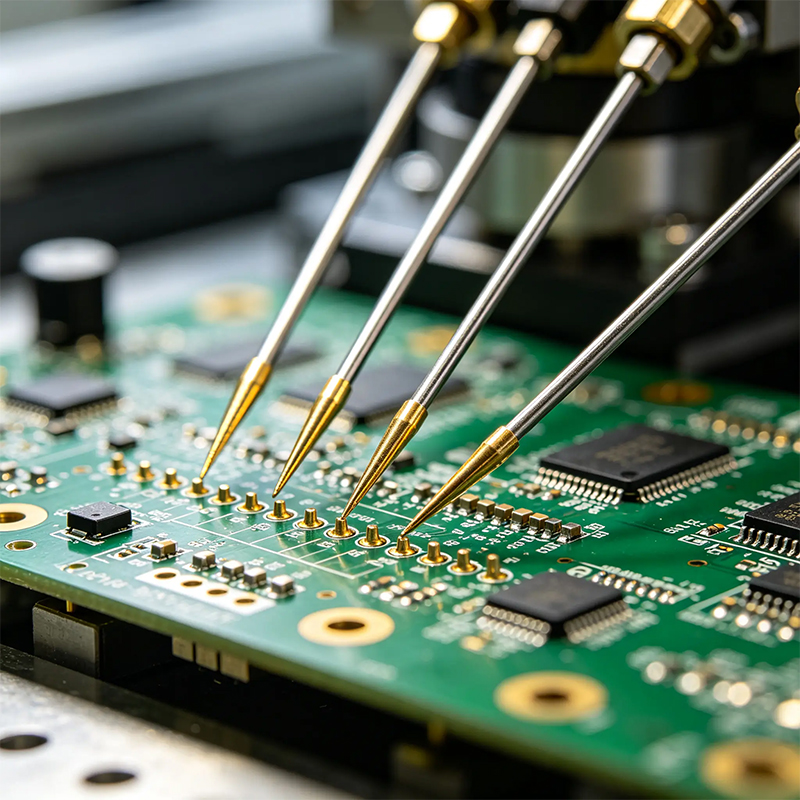
ICT (In‑Circuit Test) is the standard for high‑volume PCBA testing. A "bed‑of‑nails" fixture contains hundreds or thousands of spring‑loaded probes. When a board is pressed down, each probe contacts a specific test point. The test takes only a few seconds.
Key features:
Spring loaded – the tip retracts, ensuring good contact even if the board isn't perfectly flat.
Long life – quality ICT probes can last tens of thousands to hundreds of thousands of cycles.
Many tip shapes – sharp (breaks through oxide), rounded (gentle on pads), crown (multiple contact points).
ICT is perfect for high‑volume, stable products. The fixture costs money upfront, but each board tests in seconds.
An oscilloscope probe doesn't test continuity. It transfers voltage waveforms from the circuit to the scope, so you can see if the signal is clean, noisy, or distorted.
Two common types:
Passive probe – cheap and durable, bandwidth up to a few hundred MHz. Good for everyday debugging.
Active probe – very high bandwidth (GHz range), but expensive (thousands of dollars per probe). Used for high‑speed signals like USB 3.0 or DDR memory.
Most oscilloscope probes have a compensation adjustment to match the scope's input capacitance. If you skip this step, your waveform will be wrong.
You probably use these but never call them "probes". A standard multimeter lead is simply two wires (red and black) with pointed metal tips. They measure voltage, resistance, continuity, diodes, etc.
Upgraded versions include alligator clips (clamp onto wires), hooks (grab component leads), and extra‑sharp tips (pierce insulation). If you work with surface‑mount parts, buy a pair of sharp‑tip leads – they make probing tiny pads much easier.
| Tip Shape | Characteristic | Best For |
|---|---|---|
| Sharp | Pierces oxidation | Pads with oxide layer, need to scratch through |
| Round | Gentle on pads | Expensive PCBs, soft boards, gold fingers |
| Crown (3‑point/4‑point) | Multiple contact points | ICT testing, lowest possible contact resistance |
| Flat | Large contact area | Large pads, thermal pads |
| Hook | Grabs component leads | Hand debugging, temporary connections |
Yes – probes are consumables, especially flying probe and ICT probes. Common failure modes:
Tip wear – becomes blunt, causing intermittent contact.
Spring fatigue – loses force, no longer presses firmly.
Oxidation/contamination – flux residue builds up, increasing contact resistance.
Maintenance tips:
Clean tips regularly with a rubber eraser or special cleaning pad.
Replace flying probe tips every 50,000‑100,000 touches (or sooner if you see bad contacts).
Inspect and replace worn ICT probes every 3‑6 months for high‑volume lines.
Quality probes have:
Material – barrel and tip made of beryllium copper or tungsten steel for good conductivity and wear resistance.
Plating – gold or palladium plating on the tip prevents oxidation and extends life.
Spring force – typically 100‑200 grams. Too high damages the board; too low causes bad contact.
Rated life – good probes are rated for 100,000 to 500,000 cycles.
Cheap probes may bend or break after a few uses, costing more in downtime than you saved.
Flying probe → low‑volume bare board testing. Flexible but slow.
ICT probe → high‑volume PCBA testing. Fast but requires a fixture.
Oscilloscope probe → waveform viewing. For signal debugging.
Multimeter lead → basic voltage, resistance, continuity. Everyone has one.
Choosing the right probe type and tip shape makes your testing faster, more accurate, and more reliable. If you work with PCBs regularly, keep a few different tip shapes on hand – they're cheap and save a lot of frustration.
Next time you see a machine "ticking" across a circuit board, or you pick up your multimeter leads, you'll know exactly what's happening. Probes are tiny, but they're the unsung heroes of electronics testing.

Kaboer manufacturing PCBs since 2009. Professional technology and high-precision Printed Circuit Boards involved in Medical, IOT, UAV, Aviation, Automotive, Aerospace, Industrial Control, Artificial Intelligence, Consumer Electronics etc..


 English


 Wechat
 +86 13670210335
 +86 13670210335
 E-mail