
Date: 2026-03-31
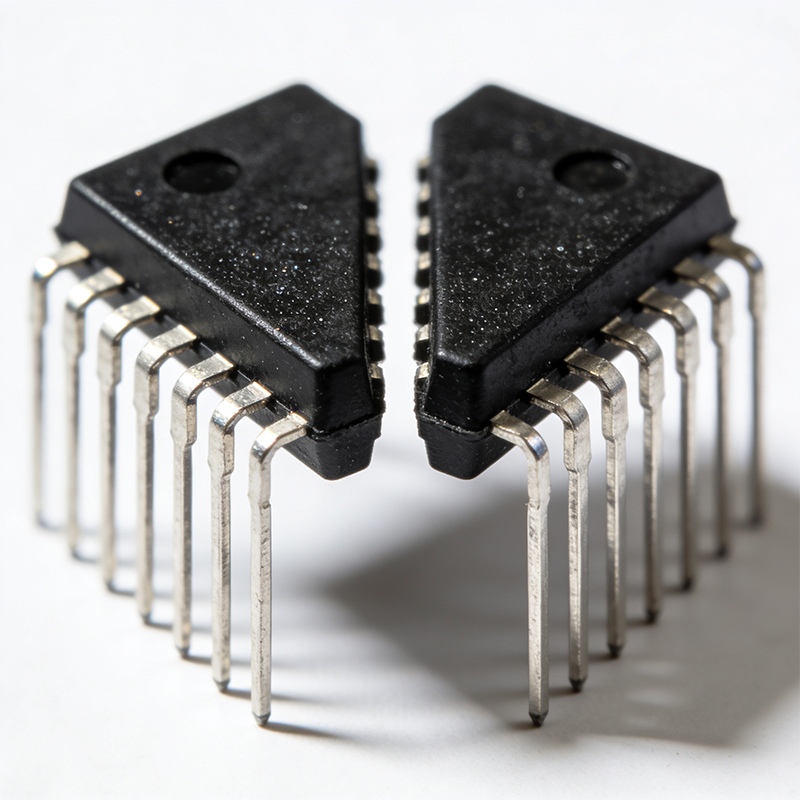
If you’ve ever looked at a computer motherboard from the 90s or tinkered with an Arduino in a lab, you’ve seen them: those little black rectangular chips with two parallel rows of metal pins sticking out like centipede legs.
That, in its simplest form, is a Dual Inline Package (DIP).
But if you’re a manufacturer today, the question isn’t just "what is it?" It’s more like, "Why are we still using this in the age of microscopic wearables and high-speed HDI boards?" Let’s dive into the nuts and bolts of DIP and why it still matters for your next project.
A Dual Inline Package is a type of electronic component housing that features two rows of electrical connecting pins. These pins are designed to be mounted using through-hole technology (THT). You either plug them into a socket or solder them directly into holes drilled through the printed circuit board (PCB).
It was the king of the 1970s and 80s. Why? Because it was easy to handle. You didn't need a high-tech robotic arm to pick one up; you could plug it into a breadboard with your own hands.
Let’s be real: DIP is bulky. In today's market, where everyone wants a smart ring or a foldable phone, DIP takes up way too much "real estate" on the board. Most modern designs have switched to Surface Mount Technology (SMT).
Size: SMT components are tiny. DIPs are giants.
Assembly Speed: SMT is built for high-speed robotics. DIP often requires manual or semi-automated insertion, which can be a bottleneck in mass production.
Performance: For high-frequency designs, those long DIP pins act like little antennas, creating unwanted noise.
You’d be surprised. We still see plenty of DIP requirements in our PCBA lines, especially for:
Industrial Controllers: Where vibration resistance and easy repairs are more important than being tiny.
Prototyping: It’s still the best way to swap out a chip during the R&D phase without desoldering an entire board.
Power Electronics: Sometimes you need that extra physical strength that only a through-hole connection can provide.
While we respect the classics like DIP, our facility specializes in what comes after. Many of our clients come to us because they need to transition from old-school DIP designs to something much more advanced.
Shrinking the Tech: We take DIP-based industrial designs and miniaturize them using HDI (High Density Interconnect) technology.
Adding Flexibility: Need that circuit to fit into a curved housing? We can take your logic and put it on a Custom Flexible PCB or a Rigid-Flex board.
High-Speed Signal Integrity: If your old DIP design is lagging, we can redesign it for high-speed performance, ensuring your data moves without interference.
Whether your project still relies on a few DIP components for reliability or you're ready to leap into the world of high-speed HDI and rigid-flex assembly, you need a partner who understands both ends of the spectrum.
At our shop, we don't just "print boards." We provide a full engineering review. If we see that your DIP components are going to cause a production headache or a failure in the field, we’ll tell you—and we’ll help you find a better way.
Ready to modernize your hardware? Or maybe you need a reliable source for a complex PCBA that combines old-school THT with new-school SMT? Drop us a message with your Gerber files today, and let's get your project moving.

Kaboer manufacturing PCBs since 2009. Professional technology and high-precision Printed Circuit Boards involved in Medical, IOT, UAV, Aviation, Automotive, Aerospace, Industrial Control, Artificial Intelligence, Consumer Electronics etc..


 English



 Wechat
 +86 13670210335
 +86 13670210335
 E-mail