
Date: 2026-01-13
There comes a point in some projects where you find yourself staring at a circuit simulation, and the numbers just don't add up. The signal is too noisy, the heat is building up in one spot, or you simply can't route everything in the space you've got. You've tweaked the design, but the bottleneck isn't your schematic—it's the foundation. The board itself.
That’s the quiet moment that leads someone to search for advanced PCB. It's not about wanting something fancier; it's about needing something that performs differently.
Calling a PCB "advanced" isn't a marketing term on our end. It's a practical label for when standard materials and processes hit their limits. If you're nodding along, you're likely dealing with one of these situations:
Your signals are so fast that the board material starts to act like a sponge, soaking up their energy before they reach the other end.
Components are so close together that a standard drill bit is too crude a tool to connect them without sacrificing real estate.
The environment your product lives in—whether it's under a car hood, inside a telecom tower, or on a wearable—would make a conventional board warp, crack, or fail prematurely.
In short, you're not just laying out traces anymore. You're engineering the electrical and mechanical environment those traces live in.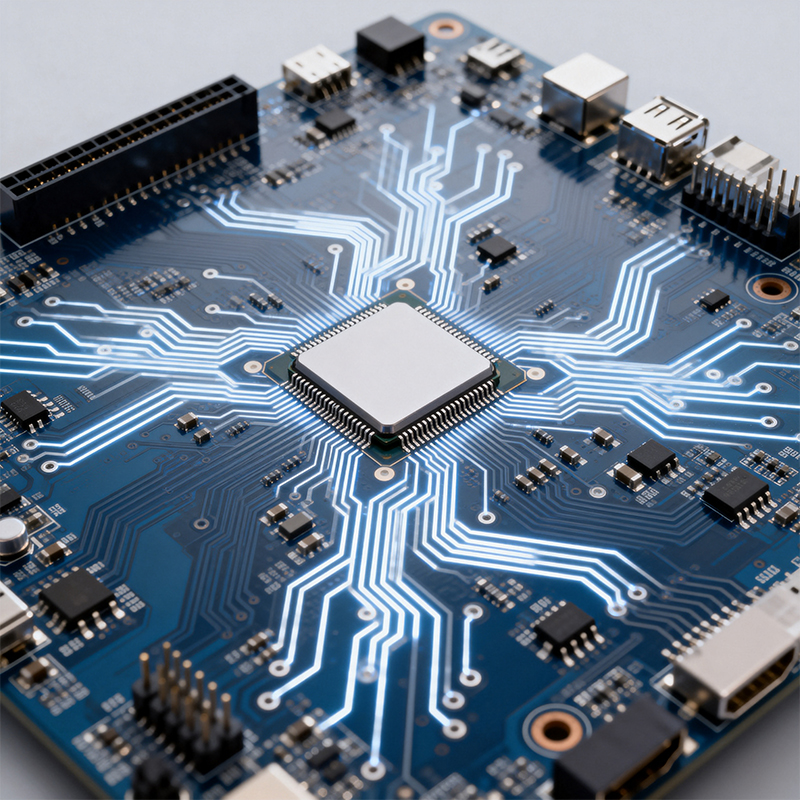
The jump to advanced often starts with what the board is made of. Moving beyond standard FR-4 is like swapping out a gravel road for a paved highway for your electrical signals.
For the Speed Demons: When signal loss is the enemy, materials like Rogers or specialized hydrocarbon ceramics become essential. They have a consistent dielectric constant, meaning your signal doesn't distort as it travels. Think of it as having a perfectly predictable road surface at 100 mph.
For the Heat Battles: If thermal management is keeping you up at night, metal-core PCBs or substrates with high thermal conductivity can act as a built-in heat sink, pulling warmth away from critical components like CPUs or power LEDs.
For the Shape-Shifters: When your device bends or folds, the board needs to as well. Polyimide-based flex materials are tough, thin, and can withstand thousands of flex cycles without failing.
This is where advanced fabrication feels like watchmaking. High-Density Interconnect technology uses lasers to create connections so small they're measured in microns.
Instead of drilling a hole through all 12 layers of your board (which eats up space on every layer), a laser can drill a "blind via" from layer 1 to layer 2, and another from layer 2 to layer 3. These tiny, stacked, or staggered micro-vias free up an incredible amount of room for routing. It's how modern smartphones pack supercomputer power into your pocket. If your component pins are 0.4mm apart or less, you're in HDI territory.
Here’s the reality check: you can design the most brilliant advanced board, but if the factory can't build it consistently, you're stuck. The fabrication of an advanced PCB is less about following instructions and more about solving puzzles.
This means your relationship with the manufacturer changes. You're not just sending Gerber files over a wall. You're in a technical dialogue. A good partner will ask "why" questions about your stack-up and propose material alternatives. They'll run simulations on their end for things like impedance and thermal dissipation before a single board is made.
At Kaboer, our engineering team in Shenzhen spends as much time in collaborative review as they do on the production floor. We've found that the most successful advanced projects start with a shared whiteboard session (virtual or real), where we can stress-test the design against the realities of laser drilling, precision plating, and multilayer lamination. Our goal is to be your reality-check before you commit to tooling.
Let's be honest: going advanced affects your timeline and budget. The materials cost more. The processes are slower and more meticulous. The first prototype run is absolutely critical—it's not just for testing function, but for validating the entire manufacturing process.
The smartest teams we work with treat the first prototype as a learning phase. They build in time and budget for one or two iterations to dial in the exact laminate, finalize the via structure, and lock down the impedance controls. This upfront investment saves monumental headaches and cost during volume production.
If your design has pushed past the limits of a standard board, the path forward is a partnership. It's about finding a fabricator who speaks your technical language, who isn't afraid to challenge a design choice for the sake of manufacturability, and who has the tools and patience to build something exceptional.

Kaboer manufacturing PCBs since 2009. Professional technology and high-precision Printed Circuit Boards involved in Medical, IOT, UAV, Aviation, Automotive, Aerospace, Industrial Control, Artificial Intelligence, Consumer Electronics etc..


 English



 Wechat
 +86 13670210335
 +86 13670210335
 E-mail