
Date: 2025-12-19
Assembling circuit boards, commonly referred to as PCB assembly (PCBA), is the transformative process where electronic components are permanently mounted onto printed circuit boards to create functional electronic devices. This intricate manufacturing discipline combines precision engineering, advanced automation, and rigorous quality control—serving as the bridge between circuit design and finished electronic products.
SMT represents the dominant approach in modern electronics manufacturing, where components are mounted directly onto the surface of PCBs.
Key SMT Process Stages:
Solder Paste Application: Precision deposition of solder paste through laser-cut stencils
Component Placement: High-speed automated machines placing components at rates exceeding 25,000 placements per hour
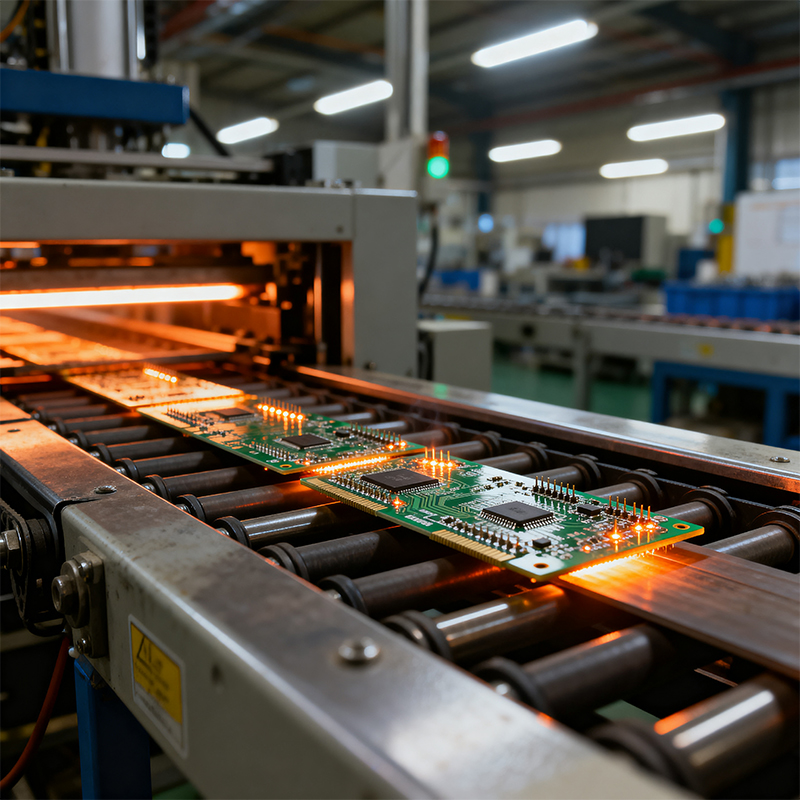
Reflow Soldering: Controlled heating to melt solder and form permanent connections
Cleaning: Removal of flux residues and contaminants
Advantages:
Enables miniaturization with smaller components and higher density
Supports automated, high-volume production
Allows for components on both sides of the PCB
Typically lower production costs at scale
The traditional method where component leads are inserted through drilled holes and soldered to pads on the opposite side.
Key THT Process Stages:
Component Insertion: Manual or automated insertion of leaded components
Wave Soldering: Board passes over a wave of molten solder
Lead Trimming: Cutting excess component leads
Applications:
Components requiring mechanical strength (connectors, transformers)
High-power or high-voltage applications
Prototypes and specialized low-volume products
Most modern boards utilize both SMT and THT approaches, requiring specialized processes:
Sequence Optimization: Determining optimal order of SMT and THT operations
Selective Soldering: Precise soldering of through-hole components on otherwise SMT boards
Process Integration: Managing thermal profiles for multiple soldering operations
Design Review: Manufacturing feasibility analysis of PCB designs
Component Verification: Ensuring all components meet specifications and are available
Stencil Fabrication: Creating solder paste application templates
Program Development: Machine programming for pick-and-place equipment
Stencil Alignment: Precise alignment with PCB solder pads
Printing Process: Controlled deposition of solder paste
Inspection: 2D/3D measurement of paste volume and alignment
Automated Pick-and-Place: High-speed robotic component placement
Vision Systems: Component verification and alignment correction
Tape-and-Reel Feeding: Continuous component supply for production efficiency
Reflow Oven Process: Controlled temperature zones melt solder to form connections
Atmosphere Control: Nitrogen environments for superior solder joint quality
Profile Optimization: Board-specific thermal profiles for different component types
Automated Optical Inspection (AOI): High-resolution camera systems checking for placement accuracy and solder defects
X-Ray Inspection: Internal examination of BGA, QFN, and hidden solder joints
In-Circuit Testing (ICT): Electrical verification of component presence, orientation, and basic functionality
Flying Probe Testing: Flexible electrical testing without custom fixtures
Conformal Coating: Protective layer application for harsh environments
Final Assembly: Installation of connectors, heatsinks, and mechanical components
Functional Testing: Comprehensive validation of complete board functionality
Packaging: Anti-static packaging for shipment
Proactive design optimization to ensure efficient, reliable, and cost-effective assembly:
Component Selection: Standardized parts with reliable supply chains
Placement Considerations: Adequate spacing for automated assembly
Thermal Management: Component placement considering heat dissipation
Test Point Accessibility: Provision for comprehensive testing
Statistical Process Control: Real-time monitoring of production quality metrics
Traceability Systems: Component-level tracking throughout production
Failure Analysis: Systematic investigation of defects to prevent recurrence
Compliance Management: Adherence to industry standards (IPC, ISO, UL)
Component Sourcing: Reliable procurement with counterfeit mitigation
Inventory Management: Balancing availability with carrying costs
Alternate Sourcing: Identifying acceptable component substitutes
Lead Time Management: Realistic production scheduling
Microvia Technology: Laser-drilled vias for ultra-fine interconnections
Sequential Lamination: Multiple lamination cycles for complex routing
Advanced Materials: High-performance substrates for signal integrity
Specialized Handling: Fixtures and processes for flexible substrates
Adhesive Selection: Appropriate bonding materials for flex circuits
Strain Relief: Design considerations for moving applications
Die Attach: Precise placement of bare semiconductor dies
Wire Bonding: Ultrasonic or thermosonic interconnection
Encapsulation: Protective covering of delicate assemblies
Component Handling: Managing ultra-small components (01005, 0201)
Placement Accuracy: Increasing precision requirements
Inspection Limitations: Visual confirmation of microscopic features
Process Sequencing: Optimal order for multiple assembly operations
Thermal Management: Protecting sensitive components during multiple soldering cycles
Rework Difficulties: Accessing components in dense mixed-technology boards
Defect Detection: Identifying increasingly subtle assembly flaws
Process Consistency: Maintaining quality across high-volume production
False Failures: Differentiating true defects from inspection system anomalies
Equipment Obsolescence: Keeping pace with advancing component packaging
Skill Development: Training technicians on new technologies
Process Validation: Establishing reliability for novel assembly approaches
Panelization: Efficient PCB array layouts to maximize material usage
Standardization: Minimizing unique components and processes
Test Strategy: Balancing test coverage with implementation cost
Line Balancing: Optimizing workflow through assembly stations
Changeover Reduction: Minimizing setup time between production runs
Yield Improvement: Reducing scrap and rework through process control
Prototype vs. Production: Different cost structures for various quantities
Tooling Investments: Amortizing capital costs across production volumes
Supply Chain Leverage: Component pricing advantages at scale
Successfully assembling circuit boards requires more than just equipment—it demands integrated expertise across design, procurement, manufacturing, and quality assurance. At Kaboer, we've built our reputation on delivering precisely this comprehensive capability from our advanced manufacturing facility in Shenzhen, China.
State-of-the-Art Manufacturing Infrastructure
Automated SMT lines capable of handling components down to 01005 size
Advanced inspection systems including 3D AOI and high-resolution X-ray
Climate-controlled production environment ensuring process consistency
Complete through-hole capabilities including selective soldering
Engineering-Led Process Optimization
Proactive DFM analysis that identifies potential issues before production
Customized process development for challenging assemblies
Thermal profile optimization for complex mixed-technology boards
Continuous process improvement based on production analytics
Integrated Quality Management
IPC-certified production staff and inspection standards
Full traceability from component receipt to finished assembly
Statistical process control with real-time monitoring
Comprehensive testing options tailored to product requirements
Supply Chain Reliability
Established relationships with component manufacturers and distributors
Rigorous component verification and counterfeit detection
Safety stock management for critical components
Alternate sourcing strategies to mitigate supply disruptions
Flexible Service Models
Prototype assembly with rapid turnaround for design validation
Low-to-medium volume production with quick launch capabilities
High-volume manufacturing with consistent quality at scale
Complete box-build assembly including final product integration
Whether you're developing a novel IoT device, medical instrument, industrial controller, or consumer electronic, assembling circuit boards with precision and reliability is where your concept becomes reality. Kaboer's expertise ensures this transition happens efficiently, economically, and with quality that stands up to real-world use.
Smart Factories: Connected equipment with real-time data exchange
Predictive Maintenance: Anticipating equipment needs before failures occur
Adaptive Processes: Self-adjusting parameters based on real-time conditions
Lead-Free Processes: Continuing evolution of environmentally-friendly solders
Material Efficiency: Reduced waste through process optimization
Energy Conservation: Lower power consumption in assembly operations
Embedded Components: Components within the PCB substrate itself
Additive Electronics: 3D printing of circuits and components
Heterogeneous Integration: Combining disparate technologies in single packages
Assembling circuit boards represents the critical convergence point where electronic designs are translated into physical products. The quality, reliability, and cost-effectiveness of this process directly determine market success in today's competitive electronics industry.
By understanding the full spectrum of assembly technologies, challenges, and best practices—and by partnering with experienced manufacturing specialists like Kaboer—electronics companies can transform innovative concepts into reliable, manufacturable, and successful products. In an industry where technological advancement never pauses, excellence in circuit board assembly remains a fundamental competitive advantage.

Kaboer manufacturing PCBs since 2009. Professional technology and high-precision Printed Circuit Boards involved in Medical, IOT, UAV, Aviation, Automotive, Aerospace, Industrial Control, Artificial Intelligence, Consumer Electronics etc..


 English



 Wechat
 +86 13670210335
 +86 13670210335
 E-mail