
Date: 2026-06-11
You're designing an electronic product. It's getting smaller, faster, and more feature‑packed. Your PCB traces are packed like rush‑hour traffic. Regular through‑holes (drilled from top to bottom) take up too much space and block routing channels on other layers. You need a smarter way to drill holes – you need blind vias.
In this guide, I'll explain what blind vias are, how they differ from regular vias, where they're used, and what design mistakes to avoid. No engineering degree required – just plain talk from a custom PCB manufacturer that does HDI and rigid‑flex every day.
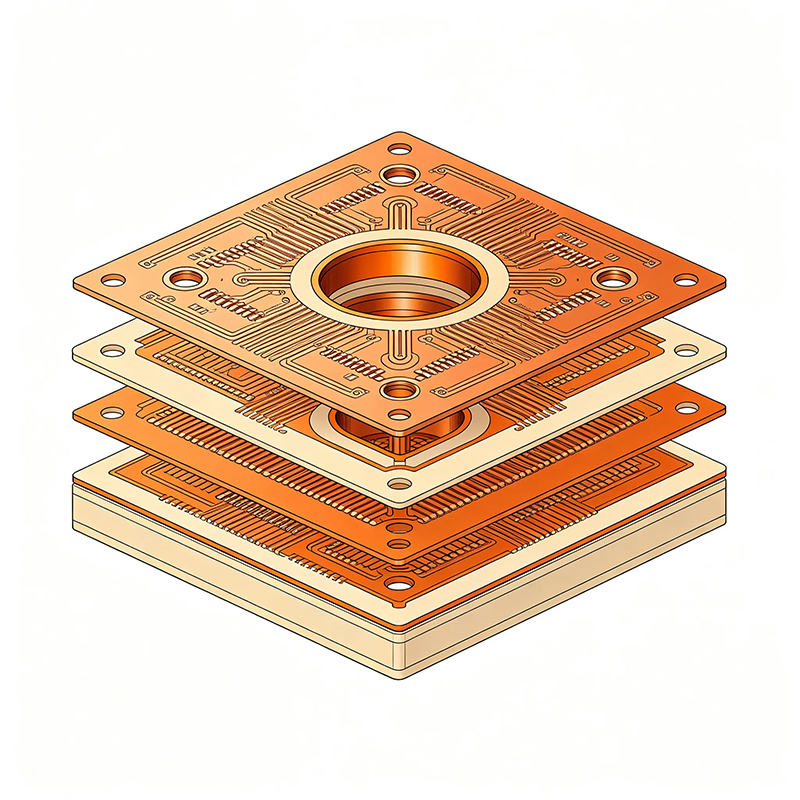
A blind via is a hole that doesn't go all the way through the board. It starts on an outer layer and stops at an inner layer – like a well that isn't dug to the bottom.
Compare the three via types:
Through via – goes from top to bottom, through every layer. Like an elevator shaft from the 1st floor to the basement.
Blind via – goes from top layer to an inner layer (e.g., layer 2 or 3) and stops. Like an elevator that only runs between the 1st and 2nd floors.
Buried via – connects two inner layers, completely invisible from the outside. Like a stairwell inside the building that you can't see from the street.
The big advantage of blind vias: they only occupy the layers they need. They don't block routing channels on other layers, allowing much higher wiring density.
Through holes are cheap and simple, but they have two major problems:
They waste space – A through hole passes through every layer. If you need to route a trace on layer 3 exactly where that hole is, you have to go around it. On dense boards (like smartphone motherboards), this wastes valuable real estate.
They limit layer stacking – Through holes must connect top to bottom. If you only need to connect top to layer 2, a through hole still punches through layers 3, 4, etc., creating unnecessary interference.
Blind vias and buried vias solve both problems. They allow you to drill layer‑by‑layer, connecting only what needs to be connected. This is the core of HDI (High Density Interconnect) technology.
In HDI boards, blind vias are classified by "order" – which refers to how many laser drilling steps are used to reach the target inner layer.
| Type | Structure | Typical Use |
|---|---|---|
| 1‑order blind via | From outer layer to layer 2 | Standard HDI – phone sub‑boards, consumer electronics |
| 2‑order blind via | From outer to layer 3 (drill to layer 2, then stack drill to layer 3) | High‑density HDI – flagship phone motherboards |
| 3‑order and above | From outer to deeper inner layers | Ultra‑high density – AI chip substrates, high‑end GPUs |
| Any‑layer HDI | Every layer can connect directly to its neighbors | Extreme density – ultra‑thin smartphones |
You don't need to memorize all these. Just know: higher order = harder to manufacture = more expensive. If a 1‑order design works, don't force a 2‑order.
1. Laser drilling (most common)
Over 90% of blind vias are drilled with CO₂ or UV lasers. Lasers can precisely control depth, burning through only the target layers. Hole diameters can be as small as 0.075mm. Fast and accurate.
2. Controlled‑depth mechanical drilling (older method)
A CNC drill bit stops at a specified depth. But mechanical bits have a taper, leave a rough bottom, and can't go very small (typically ≥0.2mm). Only used for special materials or very large holes.
For the vast majority of HDI boards, laser‑drilled blind vias are the standard.
Smartphone motherboards – From budget phones to flagships, almost every signal relies on blind and buried vias.
Smartwatches / fitness bands – Extremely tight internal space demands HDI with blind vias.
Drone flight controllers – Need to pack gyroscopes, barometers, and video transmitters on tiny boards.
Medical endoscopes – The probe is only a few millimeters wide; the PCB inside must be multi‑layer HDI.
Automotive camera modules – High‑resolution image sensors require dense signal fan‑out – blind vias are standard.
Rigid‑flex boards – Blind vias can be used in the transition areas to connect different layers without compromising bendability.
Mistake 1 – Stacking a blind via on top of a through via
They will interfere. Keep them separated.
Mistake 2 – Forgetting the capture pad
Each blind via needs a copper ring (capture pad) on the target layer that is slightly larger than the hole. If the pad is too small, the laser might miss.
Mistake 3 – Mixing different orders on the same layer pair
For example, using both 1‑order and 2‑order blind vias ending on the same inner layer. This greatly increases manufacturing complexity. Keep the same order per region.
Mistake 4 – Placing blind vias in bend areas (for rigid‑flex)
If your board has a flexible section, keep blind vias out of the bend area. Otherwise, the copper in the via wall will crack after a few bends.
Mistake 5 – Over‑specifying
More blind vias and higher orders cost more. Don't design for the sake of "advanced technology" – design for what you actually need.
We are a custom flexible circuit board, rigid‑flex, HDI high‑frequency, and PCBA manufacturer. Blind vias are a routine part of our work.
HDI capability – 1‑order, 2‑order, 3‑order, and any‑layer HDI. Minimum laser blind via 0.075mm, minimum mechanical via 0.15mm.
Rigid‑flex expertise – We know how to design blind vias in the transition zones without breaking. We also know how to keep them away from bend areas.
High‑frequency materials – Rogers, PTFE, LCP – we laser‑drill blind vias on all of them, with clean hole walls.
Turnkey PCBA – We not only make the board, but also assemble it. Our high‑precision placement machines and 3D SPI ensure perfect solder paste on blind via pads.
Industries we serve: consumer electronics (phones, watches, TWS earbuds), automotive (cameras, radar), medical (endoscopes, sensors), industrial (robotics, encoders).
Step 1 – Send your design files
Provide: Gerber files (with blind/buried via definitions), stackup, drill file (clearly marking which holes are blind, buried, or through). Not sure how to define them? Just send us your raw design – we'll help you sort it out.
Step 2 – We review and quote
Within 24 hours, you'll receive: a DFM report (potential issues like stacked vias or missing capture pads), sample pricing and lead time, and volume pricing.
Step 3 – Sample, test, then production
We'll make 10‑20 samples. You test functionality and reliability. Once approved, we move to small batch and then mass production.
Many engineers start with through holes and only consider blind vias when they've painted themselves into a corner. By then, the layout is done and changes are painful.
If your product has high density, small size, or many layers, consider blind vias as a normal design tool from the beginning – not an emergency last resort. Planning your via layers early will save you weeks of rework.
Have an HDI or rigid‑flex project that needs blind vias? Send us your design files – even if it's just a rough draft. We'll take a look and give you honest feedback.
When you contact us, please include:
Layer count and board dimensions
Blind via order (if known) and approximate locations
Any rigid‑flex or high‑frequency material requirements
We'll tell you what's possible, what's not, and how to fix it. Let's turn your density‑crammed board into reality.

Kaboer manufacturing PCBs since 2009. Professional technology and high-precision Printed Circuit Boards involved in Medical, IOT, UAV, Aviation, Automotive, Aerospace, Industrial Control, Artificial Intelligence, Consumer Electronics etc..


 English



 Wechat
 +86 13670210335
 +86 13670210335
 E-mail