
Date: 2026-03-17
You've got a circuit board that works perfectly. It's been designed, fabricated, and assembled. All the components are in place, and it passes every test you throw at it. But here's the thing: a bare board isn't a product. It's just a board.
Turning that board into something a customer can actually use—something with an enclosure, cables, connectors, maybe a display or some buttons—that's where box build assembly services come in.
If you're not familiar with the term, don't worry. It's one of those industry phrases that sounds more complicated than it actually is. Let's break it down in plain language.
Box build assembly (sometimes called systems integration) is the process of taking electronic components—most importantly, your PCBA—and assembling them into a complete, functioning product inside an enclosure . The "box" can be anything from a simple plastic case to a complex sheet-metal cabinet .
Think of it this way: if your PCBA is the heart of the product, box build is everything else that makes it a living, breathing device. The enclosure protects it. The cables connect it. The power supply feeds it. The buttons and displays let users interact with it .
A full-service box build can include:
Mounting the PCBA inside the enclosure
Installing connectors, switches, and displays
Routing and securing cables and wire harnesses
Loading firmware or software
Final system testing
Labeling, packaging, and shipping
The goal is simple: when you receive the finished assembly, you can unbox it and put it to work immediately .
If you're manufacturing electronic products, you've probably faced this decision: do you handle the final assembly yourself, or do you let someone else do it?
There are a few good reasons to consider professional box build assembly services.
Designing and testing the core electronics is hard enough. Once the board works, do you really want to spend time sourcing enclosures, figuring out cable routing, and training people on final assembly? Probably not. A good box build partner takes that burden off your plate .
Without box build, you might deal with one supplier for boards, another for cables, another for enclosures, and yet another for final assembly. That's a lot of coordination. With a turnkey box build service, one partner manages everything . Fewer vendors means fewer headaches.
When the same company that builds your boards also does the final assembly, they understand how everything fits together. They can catch issues—like a connector placed too close to the edge of the enclosure—before they become problems . And because they do system-level testing, you know the whole product works, not just the board .
Handing off final assembly to a专业 partner frees up your team to focus on the next project. And because they have established processes for sourcing, assembly, and testing, things move faster than if you tried to do it all yourself .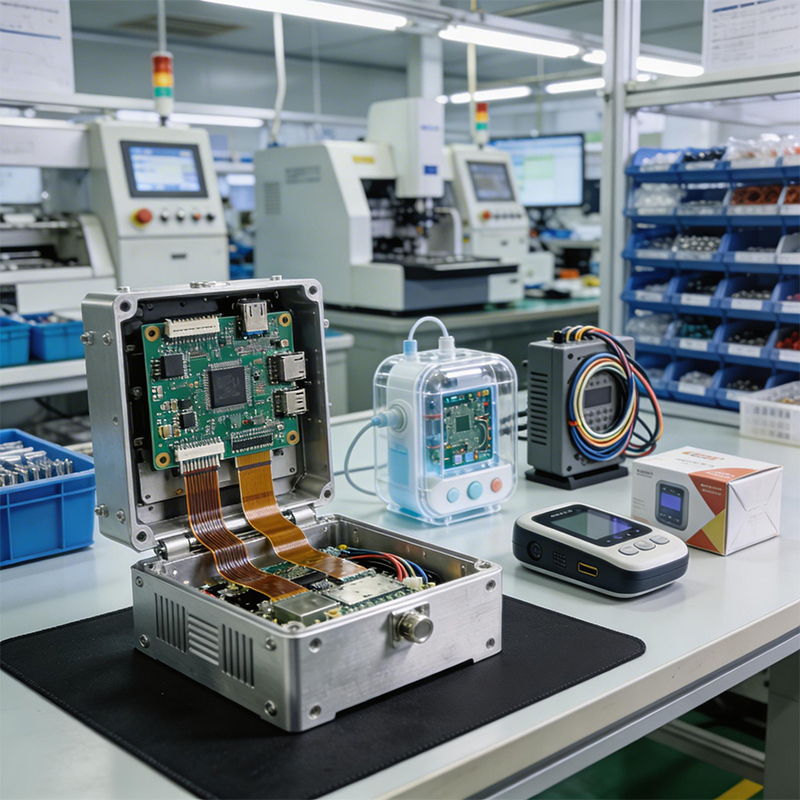
Every manufacturer has their own way of doing things, but most box build processes follow a similar pattern.
Before any assembly starts, engineers review your design. They look at the enclosure, the PCBA, the cabling, and all the mechanical bits to make sure everything fits and works together . This is the time to catch problems—like a mounting hole that doesn't line up—before they cost money.
They'll also work with you to create the documentation needed for assembly: mechanical drawings, BOMs with all the extra parts (screws, standoffs, cables), and test procedures .
Once the design is locked, the manufacturer sources everything needed for the build. That includes:
The enclosure (custom or off-the-shelf)
Cables and wire harnesses
Connectors and switches
Fasteners and mounting hardware
Labels and packaging materials
If any parts need customization—like machining holes in an enclosure or pre-flashing firmware on a chip—that happens now .
This is where it all comes together. Technicians mount the PCBA into the enclosure, install the connectors and displays, route the cables, and secure everything in place . Some manufacturers use dedicated work cells for specific products to keep things consistent .
If the product requires software or firmware, that gets loaded during this stage as well .
A box build isn't complete until it's been tested. Depending on the product, this can include:
Functional testing to verify the whole system works
Burn-in testing to catch early failures
Safety testing (hipot, insulation resistance)
Environmental testing if needed
The goal is to make sure that when the product lands on your customer's desk, it works exactly as intended.
Finally, the finished products get labeled with serial numbers, compliance marks, or your branding. They're packaged according to your requirements and shipped to wherever they need to go—whether that's your warehouse, a distributor, or directly to customers .
A typical box build assembly involves a lot more than just the PCBA and an enclosure. Here are some of the common components :
Enclosures – Plastic, metal, or even custom sheet-metal boxes that house everything
Cables and wire harnesses – For power, data, and connections between boards
Connectors – USB, D-shell, terminal blocks, and more
Displays and HMI elements – Screens, buttons, switches, LEDs
Power supplies – Both internal and external
Cooling components – Fans, heat sinks, thermal interface material
Mounting hardware – Screws, standoffs, brackets
Batteries – For portable or backup power
Some builds also include firmware or software loading, especially if the device needs to be programmed before it leaves the factory .
This is a common point of confusion, so let's clear it up.
PCBA (Printed Circuit Board Assembly) is just the board with components soldered on. It's the brains of the operation, but it's not a finished product .
Box build takes that PCBA and turns it into a finished product by adding the enclosure, cables, connectors, and everything else needed to make it usable .
Think of it this way: PCBA is the engine; box build is the whole car.
If you're considering box build assembly services for your next project, here are a few things to keep in mind:
Experience matters. Box build involves more than just following a checklist. It requires understanding how mechanical and electronic parts interact. Look for a partner with a track record .
They should ask questions. A good manufacturer will review your design and flag potential issues before they become expensive problems .
Testing capability is non-negotiable. Make sure they can do the level of testing your product requires—whether that's simple functional test or full environmental qualification .
Documentation is key. You need clear records of what was built, what parts were used, and how it was tested .
Flexibility helps. Not all products need the same thing. A partner who can handle both simple builds and complex integrations is worth their weight in gold .
At Kaboer, we've been building electronic products since 2009. Based in Shenzhen, we offer a full range of PCBA services—flexible circuits, rigid-flex boards, HDI high-frequency boards, and more. But we don't stop at the board.
Our box build assembly services take your project from populated board to finished product. We handle enclosures (custom or off-the-shelf), cable assemblies, hardware integration, and final testing. We can even load firmware and manage packaging and logistics.
The advantage? One partner, one quality standard, one point of accountability. Your boards and your final assembly come from the same team, so there's no finger-pointing when something needs attention.
We welcome customers to visit our Shenzhen factory and see our box build lines in action. Walk the floor, meet the engineers, ask whatever you want. We're an open book.
If you're tired of juggling multiple vendors for enclosures, cables, and assembly, box build services might be exactly what you need.
Send us your requirements or Gerber files. We'll review your design, give you honest feedback, and get back to you with a quote. We've been at this since 2009, and we believe the best partnerships start with straightforward conversations.
And if you're ever in Shenzhen, we'd be happy to show you around.

Kaboer manufacturing PCBs since 2009. Professional technology and high-precision Printed Circuit Boards involved in Medical, IOT, UAV, Aviation, Automotive, Aerospace, Industrial Control, Artificial Intelligence, Consumer Electronics etc..


 English



 Wechat
 +86 13670210335
 +86 13670210335
 E-mail