
Date: 2026-03-17
If you've ever opened up an electronic gadget and stared at that green board covered in tiny parts, you've looked at a circuit board device. It's one of those terms people throw around without really defining. But if you're sourcing components or building products, it helps to know what you're actually looking at.
A circuit board device isn't one single thing. It's the whole package—the board itself, plus every little component soldered onto it, working together to make your product do whatever it's supposed to do. The microcontroller that runs the show, the resistors that keep currents in check, the connectors that let stuff plug in—all of it.
Let's break down what actually makes up a circuit board device, what each piece does, and why it matters when you're picking a manufacturing partner.
Every circuit board device is built from a handful of basic building blocks . Once you know what they are, you can look at almost any board and start to understand what's going on.
Resistors are probably the most common thing you'll see. They're those little components with color bands or tiny printed numbers . Their job is simple: limit how much current flows through a part of the circuit. They protect sensitive components, divide voltages, and generally keep things from blowing up. When you're picking resistors, you look at the resistance value (in ohms), how accurate it is (tolerance), and how much heat it can handle (power rating).
Capacitors store and release electrical energy . They smooth out power supplies, filter out noise, and help signals stay clean. You'll see two main types everywhere: little ceramic ones (usually beige or gray) for high-frequency stuff, and bigger electrolytic ones (can-shaped, often with a stripe) for bulk energy storage in power sections. The key specs are capacitance (in farads) and voltage rating.
Inductors store energy in magnetic fields . They resist sudden changes in current, which makes them useful in power supplies and radio frequency circuits. They often look like little coils or wound wire. You'll find them working alongside capacitors to filter signals.
A diode lets current flow in only one direction . That's it. But that simple property makes them incredibly useful—for converting AC to DC, protecting circuits from reverse voltage, and emitting light (in the case of LEDs). Standard diodes are often small with a stripe at one end; LEDs are the ones that light up.
Transistors are the workhorses of modern electronics . A small signal at one pin can control a much larger current flowing between the other two. That's what makes amplification possible, and it's also how processors create logic gates and memory. You'll find them in little SOT packages or built into larger chips.
ICs are complete circuits—sometimes incredibly complex ones—packaged into a single component . Microcontrollers, memory chips, power management chips, sensors… all of these are ICs. They're the black rectangles with lots of pins. The number on top tells you what it is, and you look up the datasheet to figure out how to use it.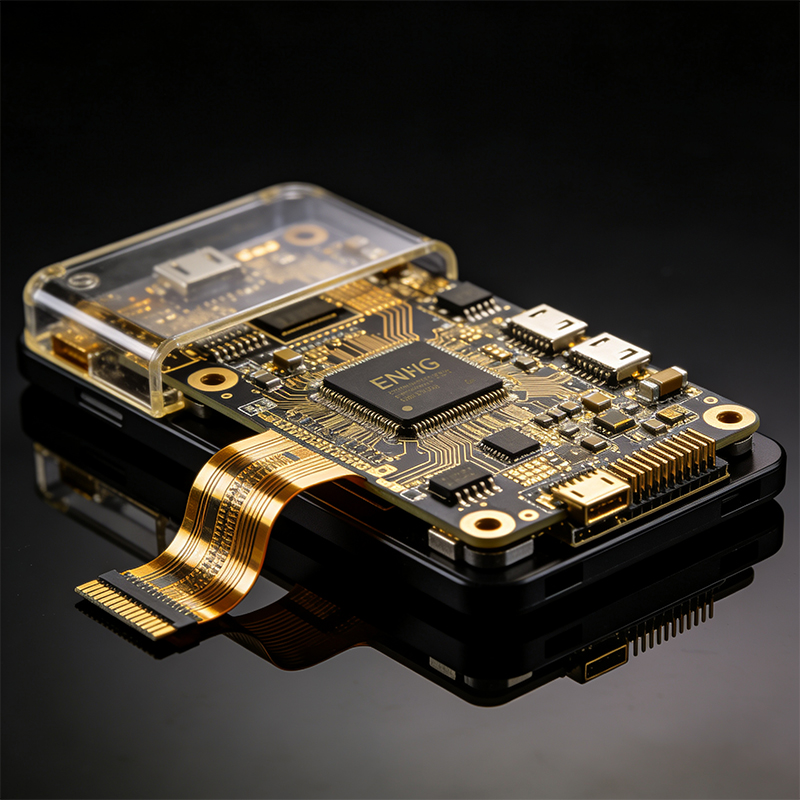
Here's something people don't always think about: a circuit board device is more than the sum of its components. The way those components are placed, the way the traces are routed between them, the type of board they're mounted on—all of that affects how well the final product works.
Put a decoupling capacitor too far from an IC's power pin, and the chip might glitch. Run high-speed traces too close to a noisy power supply, and you'll get interference that's a nightmare to debug. Pick the wrong type of capacitor for a high-frequency circuit, and it might not even work at the right value.
That's why "device" is the right word. It's a complete functional unit.
Honestly, they're everywhere. Anything with electronics inside has one .
Consumer stuff – Phones, laptops, TVs, game consoles, smart home gadgets. These usually use rigid boards, often with multiple layers to pack everything in tight.
Wearables and medical devices – Fitness trackers, smartwatches, hearing aids. These need flexible circuits that can bend and fit into small, curved spaces.
Automotive and industrial – Engine control units, factory automation, robotics. These often need boards that can handle heat, vibration, and harsh environments. You might see metal-core boards here to help with cooling.
High-frequency gear – 5G equipment, radar systems, high-speed data centers. These use special low-loss materials and HDI (High-Density Interconnect) boards to keep signals clean at gigahertz speeds .
If you're the one buying these things, here's what actually matters:
Quality of the components. Not all parts are created equal. Counterfeit ICs are a real problem. Work with suppliers who source from authorized channels.
Design for manufacturing. A board that works on a prototype bench might be a nightmare to build in volume. Good partners do a DFM check and flag issues before they cost you money.
Testing. You want boards that have been tested—not just visually inspected, but electrically tested to make sure they work. Functional testing of the whole assembly is even better.
The right board type for the job. Standard rigid FR-4 works for most things. But if your product needs to bend, you need flexible circuits. If it runs hot, you might need metal-core or ceramic boards. If it handles high-speed data, you probably need HDI .
At Kaboer, we've been building circuit board devices since 2009. We're in Shenzhen, with our own factory, and we handle the whole range—from simple rigid boards to complex flexible circuits, rigid-flex boards, HDI high-frequency boards, and metal-core boards for tough applications .
Our engineers don't just take orders. They look at your design, check the component choices, and flag potential issues before they become expensive problems. We offer fast prototyping so you can validate your design quickly . And because we have our own PCBA lines, we can take you from bare boards to fully assembled, tested devices—all under one roof.
We hold ISO 9001, IATF 16949, and ISO 14001 certifications, so you know our processes are documented and repeatable . And if you're ever in Shenzhen, you're welcome to visit our factory and see how we work.
If you're looking for someone who actually understands the engineering behind the boards—not just someone who moves parts through a line—let's talk.
Send us your requirements or Gerber files. We'll review your design, give you honest feedback, and get back to you with a quote. We've been at this since 2009, and we believe the best partnerships start with straightforward conversations.
And if you're ever in Shenzhen, we'd be happy to show you around.

Kaboer manufacturing PCBs since 2009. Professional technology and high-precision Printed Circuit Boards involved in Medical, IOT, UAV, Aviation, Automotive, Aerospace, Industrial Control, Artificial Intelligence, Consumer Electronics etc..


 English



 Wechat
 +86 13670210335
 +86 13670210335
 E-mail