
Date: 2026-02-27
Ever wondered what a circuit board is made of before all those copper traces get etched onto it? The answer is a specially engineered material called Copper Clad Laminate—or CCL for short.
Think of CCL as the "raw dough" before it's baked into a finished PCB. It's a sandwich-like composite material that forms the foundation for every printed circuit board in existence . Without it, there would be no smartphones, no computers, no electronics at all.
This guide breaks down everything you need to know about copper clad laminates—what they are, how they're made, the different types available, and why choosing the right one matters for your electronic products.
In simple terms, Copper Clad Laminate is the base material used to manufacture PCBs . It's a composite structure made by laminating copper foil onto both sides (or one side) of an insulating substrate material under high heat and pressure .
Picture a sandwich:
The bread on the outside is copper foil—this will eventually become the circuit traces
The filling in the middle is the insulating core—made from materials like glass fiber fabric impregnated with resin
When this "sandwich" is compressed under high temperature (around 180°C) and high pressure (hundreds of psi), the resin cures and bonds everything together into a solid, flat panel . That panel is then cut into standard sizes and shipped to PCB manufacturers, who etch away unwanted copper to create the circuit patterns you recognize.
In the PCB industry, when you hear terms like "FR4 board" or "substrate," people are usually talking about different types of copper clad laminates .
Every copper clad laminate is made from three essential components, each playing a critical role.
This gives the laminate its mechanical strength and dimensional stability. Think of it as the "skeleton" inside the board. The most common reinforcing materials are :
Glass fiber fabric (woven glass cloth) : Used in FR-4 and other high-performance laminates. It provides excellent strength and stability.
Paper (cellulose paper) : Used in lower-cost laminates like FR-2, often found in simple consumer electronics .
Other materials: For special applications, manufacturers use materials like Kapton® polyimide film for flexible circuits .
The resin holds everything together, provides electrical insulation, and determines many of the laminate's key properties . Different resin types include :
Epoxy: The workhorse of the industry—used in standard FR-4.
Phenolic: Used in older, lower-cost paper-based boards (FR-2).
PTFE (Teflon): Used for high-frequency applications because of its excellent electrical properties .
Polyimide: Used for high-temperature and flexible applications .
Advanced resins: For high-speed digital and RF applications, manufacturers use specialized resins like cyanate ester, PPO, or others to achieve low dielectric loss .
This is what will become the circuits. Copper foil comes in various thicknesses, measured in ounces per square foot (oz) :
1/3 oz (about 12 μm) : Ultra-thin, used for fine-pitch, high-density circuits
1/2 oz (about 18 μm)
1 oz (about 35 μm) : The most common thickness for standard boards
2 oz (about 70 μm) : Used for higher current-carrying applications
3 oz and thicker: For power electronics and heavy copper boards
The copper can be on one side (single-sided CCL) or both sides (double-sided CCL) . For multi-layer boards, multiple cores and prepregs are stacked together .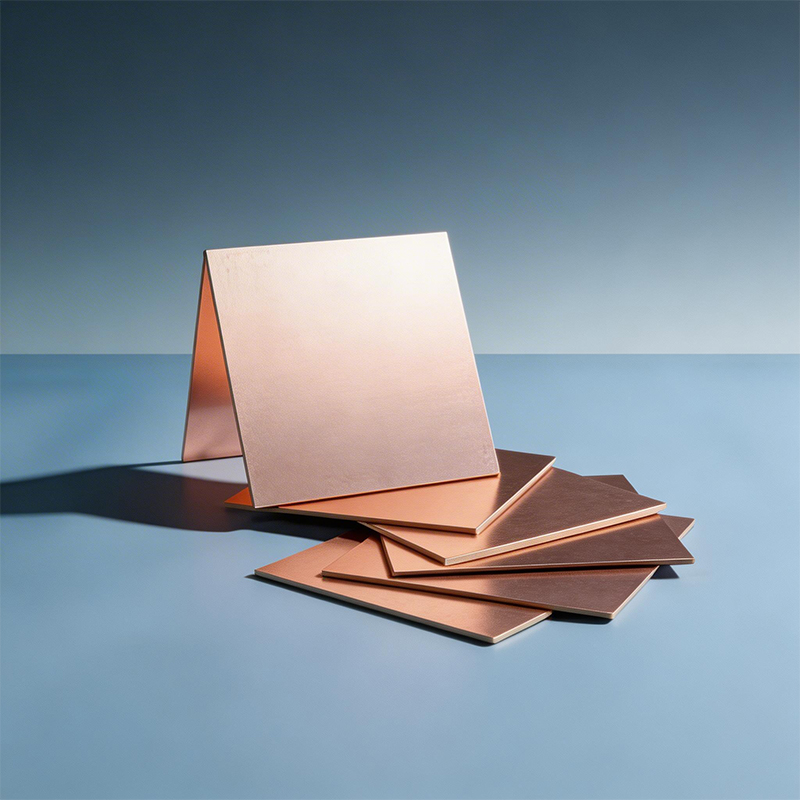
If you've ever looked at PCB specifications, you've seen terms like FR-4, CEM-1, and FR-2. These are all different grades of copper clad laminate .
FR-4 is by far the most common copper clad laminate in use today. It's made from woven glass fiber cloth impregnated with epoxy resin . The "FR" stands for Flame Retardant, and the "4" denotes the type of woven glass-reinforced epoxy laminate.
Characteristics:
Good mechanical strength
Excellent electrical insulation
Flame retardant (UL94 V-0 rated)
Reasonable cost
Works for most general-purpose applications
If you don't specify a material for your PCB, you're getting FR-4. It's the default choice for everything from consumer electronics to industrial controls.
FR-2 is made from paper impregnated with phenolic resin . It's cheaper than FR-4 but has poorer mechanical and electrical properties.
Used in: Low-cost consumer products like toys, calculators, and some simple electronics where high performance isn't critical.
These are composite materials that bridge the gap between paper-based and glass-based laminates :
CEM-1: Has a paper core with woven glass surfaces. Better mechanical properties than FR-2 but lower cost than FR-4.
CEM-3: Looks and performs like FR-4 but uses a different reinforcement structure. Often used as a lower-cost alternative to FR-4.
For demanding applications, standard FR-4 won't cut it. Specialty laminates offer superior performance :
High-Frequency Laminates (Rogers, PTFE) : Used for RF, microwave, and high-speed digital applications where signal loss must be minimized .
Polyimide (Kapton®) : Used for flexible circuits and high-temperature environments .
Metal-Core Laminates: Used for applications requiring excellent heat dissipation, like LED lighting and power electronics.
For flexible circuits, the base material isn't rigid FR-4 but a thin, flexible polyimide film . These are called FCCL (Flexible Copper Clad Laminates) .
When selecting a copper clad laminate for your application, several key properties matter :
Dielectric Constant (Dk) : This determines how fast signals travel through the board. Lower Dk generally means faster signal propagation. FR-4 has a Dk around 4.3-4.8; high-frequency materials can go below 3.0 .
Dissipation Factor (Df) : This measures signal loss in the material. Lower Df means less energy is lost as heat. Standard FR-4 has Df around 0.02; high-performance materials go much lower .
Dielectric Strength: The material's ability to withstand high voltage without breaking down.
Glass Transition Temperature (Tg) : The temperature at which the material begins to soften and change properties. For standard FR-4, Tg is around 130-140°C. High-Tg materials go to 170°C or higher .
Decomposition Temperature (Td) : The temperature at which the material starts to chemically decompose.
Thermal Conductivity: How well the material conducts heat away from hot components.
Peel Strength: How strongly the copper foil bonds to the substrate. You don't want pads lifting off during soldering .
Dimensional Stability: How much the material expands or contracts during processing and temperature changes.
Flexural Strength: Resistance to bending and breaking.
Moisture Absorption: How much water the material absorbs. High absorption can degrade electrical performance and cause problems during soldering .
Flammability Rating: Most modern laminates are rated UL94 V-0, meaning they self-extinguish .
The manufacturing process for CCL is fascinating and requires precise control :
The resin system is prepared by mixing epoxy or other resins with solvents, hardeners, and sometimes fillers to achieve the desired properties . For high-performance laminates, this formulation is a closely guarded secret.
The reinforcing material—glass cloth, paper, or polyimide film—is run through a bath of liquid resin . It soaks up the resin like a sponge. Then it passes through heated towers that evaporate the solvents and partially cure the resin, creating a semi-rigid sheet called prepreg .
Multiple layers of prepreg are stacked to achieve the desired thickness. For double-sided CCL, copper foil is placed on the top and bottom of the stack . This assembly is placed between heavy steel plates with mirror-smooth surfaces.
The entire stack goes into a hydraulic press under high heat (around 180°C) and high pressure (hundreds of psi) . The heat melts the resin, which flows and bonds everything together. The pressure ensures uniform thickness and squeezes out any air bubbles. After several hours, the resin cures completely, forming a solid panel.
The panels are cooled slowly to prevent warping. Then they're trimmed to standard sizes, inspected for defects, and packaged for shipment to PCB manufacturers .
In multi-layer PCB manufacturing, you'll hear two related terms :
CCL (Core) : Fully cured laminate with copper on one or both sides. Used as the starting material for inner layers.
Prepreg: Partially cured resin-impregnated glass cloth. It's like "B-stage" material—stiff but still tacky. During lamination, it melts and bonds the cores together, then cures into a solid insulator.
Think of it this way: CCL is the "pre-made" boards with copper already attached. Prepreg is the "glue" that bonds multiple CCLs together in a multi-layer stack.
Selecting the right copper clad laminate for your project depends on several factors:
| Application | Recommended Material | Key Considerations |
|---|---|---|
| General consumer electronics | FR-4 | Cost-effective, good all-around performance |
| High-temperature environments | High-Tg FR-4 or Polyimide | Must survive repeated thermal stress |
| High-frequency/RF (5G, radar) | PTFE, Rogers, or low-loss materials | Low Dk and Df are critical |
| Flexible circuits | Polyimide FCCL | Must bend without cracking |
| High-power/LED | Metal-core (aluminum) | Needs to dissipate heat efficiently |
| Cost-sensitive, simple products | FR-2 or CEM-1 | Lower performance but cheaper |
| Automotive under-hood | High-Tg FR-4 or Polyimide | Wide temperature range, vibration |
As electronics demand higher speeds and smaller form factors, CCL technology continues to evolve :
Ultra-low loss materials for 112Gbps and beyond
Very thin copper foils (down to 1-3 μm) for fine-pitch HDI designs
Smooth copper foils that reduce conductor losses at high frequencies
Halogen-free, environmentally friendly materials meeting global regulations
Materials with matched CTE for better reliability in large packages
The roadmap for laminates is pushing toward better electrical performance, tighter dimensional stability, and compatibility with advanced manufacturing processes like mSAP (modified semi-additive processing) .
Copper clad laminates may not be glamorous, but they're the unsung foundation of every electronic device. From the simple FR-4 board in a calculator to the high-frequency Rogers material in a 5G base station, CCL technology makes modern electronics possible.
For electronic device manufacturers, understanding CCL means understanding the starting point of your product's quality and performance. The right material choice can make the difference between a product that works reliably for years and one that fails in the field.
Whether you're designing consumer gadgets, industrial controls, automotive electronics, or cutting-edge communications equipment, the journey always begins with the same humble foundation: a sheet of copper clad laminate.

Kaboer manufacturing PCBs since 2009. Professional technology and high-precision Printed Circuit Boards involved in Medical, IOT, UAV, Aviation, Automotive, Aerospace, Industrial Control, Artificial Intelligence, Consumer Electronics etc..


 English



 Wechat
 +86 13670210335
 +86 13670210335
 E-mail