
Date: 2026-03-26
If you've ever tried to mount a circuit board and found that the screw heads stick out too far, or that the board doesn't sit flat against its mounting surface, you've run into a problem that a counter bore solves.
Here's the thing: a standard through-hole is great for letting a screw pass through. But the head of that screw has to go somewhere. If it sticks up above the board, it can interfere with other components, prevent stacking, or just make your assembly look sloppy.
A counter bore creates a flat-bottomed recess that lets the screw head sit flush with or below the board surface. It's a small detail, but in tight enclosures and stacked board assemblies, it makes all the difference.
Let's talk about what a counter bore actually is, when you need it, and what to watch for when designing it into your PCBs.
A counter bore is a cylindrical flat-bottomed hole that is drilled to a larger diameter than the main hole, creating a recess for the head of a screw or bolt.
Think of it like this: the main hole is drilled all the way through the board for the screw shaft. Then, from the top (or bottom) side, a second, wider hole is drilled partway down. This second hole is the counter bore. It has straight walls and a flat bottom, designed to accommodate the screw head so it doesn't protrude above the board surface.
The result is a flush or recessed screw head, which means:
Boards can stack closely together
Nothing catches on protruding screw heads
The assembly looks clean and professional
The screw head doesn't interfere with nearby components
This is a common point of confusion. Both are ways to recess a screw head, but they're different.
| Feature | Counter Bore | Countersink |
|---|---|---|
| Shape | Cylindrical, flat bottom | Conical, angled |
| Screw type | Socket head, pan head, button head | Flat head, countersunk head |
| Angle | 0° (straight walls) | 82° or 90° (tapered) |
| Head position | Below surface | Flush with surface |
Use a counter bore when you need the screw head to sit below the surface, especially for socket head or hex head screws. Use a countersink when you need a smooth, flush surface for flat head screws.
For PCBs, counter bores are more common because many mounting screws have cylindrical heads that need a cylindrical recess.
You might think: why not just use a smaller screw? Or a different head type? Sometimes that works. But when it doesn't, a counter bore is the answer.
Stacked boards. If you have multiple PCBs stacked with spacers, protruding screw heads add thickness. Counter bores let the screw heads sink into the board, reducing the overall stack height.
Tight enclosures. When a board fits into a narrow case, any protrusion can hit the case or prevent closing. Counter bores keep everything flush.
Component clearance. Sometimes a screw needs to go through a board, but there's a component directly underneath. A counter bore from the top lets the screw head sit low, keeping clearance above.
Cosmetic reasons. A board with flush screw heads just looks more professional. When the inside of your product matters, details like this show attention to quality.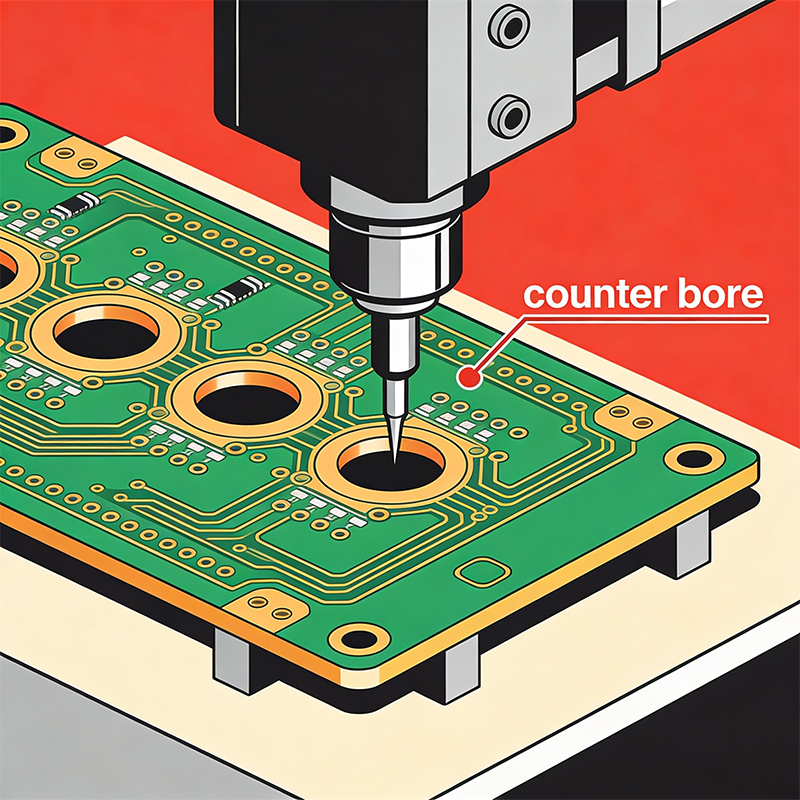
In PCB manufacturing, a counter bore is created during the drilling process. It's not a single drill—it's two operations.
Step 1: Drill the main hole (pilot hole) for the screw shaft. This is a standard through-hole.
Step 2: Use a larger drill bit or a specialized counter bore tool to drill the recess to the required depth. The second drill is centered on the first hole, creating a flat-bottomed cylindrical cavity.
For high-volume production, specialized counter bore tools that combine both operations in one pass are used. For prototypes or small runs, separate drilling steps are typical.
The key is precision. The counter bore must be perfectly concentric with the main hole. If it's off-center, the screw head won't seat correctly, or the walls may be too thin.
Adding a counter bore to your PCB isn't just about drawing a circle on your layout. There are several factors to consider.
The counter bore diameter must match the screw head size. For a socket head screw, the counter bore diameter should be slightly larger than the head diameter to allow easy insertion.
The depth must be at least the height of the screw head. If the depth is too shallow, the head sticks out. If it's too deep, you risk weakening the board or breaking through to the other side.
This is critical. After you drill the counter bore, there needs to be enough material left between the bottom of the counter bore and the opposite board surface. If you drill too deep, you can:
Break through to the other side
Weaken the board so it cracks under stress
Create a thin spot that can delaminate
A good rule is to leave at least 0.5mm to 1mm of material thickness, depending on the board thickness and the stress on the screw.
Counter bores are usually non-plated. The walls of the counter bore are bare laminate or copper, but the hole itself may be plated if it's a plated through-hole. If you need the screw to make electrical contact, you need to specify a plated counter bore. This is more expensive and requires careful design.
Don't put a counter bore too close to the board edge. The remaining material can be too thin, causing cracks. Also, avoid placing components too close to the counter bore—the drill could hit them, or the screw head could interfere.
Standard FR-4 handles counter bores fine. But if you're using flexible circuits or thin materials, counter bores may not be practical. For flexible boards, consider using stiffeners or alternative mounting methods.
You drill the counter bore too deep and it breaks through the other side.
Prevention: Calculate the required depth carefully. For a 1.6mm board, a screw head height of 1mm, you need a counter bore depth of 1mm, leaving 0.6mm of material. That's fine. For a 0.8mm board, the same screw leaves only 0.2mm—too thin. Consider a different screw or a different mounting method.
The counter bore isn't centered on the main hole.
Prevention: Use a manufacturer with precise drilling equipment. Specify registration requirements. For critical holes, ask about their drilling accuracy.
The counter bore walls are rough, making the screw hard to insert or the head doesn't seat properly.
Prevention: Use standard drilling parameters. If roughness is an issue, ask the manufacturer about deburring or finishing processes.
The board cracks around the counter bore during assembly or in use.
Prevention: Leave adequate material around the hole. Don't place counter bores too close to the edge or to other holes. Consider using a larger counter bore diameter to distribute stress.
Flexible circuits add complexity. Drilling a counter bore in a thin flex material is risky—there's just not enough thickness. Instead, designers often use stiffeners (rigid sections attached to the flex) to create a mounting area. The counter bore is drilled into the stiffener, not the flex material itself.
Rigid-flex boards combine both rigid and flexible sections. Counter bores can be placed in the rigid sections, but you need to avoid the flex-rigid boundaries.
At Kaboer, we've been manufacturing custom PCBs since 2009. Based in Shenzhen with our own PCBA factory, we understand that the details—like counter bores—make the difference between a board that works and a board that works perfectly.
What we offer:
Precision drilling: Our CNC drilling machines hold tight tolerances, ensuring counter bores are concentric and accurate.
Design review: We check your counter bore dimensions against your board thickness. If we see a potential problem—like drilling too deep for your board—we flag it before production.
Material expertise: We know what works for rigid boards, flexible circuits, and rigid-flex. If a counter bore isn't practical for your board type, we'll suggest alternatives.
Fast prototyping: Need to test a design with counter bores? We can get you prototypes quickly.
One-stop service: We fabricate, drill, and assemble. One partner, one quality standard, no finger-pointing.
If you're designing a board that needs counter bores—or if you're not sure whether you need them—send us your requirements or Gerber files. We'll review your design, give you honest feedback, and get back to you with a quote. We've been at this for over 15 years, and we believe the best partnerships start with straightforward conversations.
And if you're ever in Shenzhen, we'd be happy to show you around our factory and walk you through how we drill counter bores with precision.

Kaboer manufacturing PCBs since 2009. Professional technology and high-precision Printed Circuit Boards involved in Medical, IOT, UAV, Aviation, Automotive, Aerospace, Industrial Control, Artificial Intelligence, Consumer Electronics etc..


 English



 Wechat
 +86 13670210335
 +86 13670210335
 E-mail