
Date: 2026-03-26
If you've ever had a batch of boards come back from assembly with bridges, missing solder, or components that just didn't sit right, there's a good chance the problem started with the silk screen stencil.
Most people don't think about the stencil. They think about the pick-and-place machine, the reflow oven, the components. But here's the reality: if the stencil is wrong, nothing else matters. You can have the best placement equipment and the most expensive components, but if the solder paste isn't where it's supposed to be—in the right amount, in the right shape—your boards will fail.
Let's talk about what silk screen stencils actually are, how they're made, and why getting them right is the first step to reliable SMT assembly.
A silk screen stencil (more accurately called a solder paste stencil or SMT stencil) is a thin sheet of metal—usually stainless steel—with precision-cut openings that match the pads on your PCB. It's the tool that applies solder paste exactly where it needs to go before components are placed.
Here's how it works:
The stencil is aligned over the PCB. Solder paste (a grayish mixture of tiny solder spheres and flux) is spread across the stencil with a squeegee. The paste pushes through the openings and deposits onto the pads below. When the stencil lifts away, the paste stays on the pads—exactly where it should be.
Think of it like a screen printer for electronics. The stencil is the screen, the paste is the ink, and the PCB is the paper. Get the stencil right, and every pad gets the right amount of paste. Get it wrong, and you're looking at shorts, opens, and rework.
In SMT assembly, the solder paste printing step is responsible for the majority of defects. Get the stencil wrong, and you're fighting an uphill battle.
Too much paste leads to bridges between pins. That's a short circuit waiting to happen.
Too little paste leads to weak joints, cold joints, or components that don't connect at all.
Paste in the wrong place means components won't align correctly, or solder will end up where it shouldn't.
The stencil determines all of this. Its thickness, the size and shape of its openings, the quality of its cut—every detail matters.
There are a few ways to make a stencil, and the method affects both cost and quality.
This is the most common method for prototypes and production. A high-power laser cuts the openings directly into the stainless steel sheet. It's precise, fast, and cost-effective. The edges of the openings can be slightly rough, but most manufacturers use electropolishing after cutting to smooth them out.
Best for: Most applications, from prototypes to production.
An older method where a chemical etchant dissolves the metal to create the openings. It's less precise than laser cutting and can undercut the edges, creating a tapered profile. It's rarely used today except for very simple boards.
Best for: Low-cost, low-precision applications.
The premium option. The stencil is built up by electroplating nickel around a pattern, creating smooth, trapezoidal openings that release paste beautifully. It's expensive and takes longer to produce, but for ultra-fine-pitch components (0.4mm pitch or smaller), it's often the only way to get consistent results.
Best for: Fine-pitch BGAs, 01005 passives, and other high-density applications.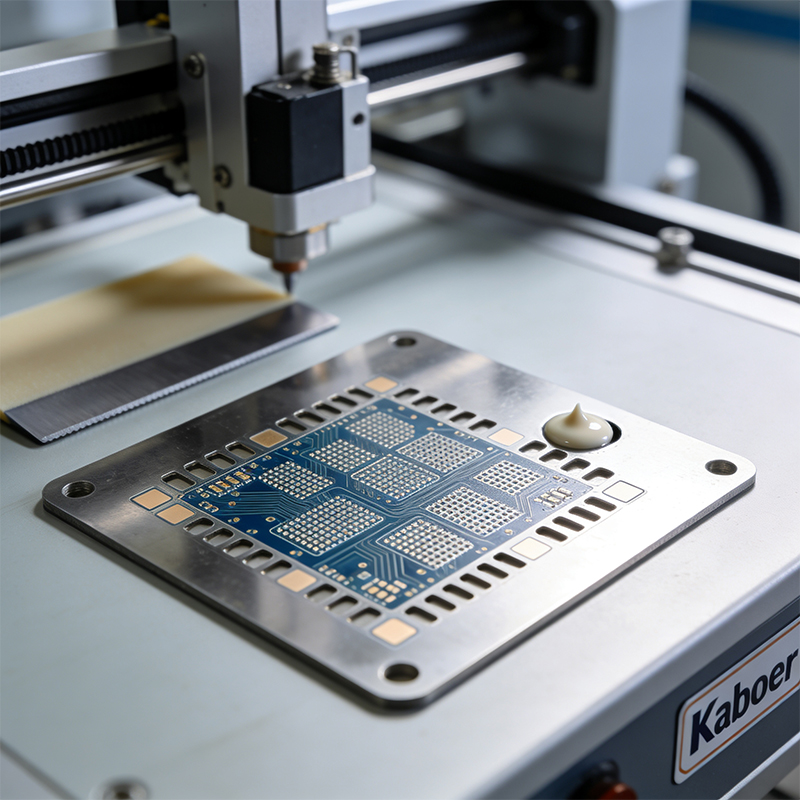
A stencil isn't just a piece of metal with holes. It's a precision tool, and two numbers define its performance.
The thickness determines how much paste is deposited. Typical thicknesses range from 0.1mm (4 mils) to 0.2mm (8 mils).
Thicker stencils deposit more paste. Good for large components, connectors, and anything that needs a lot of solder.
Thinner stencils deposit less paste. Essential for fine-pitch components where too much paste would cause bridges.
For most boards with a mix of components, a standard 0.12mm or 0.15mm thickness works well.
The openings in the stencil aren't just copies of your PCB pads. They're carefully engineered to deposit the right amount of paste.
The industry uses two key ratios to design apertures:
Area Ratio: The area of the aperture opening divided by the area of its sidewalls. For reliable paste release, this needs to be greater than 0.66. If the ratio is too low, paste will stick to the stencil walls instead of transferring to the pad.
Aspect Ratio: The width of the aperture divided by the stencil thickness. Target >1.5 to ensure paste flows through cleanly.
For fine-pitch components, the apertures are often modified:
Home plate shape (a rectangle with a pointed end) for fine-pitch QFPs to control paste volume
Window-pane pattern (multiple small squares) for large thermal pads to prevent component floating
Oval or rounded shapes for chip components to reduce tombstoning
Over time, paste can dry and clog the apertures. The result: missing paste on some pads.
Prevention: Regular cleaning cycles during production. Under-stencil cleaning systems wipe the stencil bottom between prints.
Paste sticks to the stencil walls instead of the pad. This happens when the area ratio is too low or when the aperture walls are rough.
Prevention: Design apertures with area ratio >0.66. Use laser-cut stencils with electropolishing to smooth the walls.
Paste gets on the stencil bottom and transfers to the board where it shouldn't be. This causes bridges.
Prevention: Proper squeegee pressure, regular cleaning, and under-stencil wiping.
The stencil doesn't line up with the PCB pads. Paste goes where it shouldn't.
Prevention: Use fiducial marks on the PCB for optical alignment. Check registration before printing.
A bent or dented stencil can't print properly. It's usually game over.
Prevention: Handle carefully. Store flat. Inspect before each use.
Not all boards are the same, and the stencil needs to match.
Rigid boards are straightforward. The stencil sits flat, and alignment is predictable.
Flexible circuits need special handling. Flex boards can stretch and shift during printing. Use stencil adapters or vacuum plates to keep them flat. The stencil itself may need thicker gasketing to maintain contact.
Rigid-flex boards combine both challenges. Pay attention to the transition zones.
HDI and fine-pitch boards need the most precise stencils. For 0.4mm pitch BGAs, you might need an electroformed stencil with nanocoating for perfect paste release.
At Kaboer, we've been manufacturing custom PCBs since 2009. Based in Shenzhen with our own PCBA factory, we make stencils for every board we assemble. We know that a good stencil is the foundation of good assembly.
What we offer:
Laser-cut stencils with electropolishing for smooth aperture walls
Standard thicknesses: 0.1mm, 0.12mm, 0.15mm, and custom options
Design support: We review your PCB layout and suggest stencil modifications for better print quality
Fine-pitch capability: Apertures down to 0.2mm, area ratio optimized for reliable release
Fast turnaround: Need a stencil quickly? We can have it ready in 24-48 hours
One-stop service: We design the stencil, print the paste, place the components, and test the boards. One partner, one quality standard
We work across the full range of boards—rigid, flexible, rigid-flex, HDI—and we understand that stencil requirements change with the application.
If you're designing a board and want to make sure your stencil is right—or if you need a stencil for your next SMT run—send us your requirements or Gerber files. We'll review your design, give you honest feedback on stencil design, and get back to you with a quote. We've been at this for over 15 years, and we believe the best partnerships start with straightforward conversations.
And if you're ever in Shenzhen, we'd be happy to show you around our factory and walk you through how we design and use stencils to get perfect paste prints every time.

Kaboer manufacturing PCBs since 2009. Professional technology and high-precision Printed Circuit Boards involved in Medical, IOT, UAV, Aviation, Automotive, Aerospace, Industrial Control, Artificial Intelligence, Consumer Electronics etc..


 English



 Wechat
 +86 13670210335
 +86 13670210335
 E-mail