
Date: 2026-04-04
We’ve all had that "heart-sink" moment. You’ve designed a brilliant piece of hardware, the boards arrive, you flip the switch, and… nothing. Zero. Zilch. Usually, the culprit is a silent killer: the open circuit.
But what is the actual definition for open circuit, and more importantly, why does it keep happening in high-end electronics like HDI and Flexible PCBs? Let's break it down in plain English.
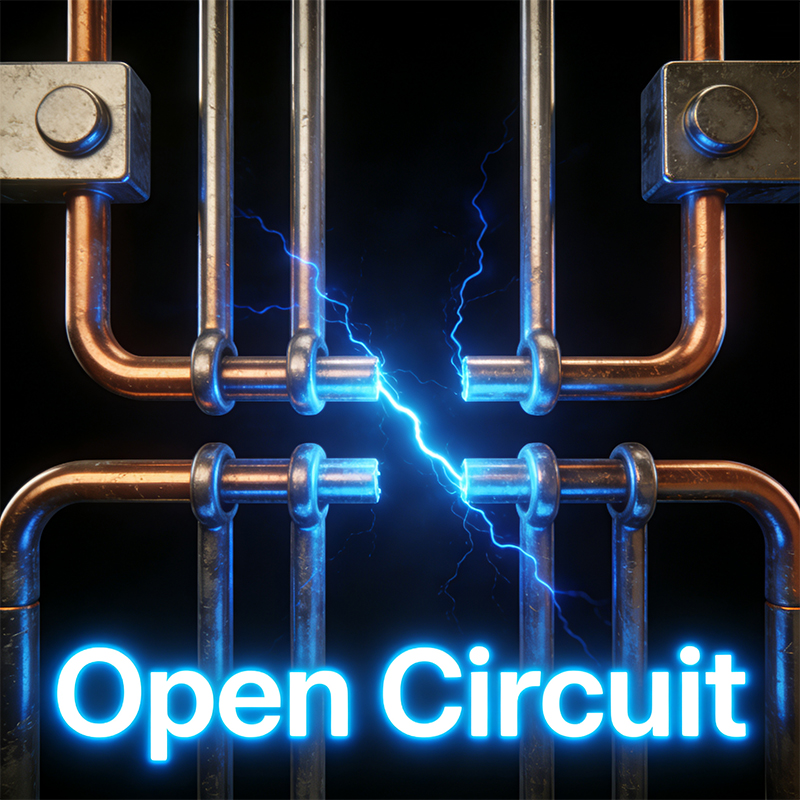
At its simplest, an open circuit is a break in an electrical path. Think of it like a drawbridge that’s been raised—the cars (electrons) want to cross, but there’s a giant gap in the road. Because the path isn't continuous, the resistance becomes effectively infinite, and current stops dead in its tracks.
In the world of PCBA (Printed Circuit Board Assembly), an open circuit means your signal never reaches its destination. It’s the "ghost in the machine" that turns your high-tech device into a fancy paperweight.
If you’re working with standard double-sided boards, opens are rare. But when you move into the territory of high-speed HDI or Rigid-Flex boards, the stakes get much higher. Here is where things usually go wrong:
Flex PCB Fatigue: This is a big one. If a Flexible PCB is designed without the right bend radius, or if the copper traces are too thin, they can develop microscopic cracks. It’s an open circuit that only happens when you bend the device—a nightmare to troubleshoot!
Microvia Failures in HDI: In HDI (High-Density Interconnect) boards, we use laser-drilled microvias. If the plating process isn't perfect, that tiny hole won't connect the layers. Result? An open circuit hidden deep inside your 12-layer board.
Cold Solder Joints: During the PCBA process, if the reflow oven temperature isn't dialed in, the solder might look like it’s touching the pad, but it hasn't actually bonded. It’s an open circuit masquerading as a connection.
When you partner with a manufacturer in China, you shouldn't have to worry about the definition for open circuit—you should be worrying about your next product launch. We use three main "weapons" to ensure your boards are 100% continuous:
E-Test (Flying Probe or Fixture): We run an electrical current through every single net on your board. If there’s a gap, the machine finds it instantly.
AOI (Automated Optical Inspection): High-resolution cameras scan your Rigid-Flex or HDI layers for any trace narrowing or breaks that the human eye would miss.
X-Ray Inspection: For those tricky BGA components, we use X-rays to look through the chips and ensure every solder ball has made a perfect connection.
Understanding the definition for open circuit is great for a physics quiz, but preventing them is what keeps your business profitable.
At our facility, we specialize in the "tough stuff"—custom Flex, complex Rigid-Flex, and high-speed HDI. We don't just "print boards"; we provide a DFM (Design for Manufacturing) review on every project to spot potential open-circuit risks before they cost you money.
Ready for a board that actually works? Send us your Gerber files and BOM today. Let’s make sure your next project is a closed loop of success.

Kaboer manufacturing PCBs since 2009. Professional technology and high-precision Printed Circuit Boards involved in Medical, IOT, UAV, Aviation, Automotive, Aerospace, Industrial Control, Artificial Intelligence, Consumer Electronics etc..


 English



 Wechat
 +86 13670210335
 +86 13670210335
 E-mail