
Date: 2026-01-28
When you open up almost any electronic gadget, what do you see inside? Those flat, often green, boards covered with lines and little metal components. Those are electronic boards—the fundamental platforms that make our modern world work. If electronic devices were cities, these boards would be the foundation, roads, and power grid all in one. Let’s explore what they are, why they’re essential, and the different types you might encounter.
What Exactly Are Electronic Boards?
At their core, electronic boards (most commonly called Printed Circuit Boards or PCBs) are flat sheets of insulating material with thin layers of copper “traces” bonded to the surface. These traces act as custom wiring, connecting various electronic components—like resistors, chips, and capacitors—to form a complete, functional circuit. They provide both the physical support to hold everything together and the electrical pathways for signals and power to travel.
Common Types of Electronic Boards
You'll come across a few main varieties:
Single-Sided Boards: The simplest type. All the copper traces are on one side of the insulating board, and components are mounted on the other. Think of it like a basic, one-way street map. Great for simple, low-cost electronics like remote controls or basic toys.
Double-Sided Boards: Copper traces run on both sides of the board, and small plated holes called vias allow connections between the top and bottom layers. This is like having a road network on two levels with connecting ramps. It’s the most common type for more complex consumer electronics, offering more room for connections.
Multilayer Boards: These are the high-rises of the electronic board world. They sandwich multiple layers of copper traces (4, 6, 8, or even 30+ layers) inside a single board, connected by a network of vias. This allows for extremely complex and dense circuitry in a compact space. Essential for smartphones, computers, and advanced industrial equipment.
Flexible & Rigid-Flex Boards: Made from bendable materials like polyimide, these boards can twist and fold. Flexible boards are used in wearable devices or cameras, while rigid-flex boards combine stiff and flexible sections, perfect for fitting into unusual spaces inside laptops or medical devices.
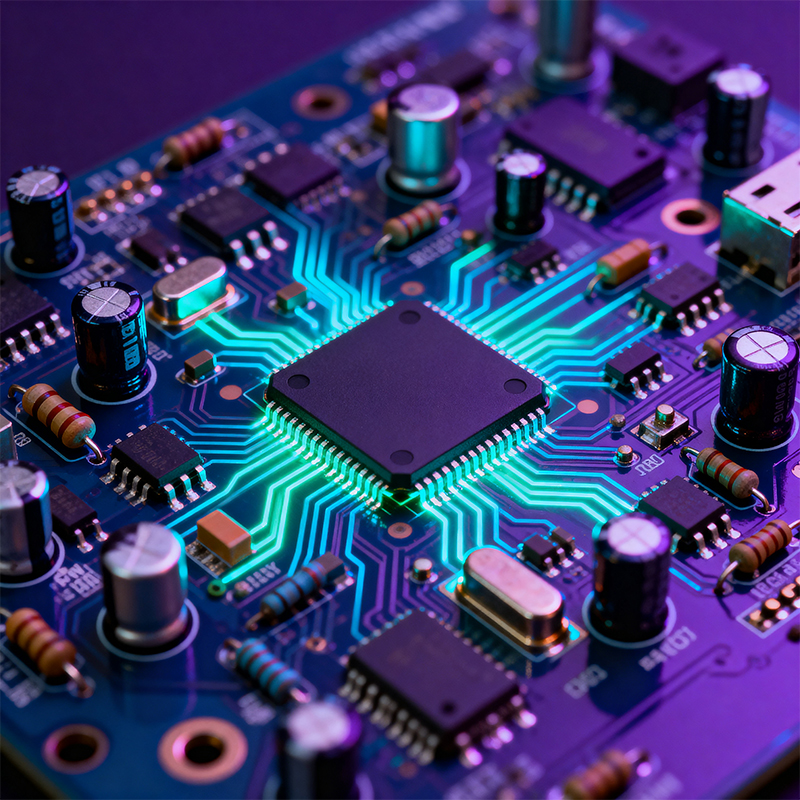
Key Parts of an Electronic Board
Every board is a mini-ecosystem made up of:
The Substrate: The base insulating material (like common FR4 fiberglass) that gives the board its structure and rigidity.
Copper Traces: The “roads” etched onto the board that carry electrical signals and power.
Solder Mask: That iconic green (or blue, red, black) coating that insulates the traces and prevents accidental shorts.
Silkscreen: The white lettering and symbols printed on top to label components and test points.
Pads & Vias: Copper pads provide the landing spots for component legs, while vias are the tiny conductive holes that connect traces between layers.
Why They Matter to Electronics Manufacturers
For anyone making electronic products, understanding boards is crucial because they are:
The Foundation: Every design starts with the board layout. Its quality dictates the reliability and performance of the final product.
A Critical Cost Factor: Board complexity (layer count, material, size) is a major part of the overall unit cost.
Key to Miniaturization: Advances in board technology (like finer traces and more layers) are what allow devices to become smaller yet more powerful.
Central to Assembly: The board design directly impacts how easily components can be automatically placed and soldered.
From the simplest timer to the most powerful supercomputer, it all happens because of these cleverly designed sheets of fiberglass and copper. They are the unsung heroes of the digital age, quietly orchestrating the flow of electrons that power our lives.

Kaboer manufacturing PCBs since 2009. Professional technology and high-precision Printed Circuit Boards involved in Medical, IOT, UAV, Aviation, Automotive, Aerospace, Industrial Control, Artificial Intelligence, Consumer Electronics etc..


 English



 Wechat
 +86 13670210335
 +86 13670210335
 E-mail