
Date: 2026-06-04
If you’ve ever opened up a smartphone, a laptop, or a fitness tracker, you’ve seen those thin, orange‑yellow flexible ribbons connecting different parts. Those are Flexible Printed Circuits, or FPCs. But have you ever wondered how those tiny copper lines get onto that bendable plastic film? The answer is a process called etching.
Let’s explore what an etched FPC is, how the etching process works, why it’s used instead of other methods, and where you’ll find these circuits every day.
What Is an Etched FPC?
An etched FPC is a flexible printed circuit manufactured by chemically removing unwanted copper from a copper‑clad polyimide film, leaving behind only the desired copper traces. The word “etched” refers to the chemical “bath” that eats away the copper where it’s not needed.
Think of it like stenciling a design on a T‑shirt. You cover the areas you want to keep, then spray paint over the whole thing. When you remove the cover, only the protected area has paint. Etching does the same for copper on a flexible plastic base – but the “paint” is a chemical that dissolves copper.
Why “Etched”? Isn’t There Another Way?
There are two main ways to make flexible circuits:
Etched FPC – The traditional and most common method. Uses photolithography and chemical etching. High precision, fine traces, good for complex designs.
Printed FPC (additive) – Uses conductive ink printing (like inkjet or screen printing). Cheaper for simple circuits, but lower conductivity and poor fine‑line capability.
Etched FPCs dominate high‑volume, high‑performance applications because copper has much better conductivity than conductive ink. Almost every smartphone, medical device, and automotive flex circuit is etched.
How Is an Etched FPC Made? (Step by Step, in Plain English)
Here’s what happens inside a factory that makes etched FPCs:
Start with copper‑clad polyimide – A thin sheet of polyimide film (like Kapton) has a thin layer of copper laminated onto one or both sides.
Apply photoresist – The copper is coated with a light‑sensitive material called photoresist – like a liquid that hardens when light hits it.
Expose through a film – A film negative of the circuit pattern is placed over the board. UV light shines through the clear parts of the film, hardening the photoresist where the copper should stay.
Develop – The board is washed with a developer solution that removes the soft, unexposed photoresist. The hardened resist remains, protecting the copper that will become traces.
Etch – The board is dipped in or sprayed with an etching solution (often ferric chloride or alkaline ammonia). This chemical dissolves the unprotected copper. The copper under the hardened resist stays intact.
Strip resist – The remaining hardened photoresist is stripped away, leaving only the copper traces on the polyimide film.
Coverlay – A protective polyimide coverlay (like a flexible solder mask) is laminated over the traces, with openings for pads and connectors.
Cut – Individual flex circuits are cut out from the panel, often by laser.
That’s it. The whole process is similar to making a rigid PCB, but the materials are flexible.
What Makes Etched FPCs So Useful?
Fine traces – Etching can produce copper lines as narrow as 0.05mm (2 mils) or even finer. That’s thinner than a human hair. This allows high‑density circuits.
Excellent conductivity – Copper is one of the best conductors. Etched copper traces carry signals with very little loss.
Flexibility – The polyimide base bends, folds, and twists without cracking. The copper is specially treated (rolled annealed) to be more flexible than standard copper.
Multi‑layer capability – You can laminate multiple etched layers together to make complex, high‑density flexible circuits.
Reliability – Etched FPCs withstand thousands of bends if designed correctly.
Where Do You Find Etched FPCs?
Almost anywhere electronics need to bend, save space, or reduce weight:
Smartphones – The main board connects to the display, cameras, buttons, and battery via etched FPCs.
Laptop hinges – The ribbon that goes from the motherboard to the screen is an etched FPC.
Wearables – Fitness trackers and smartwatches use etched FPCs to wrap around your wrist.
Printers – The moving print head is connected by a long, etched flex circuit that bends millions of times.
Medical devices – Hearing aids, endoscopes, and implantable sensors use tiny etched FPCs.
Automotive – Dashboard displays, steering wheel controls, and battery management systems.
Etched FPC vs. Die‑Cut FPC – A Quick Note
Sometimes people confuse etched FPCs with die‑cut flexible circuits. Die‑cut circuits are made by stamping copper patterns from a thin sheet – they’re only suitable for very simple, low‑density designs (like membrane switches). Etched FPCs are far more precise and can handle complex routing. If it has fine lines, many pins, or dense components, it’s almost certainly etched.
The Chemistry of Etching – Not as Scary as It Sounds
The etching solution is carefully controlled. For copper, common etchants include:
Ferric chloride – A dark brown liquid. Works well but needs careful disposal.
Alkaline ammonia – A blue solution. Used in high‑volume production because it can be regenerated.
Manufacturers monitor the concentration, temperature, and agitation to ensure the etch happens evenly. Too little etching leaves unwanted copper (shorts). Too much etching (over‑etching) makes traces too thin or breaks them.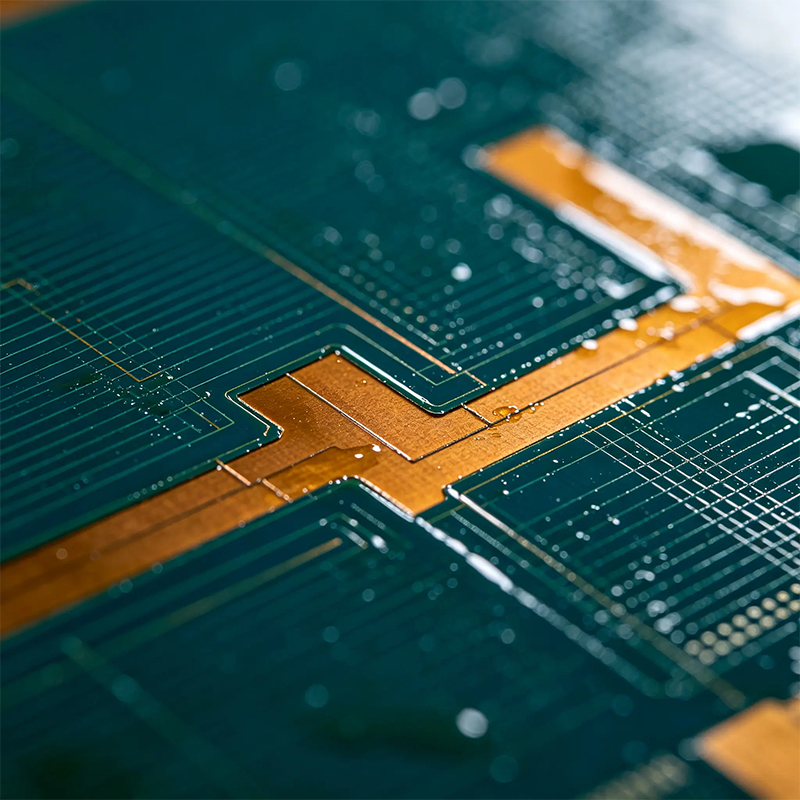
Can You Etch an FPC at Home?
Technically, yes – hobbyists sometimes etch single‑sided flex circuits using ferric chloride and a UV exposure box. But it’s messy, and controlling the etch time is tricky. Commercial etched FPCs are far more reliable. For prototypes, it’s easier to order from a manufacturer.
What About Environment? Is Etching Safe?
Modern etching facilities use closed‑loop systems that recycle etchants and reclaim copper. Waste is treated before disposal. Reputable manufacturers follow strict environmental regulations. DIY etching at home – not recommended – can produce hazardous waste.
Real‑World Example: The Camera Module Flex
Inside your phone, the tiny camera module is connected to the main board via a short, intricately patterned etched FPC. That flex has maybe 30‑50 fine copper traces, each carrying high‑speed image data. If it were printed with conductive ink, the signal would be too weak. Etched copper makes it work.
Future of Etched FPCs
As devices get smaller and faster, etched FPCs are evolving. New processes like semi‑additive and modified semi‑additive (mSAP) allow even finer traces (down to 10‑15µm). Laser‑direct imaging replaces film for higher precision. Flexible HDI (high‑density interconnect) is becoming common in foldable phones.
Final Answer – What Is an Etched FPC?
An etched FPC is a flexible printed circuit made by chemically removing (etching) unwanted copper from a polyimide film, leaving behind the desired copper traces. It’s the standard method for producing high‑quality, reliable flexible circuits with fine traces and high density. You’ll find etched FPCs in smartphones, laptops, wearables, medical devices, cars, and printers.

Kaboer manufacturing PCBs since 2009. Professional technology and high-precision Printed Circuit Boards involved in Medical, IOT, UAV, Aviation, Automotive, Aerospace, Industrial Control, Artificial Intelligence, Consumer Electronics etc..


 English



 Wechat
 +86 13670210335
 +86 13670210335
 E-mail