
Date: 2026-06-26
You're designing an electronic product. Maybe a laptop, a smartwatch, an automotive display, or a printer. You need to connect two components inside a tight space. Round wires are too bulky. Ribbon cables aren't flexible enough. What you need is an FFC — Flexible Flat Cable.
An FFC looks like a flat ribbon with multiple conductors running side by side, wrapped in a thin insulating film. It's the thin yellow ribbon connecting your phone's screen to its motherboard, or the cable bending through your laptop's hinge. Thin, lightweight, and flexible — it's the simplest solution for signal transmission in tight spaces.
In this guide, I'll explain what FFCs are, what specs they come in, where they're used, how to customize them, and how they compare to FPCs. Plain English, no fluff.
An FFC is simply a flat, bendable ribbon cable.
It's different from regular round wires — round wires are bulky and take up space. An FFC takes multiple flat copper conductors, aligns them in parallel, and bonds them inside a thin insulating film. The result is a flat ribbon that's usually only 0.1-0.3mm thick.
The construction is simple: flat tinned copper or gold-plated copper conductors, wrapped in a polyester (PET) insulating film, with a stiffener at each end for easy connector insertion.
An FFC's core job is to create a 1:1 electrical connection between two devices or components. It doesn't do complex circuit routing — it's straight through. Pin 1 on one end connects to Pin 1 on the other end, Pin 2 to Pin 2, and so on.
When customizing an FFC, three parameters matter most:
1. Pitch
Pitch is the distance from the center of one conductor to the center of the next. Common pitches include: 0.5mm, 0.8mm, 1.0mm, 1.25mm, 2.0mm, and 2.54mm. 0.5mm and 1.0mm are the most common. Smaller pitch means more conductors in the same width — but requires more precise connectors.
2. Pin Count
FFCs can have anywhere from 2 to 60 or more conductors. Common counts include 4, 6, 8, 10, 14, 16, 20, 30, 40, and 50 pins.
3. Length
FFCs can be custom-made in various lengths, from 20mm to 10,000mm (10 meters) . Common lengths include 30mm, 50mm, 75mm, 100mm, 150mm, 200mm, and 300mm.
FFCs also come in two types based on contact orientation at each end:
Type A (Same Side) : Conductors face the same direction on both ends. This is the most common type.
Type D (Opposite Side) : Conductors face opposite directions. Used when connecting two devices with reversed pin layouts.
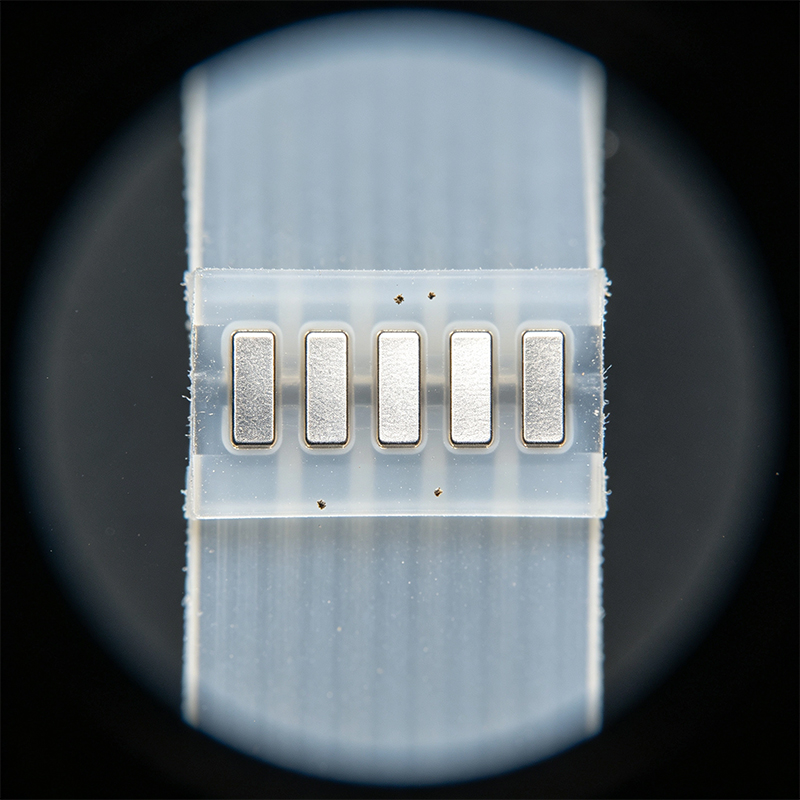
FFCs are everywhere in modern electronics:
Consumer Electronics: Smartphones, laptops, tablets, digital cameras, gaming consoles, LCD/LED displays. That thin yellow ribbon connecting your phone's screen to its motherboard is an FFC.
Automotive Electronics: Infotainment systems, GPS, driver-assistance systems, instrument clusters.
Printers and Office Equipment: Print head cables — the print head moves back and forth constantly, and FFCs survive the repeated bending.
Medical Devices: Imaging equipment, portable diagnostic tools.
Industrial Equipment and Robotics: Sensors, automation equipment, signal transmission inside robot joints.
Wearable Devices: Smartwatches, smart glasses — internal space is extremely tight, and FFCs are standard.
A lot of people confuse FFCs and FPCs — they look similar, both are flat and flexible. But they're different things.
| Feature | FFC | FPC |
|---|---|---|
| Full Name | Flexible Flat Cable | Flexible Printed Circuit |
| Construction | Flat conductors side by side + insulating film | Copper traces etched on a flexible substrate |
| Can traces cross? | No — straight 1:1 only | Yes — multi-layer with crossings |
| Can mount components? | No — just wires | Yes — can solder components onto it |
| Shape | Usually rectangular and uniform | Can be any shape |
| Cost | Cheaper | More expensive |
| Complexity | Low | High |
Here's the simple way to remember it: FFC is a flat ribbon cable — conductors flattened and bundled together. FPC is a flexible circuit board — a complete circuit built on a flexible board.
If you just need a straight connection from Point A to Point B, with no crossing traces and no components — use an FFC. It's cheap and does the job. If you need complex routing, crossed traces, or components mounted on the flex — that's FPC territory.
A few key points to consider when ordering custom FFCs:
1. Choose the right pitch
Pitch determines which connector you use. A 0.5mm pitch FFC needs a 0.5mm pitch connector. A 1.0mm needs a 1.0mm connector. Get it wrong and it won't fit.
2. Count your pins carefully
Calculate exactly how many signals you need to transmit. Leave one or two spare conductors for future expansion.
3. Add some length margin
Too short and it won't reach. Too long and it will coil inside your device. Best practice: measure the actual distance and add 10-20mm of margin.
4. Bend radius matters
FFCs can bend, but bending too sharply damages the internal conductors. General rule: bend radius should be at least 5 times the cable thickness.
5. Consider shielding
If your device has EMI issues or the signals are noise-sensitive, consider gold-plated shielded FFCs. They have an external shield that prevents noise from interfering with signal transmission.
The global FFC market is growing steadily. The market was valued at approximately $576.71 million in 2025** and is projected to reach **$825.48 million by 2033, growing at a CAGR of 4.58%. Consumer electronics and automotive electronics are the primary growth drivers.
We're not just a cable supplier. We are a one-stop manufacturer that designs and makes flexible PCBs, rigid-flex boards, HDI high-frequency boards, and then does full PCBA. FFCs are often part of a larger PCB and PCBA project — we can handle everything together, saving you the hassle of coordinating multiple suppliers.
One-stop solution: FFC customization, flexible PCBs, rigid-flex, HDI, and PCBA assembly all under one roof. No juggling between board shops, cable suppliers, and assembly houses.
All in-house: PCB fabrication, SMT assembly, and FFC customization are all done in-house — better quality control and lead time.
High-precision manufacturing: Minimum trace/space 0.05mm, minimum laser blind via 0.075mm. Supports 1-order to any-layer HDI.
Free DFM review: Send your design files and FFC specifications, get a DFM report within 24 hours with optimization suggestions.
Projects we've served: consumer electronics (laptop display connections, smartwatch internal cables), automotive (display FFCs, camera connections), medical (portable diagnostic device internal connections), industrial (robot joint signal transmission).
Three simple steps:
Send your specs — FFC requirements (pitch, pin count, length, type) and any related PCB design files.
We review and quote — Within 24 hours, you'll receive sample and volume pricing, and lead time estimates.
Sample, then scale — We build samples. You test functionality and reliability. Then we move to volume.
FFC flexible flat cables aren't high-tech, but they're one of the most basic and common signal transmission solutions inside electronic devices. Get the specs right and find the right supplier — and your product's internal wiring will be clean, reliable, and easy to assemble.
If you're designing a product that needs internal connections, send us your requirements. We won't push a contract — we'll first run a free spec review and let our expertise speak.
When you contact us, please include:
Product type and application
FFC specifications (pitch, pin count, length)
Estimated annual quantity (samples, small batch, or mass production)
We'll give you an honest answer — what we can do, what we can't, and how to modify your design to make it work.

Kaboer manufacturing PCBs since 2009. Professional technology and high-precision Printed Circuit Boards involved in Medical, IOT, UAV, Aviation, Automotive, Aerospace, Industrial Control, Artificial Intelligence, Consumer Electronics etc..


 English



 Wechat
 +86 13670210335
 +86 13670210335
 E-mail