
Date: 2026-06-24
You've definitely had this happen. You flip a switch and nothing happens. You plug something in and it doesn't work. A circuit board you just soldered sits there dead. Someone says "maybe it's an open circuit." But what does that actually mean?
In this guide, I'll explain what an open circuit is, how it happens, what it looks like in real life, and how to find it. Plain English, no fluff.
An open circuit is simply a break somewhere in a circuit that stops current from flowing.
Think about it: current flows from the positive terminal of a battery, travels through a wire to a light bulb, then returns to the battery's negative terminal. That's a complete loop — the bulb lights up. If somewhere along that loop there's a break (a cut wire, a loose solder joint, an open switch), current can't get through, and the bulb stays dark. That "break" is an open circuit.
The essence of an open circuit is the current path is cut. It's the opposite of a short circuit — a short sends current where it shouldn't go; an open leaves current with nowhere to go at all.
There are only a few reasons for an open circuit, but they're all common:
1. A wire breaks
A wire gets pulled, crushed, or chewed through. Physical breakage is the most obvious cause.
2. A solder joint cracks or cold-solders
A solder joint that wasn't done properly, or one that cracked from vibration or thermal expansion. Sometimes it looks connected, but it's completely broken.
3. A component burns out
A resistor burns open from overcurrent, a capacitor fails, a fuse blows. The component itself is destroyed, and current can't pass through.
4. Poor contact
A plug not pushed in all the way, an oxidized switch contact, a relay that doesn't close — these are "temporary" open circuits.
5. Corrosion or oxidation
Copper traces eaten away by corrosion, or connectors covered in oxide. Current can't get through.
These two are the most commonly confused terms.
| Open Circuit | Short Circuit | |
|---|---|---|
| What it is | The circuit is broken — current can't flow | Two points that shouldn't be connected are connected — current takes a shortcut |
| What happens to a bulb | Bulb stays off | Bulb may burn very bright then die, or the breaker trips |
| Resistance | Very high (∞, megohms) | Very low (near 0Ω) |
| Danger | Device doesn't work | Fire, damaged equipment, shock |
Simple analogy: with your home water pipes — an open circuit is like a closed faucet or a broken pipe — water doesn't come out. A short circuit is like a hole in the pipe — water pours out everywhere, floods the floor, and the plant you were trying to water gets nothing.
The most common tool for detecting open circuits is a multimeter.
Method 1: Continuity mode (beeper)
Set your multimeter to the continuity (beeper) mode. Touch the probes to both ends of the circuit you're testing. If the meter beeps, the circuit is continuous (low resistance). If it doesn't beep, there's a break — that's an open circuit.
Method 2: Resistance mode
Measure resistance between two points. If the display reads "OL" (Over Load) or "∞" (infinity), the two points are not connected — that's an open circuit. If it reads a low number (a few ohms), it's continuous.
Method 3: Voltage mode
With the circuit powered on, measure voltage at a node. If you expect voltage but measure none, there may be an open circuit somewhere upstream.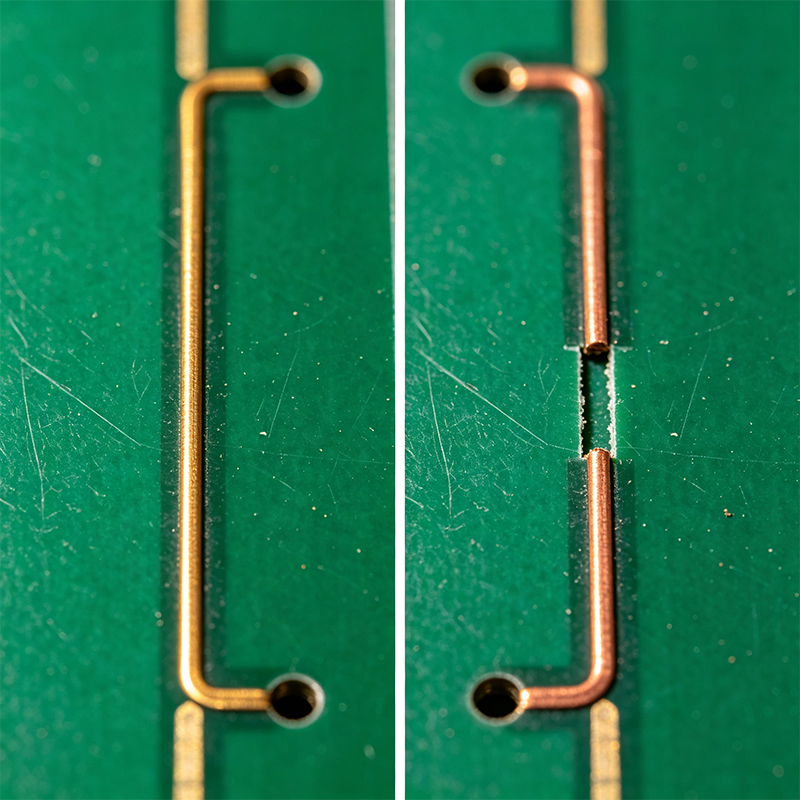
Open circuits show up differently depending on the circuit:
LED strip not lighting: If one LED burns open, the whole strip might go dark, or it might flicker then die.
Circuit board dead: A power supply trace opens, and the whole board has no power.
Intermittent signals: A marginal open circuit (bad contact) sometimes works, sometimes doesn't — the device is flaky.
Blown fuse: This is a "deliberate" open circuit — the fuse melts to protect the rest of the circuit.
There's a method to finding open circuits — don't just poke randomly:
Step 1: Look first
Visual inspection. Any obvious broken wires? Burn marks? Cracked solder joints? A lot of open circuits are visible.
Step 2: Check the power source
Make sure the power supply is actually working. Many times you think the circuit is open when the battery is dead or the power cord isn't plugged in.
Step 3: Measure in sections
Divide the circuit into sections and test each one for continuity. Find the boundary between "good" and "broken" — that's where the problem is.
Step 4: Isolate the suspect component
Once you've narrowed it down to a section, remove the suspect component and test it by itself to confirm if it's open.
An open circuit is a break in the circuit path that stops current from flowing. It can be a broken wire, a cracked solder joint, a burned component, or a bad contact. It's the opposite of a short circuit — open has very high resistance, short has very low.
Finding an open circuit isn't complicated: look, check power, measure in sections, find the part. You don't need an engineering degree — just a multimeter and a methodical approach.

Kaboer manufacturing PCBs since 2009. Professional technology and high-precision Printed Circuit Boards involved in Medical, IOT, UAV, Aviation, Automotive, Aerospace, Industrial Control, Artificial Intelligence, Consumer Electronics etc..


 English



 Wechat
 +86 13670210335
 +86 13670210335
 E-mail