
Date: 2026-03-26
If you've ever worn a smartwatch, used a foldable phone, or even just opened a laptop, you've held a flex circuit board. It's the thin, bendable layer inside that lets wires go where rigid boards can't.
Most people don't think about it. They just know their devices can bend, fold, and fit into impossibly small spaces. That's exactly what flex circuits make possible.
Let's talk about what flex circuit boards actually are, why they're everywhere now, and what you need to know if you're building products that need to move.
A flex circuit board (often called a flexible PCB or FPC) is a printed circuit board built on a flexible plastic substrate instead of rigid fiberglass. Where a standard board is stiff and flat, a flex board can bend, twist, and fold.
The base material is usually polyimide, a thin, heat-resistant plastic that can flex millions of times without breaking. Copper traces are laminated onto this film, then covered with a protective layer called coverlay instead of traditional solder mask.
Think of it as the difference between a stiff piece of cardboard and a flexible plastic sheet. Both can hold circuits, but only one can bend.
The benefits are huge:
Fits in tight spaces. Flex circuits can be folded into three-dimensional shapes that rigid boards could never fit.
Replaces wires and connectors. One flex circuit can replace a bundle of wires and multiple connectors, which means fewer failure points.
Withstands movement. Designed for dynamic flexing—opening and closing a laptop hinge thousands of times, for example.
Lighter. Polyimide is much lighter than FR-4, which matters for wearables and aerospace.
Not long ago, flex circuits were exotic—used mostly in aerospace and medical implants. Now they're in everything. Here's why:
Consumer electronics got smaller. Phones, laptops, tablets—they're all thinner than ever. Rigid boards can only shrink so much. Flex circuits let designers use the space inside a device more efficiently, folding the circuit around batteries and other components.
Wearables exploded. A smartwatch has to wrap around your wrist. A fitness tracker has to bend with your arm. Only flexible circuits can do that.
Foldable phones became real. When you open and close a phone thousands of times, the circuit inside has to survive that movement. Rigid boards crack. Flex circuits are designed to flex.
Medical devices need to be small and reliable. Hearing aids, insulin pumps, implantable devices—all rely on flex circuits to fit into tiny spaces and work reliably for years.
Not all flex circuits are the same. Here's a quick breakdown:
Single-sided flex. One copper layer on a flexible base. Simple, cost-effective, used for basic interconnects and ribbon cables.
Double-sided flex. Copper on both sides of the base, connected by plated through-holes. More routing space, more complex circuits.
Multilayer flex. Three or more copper layers stacked with insulating layers between them. For high-density designs where single or double-sided won't suffice.
Rigid-flex. The best of both worlds: rigid board sections for components, connected by flexible sections. You get the stability of a rigid board where you need it, and flexibility where you need to bend.
Each type has its place. Single-sided for simple flex cables. Multilayer for complex circuits that still need to bend. Rigid-flex for products like cameras, laptops, and medical devices that need both stability and movement.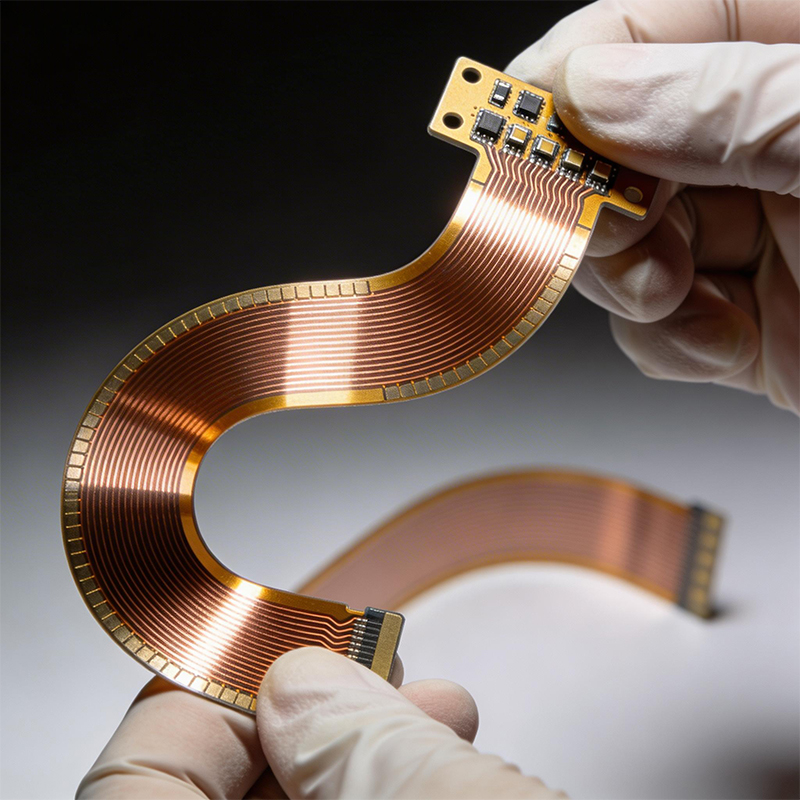
Making a flex circuit isn't the same as making a rigid board. The materials are different, and the process has to account for flexibility.
Material selection. The base is polyimide film, chosen for its ability to flex without cracking. Copper foil is bonded to it, either with adhesive or using adhesiveless construction for better reliability in dynamic flex applications.
Imaging and etching. The circuit pattern is transferred onto the copper using laser direct imaging. Then the unwanted copper is etched away, leaving the traces.
Coverlay application. Instead of liquid solder mask, flex circuits use a coverlay—a polyimide film with adhesive that's laminated over the circuits. It protects the copper while maintaining flexibility.
Stiffener attachment. Where components mount or connectors attach, stiffeners are added. These can be polyimide, FR-4, or even stainless steel, providing rigid support exactly where needed while leaving the rest flexible.
Drilling and plating. Holes for vias and component mounting are drilled—often with lasers for precision—then plated to create connections between layers.
The result is a circuit that can bend thousands of times without breaking, yet still routes signals with the precision of a rigid board.
Designing a flex circuit isn't the same as designing a rigid board. Here's what's different:
Bend radius matters. If you bend a flex circuit too tightly, the copper will stress and crack. The rule: bend radius should be at least 10 times the board thickness for single-sided flex, and more for double-sided or multilayer. A tight radius is fine for one-time installation; dynamic flexing needs more margin.
Traces in bend areas. Traces should run perpendicular to the bend direction, not parallel. Parallel traces in bend areas are more likely to crack. And keep traces straight—no sharp corners in flex zones.
No vias in bend zones. Vias create rigid spots. Keep them in flat, unbent sections of the circuit. The same goes for pads and stiffeners—they belong in rigid areas.
Copper weight. Thicker copper handles more current but reduces flexibility. For dynamic flex applications, 1 oz copper is often too thick; 0.5 oz or less is common.
Coverlay vs. solder mask. Use coverlay in flex areas. Solder mask is brittle and will crack when bent. Coverlay is designed for flexibility.
If your product needs the stability of a rigid board and the flexibility of a flex circuit, you're looking at rigid-flex. This is a single board with rigid sections (usually FR-4) and flexible sections (polyimide) built together.
Think of a laptop hinge. The main board is rigid. The display connector needs to flex every time you open and close the lid. A rigid-flex board connects them without cables or separate connectors.
The advantages:
Fewer connectors. Eliminating connectors means fewer failure points.
Simpler assembly. One board instead of multiple boards plus cables.
More reliable. The flexible section is designed for the movement; rigid sections provide stable component mounting.
The trade-off: rigid-flex is more expensive to manufacture and requires careful design at the transition between rigid and flexible sections.
Flex circuits are great, but they're not always the answer.
Choose flex when:
Space is tight and you need to fold the circuit
The board will move during use (dynamic flexing)
Weight is critical (wearables, aerospace)
You need to replace a bundle of wires with a single circuit
Stick with rigid when:
The board is flat and doesn't move
Cost is the primary driver (flex is more expensive than rigid)
You're using standard connectors that work better on rigid boards
Many products use a mix: rigid boards for main logic, flex for interconnects and moving parts.
At Kaboer, we've been manufacturing flex circuit boards since 2009. Based in Shenzhen with our own PCBA factory, we handle the full range—from simple single-layer flex to complex multilayer and rigid-flex designs.
What we offer:
Flexible PCBs: 1-20 layers, thickness from 0.075mm to 0.4mm. For wearables, medical devices, and compact consumer products where space is tight and bending is required.
Rigid-flex boards: 2-30 layers, combining rigid stability with flexible interconnects. For camera modules, military gear, and applications needing both.
Design support: We review your design for manufacturability—checking bend radius, trace routing, stiffener placement—before production.
Fast prototyping: Need to validate a flex design quickly? We can get you prototypes in days.
One-stop service: We fabricate, assemble, and test. One partner, one quality standard.
We're certified to ISO 9001, IATF 16949, and ISO 14001. Our processes are documented, repeatable, and audited. And if you're ever in Shenzhen, we'd be happy to show you around our factory and walk you through how we build flex circuits that bend without breaking.
If you're designing a product that needs to bend, fold, or fit into tight spaces, send us your requirements or Gerber files. We'll review your design, give you honest feedback, and get back to you with a quote. We've been at this for over 15 years, and we believe the best partnerships start with straightforward conversations.

Kaboer manufacturing PCBs since 2009. Professional technology and high-precision Printed Circuit Boards involved in Medical, IOT, UAV, Aviation, Automotive, Aerospace, Industrial Control, Artificial Intelligence, Consumer Electronics etc..


 English



 Wechat
 +86 13670210335
 +86 13670210335
 E-mail