
Date: 2026-03-28
If you've ever looked at a finished circuit board—components soldered, traces gleaming under solder mask—it's easy to forget where it started. Before it was a controller, a sensor, a computer, it was a blank printed circuit board. Just copper and fiberglass. No components. No function. Just potential.
Here's the thing: that blank board is the foundation of everything that follows. If the foundation is wrong, nothing else matters. The best components in the world won't save a board with poor copper adhesion, incorrect impedance, or faulty vias.
Let's talk about what a blank printed circuit board actually is, how it's made, and why the quality of that "blank slate" determines the quality of your final product.
A blank printed circuit board (also called a bare PCB or unpopulated board) is a circuit board with no electronic components attached. It's the substrate—the copper traces, pads, and vias—without the resistors, capacitors, chips, and connectors that make it functional.
Think of it like an empty house. The walls are up, the wiring is in, the plumbing is run. But there's no furniture, no appliances, no people. It's ready to be occupied, but not yet alive.
A blank board consists of:
The substrate: Usually FR-4 fiberglass, or polyimide for flexible circuits.
Copper layers: Etched into traces, pads, and planes.
Solder mask: The protective coating (usually green) that covers the copper.
Silkscreen: The white labels that show component locations.
Vias: Plated holes that connect different layers.
No components. No solder. Just the board itself.
It's easy to focus on the components. After all, they're what make the circuit do something. But the blank board is where it all starts.
The copper traces carry the signals. If a trace is too thin, it overheats. If it's too narrow for the current, it acts like a fuse. If it's etched incorrectly, it's open or shorted before you even start.
The vias connect the layers. A poorly plated via can look fine on the outside but fail months later when thermal cycling cracks the copper. By then, your product is already in the field.
The solder mask protects everything. If the mask is misaligned, pads get covered where they should be exposed. If it's too thin, copper oxidizes and won't solder.
The substrate holds it all together. If the material isn't right for your application—temperature, frequency, environment—the board can warp, delaminate, or fail.
Every component you place depends on the blank board being right. Get the blank board wrong, and nothing else can fix it.
Understanding how a blank board is made helps you know what to look for in a manufacturer. The process isn't simple.
Step 1: Material prep. Copper-clad laminate sheets are cut to size. The copper is cleaned to remove oxidation.
Step 2: Imaging. For inner layers, photoresist is applied, and the circuit pattern is transferred using laser direct imaging. The exposed areas harden; the rest stays soft.
Step 3: Etching. Chemical baths remove the unhardened resist and the copper underneath it. What's left are the copper traces.
Step 4: AOI. Each inner layer goes through automated optical inspection, checking for opens, shorts, or etching defects.
Step 5: Lamination. Inner layers are stacked with prepreg and laminated under heat and pressure. The result is a solid panel with copper traces buried inside.
Step 6: Drilling. Holes for vias and through-hole components are drilled. For HDI boards, lasers drill microvias.
Step 7: Plating. The holes are plated with copper, creating conductive vias that connect layers.
Step 8: Outer layer imaging and etching. The outer copper layers are patterned, creating the final traces and pads.
Step 9: Solder mask. The protective coating is applied, leaving openings only where components will be soldered.
Step 10: Silkscreen. Component labels are printed on.
Step 11: Surface finish. Bare copper pads are protected with HASL, ENIG, or OSP.
Step 12: Testing. Every board is electrically tested for shorts and opens.
At the end of this process, you have a blank board—ready for components, but already proven to be electrically correct.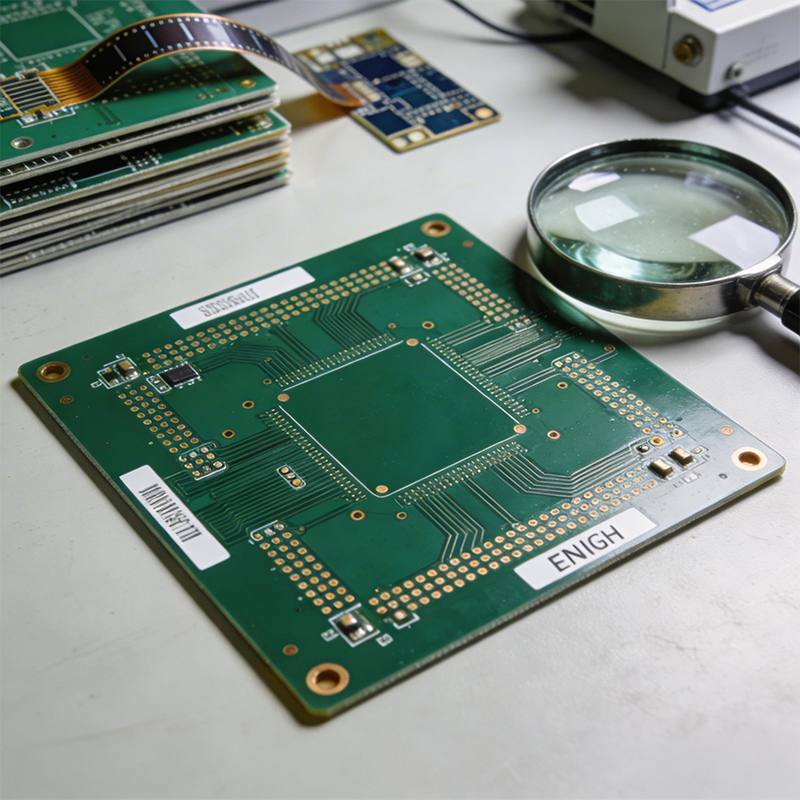
Not all blank boards are the same. The type you need depends on your product.
Rigid blank boards. The most common. FR-4 substrate, copper layers, solder mask, silkscreen. Used in everything from power supplies to computers.
Flexible blank boards. Polyimide substrate instead of FR-4. Can bend, fold, and fit into tight spaces. Used in wearables, medical devices, and foldable electronics.
Rigid-flex blank boards. Rigid sections for components, flexible sections for interconnects. One board does both.
HDI blank boards. High-density interconnect with microvias and fine traces. For compact, high-performance designs like smartphones and AI accelerators.
High-frequency blank boards. Special low-loss materials like Rogers or PTFE. For RF, microwave, and high-speed digital.
Metal-core blank boards. Aluminum or copper base for heat dissipation. Used in LED lighting and power electronics.
Each type has its own manufacturing challenges. Not every fabricator can do all of them.
When you're sourcing blank boards, here's what matters:
Material quality. Are they using genuine laminates from reputable suppliers? Cheap knockoffs can delaminate or have inconsistent dielectric properties.
Process control. Do they monitor etching rates, plating thickness, and lamination temperatures? Consistency is what separates good boards from scrap.
Testing. Do they test every board? Not spot-checking. Every board. Electrical test for shorts and opens is non-negotiable.
Registration. Can they hold alignment between layers? For multilayer boards, misregistration by a few microns can make vias miss their pads.
Surface finish quality. Is the finish consistent? Uneven HASL can cause soldering problems. Thin ENIG can lead to black pad failures.
Certifications. ISO 9001 is the baseline. For automotive, IATF 16949. For medical, ISO 13485. These aren't just stickers—they mean the manufacturer has documented, audited processes.
Even with good processes, defects happen. Here's what to watch for:
Insufficient copper thickness. Traces that are too thin can overheat or break. Plating that's too thin in vias can crack under thermal stress.
Poor registration. Layers that don't align mean vias that miss pads or pads that are partially missing.
Solder mask misalignment. If the mask shifts, pads get covered or copper gets exposed where it shouldn't.
Hole wall roughness. Rough holes can cause poor plating adhesion or wicking during soldering.
Delamination. Layers separating—usually from poor lamination or moisture absorption.
Impedance variation. Traces that don't meet impedance specs mean signals that reflect or degrade.
A good manufacturer catches these before they ship. A bad one lets them slide, hoping you won't notice until it's too late.
At Kaboer, we've been manufacturing blank printed circuit boards since 2009. Based in Shenzhen with our own PCBA factory, we understand that the blank board is the foundation for everything that follows.
What we offer:
Rigid blank boards: 1-30 layers, standard FR-4 to high-performance materials.
Flexible blank boards: 1-20 layers, 0.075mm to 0.4mm thick.
Rigid-flex blank boards: 2-30 layers, combining rigid and flexible sections.
HDI blank boards: Microvias down to 2mil, fine lines down to 2mil.
High-frequency blank boards: Rogers, PTFE, and other low-loss materials.
Metal-core blank boards: For LED and power applications.
What sets us apart:
We review every design. Before production, our engineers check your files for manufacturability—trace widths, clearances, annular rings, stackup symmetry.
We test every board. Electrical test on every blank board. No exceptions.
We control the process. Our processes are documented, monitored, and audited. ISO 9001, IATF 16949, ISO 14001.
We're transparent. Our Shenzhen factory is open to clients. You can see how your blank boards are made.
If you need blank printed circuit boards that are ready for whatever comes next—components, assembly, the field—send us your requirements or Gerber files. We'll review your design, give you honest feedback, and get back to you with a quote. We've been at this for over 15 years, and we believe the best partnerships start with straightforward conversations.
And if you're ever in Shenzhen, we'd be happy to show you around our factory and walk you through how we build the foundation for your products.

Kaboer manufacturing PCBs since 2009. Professional technology and high-precision Printed Circuit Boards involved in Medical, IOT, UAV, Aviation, Automotive, Aerospace, Industrial Control, Artificial Intelligence, Consumer Electronics etc..


 English



 Wechat
 +86 13670210335
 +86 13670210335
 E-mail