
Date: 2026-06-09
You're an electronics manufacturer. You've designed a product that needs a circuit board that bends – a flexible PCB. You get the bare boards made, send them to an assembly shop, and then… disaster. Components misaligned. Pads peeling off. Traces cracking after a few bends.
Sound familiar? You're not alone. Flex PCB assembly is genuinely much more difficult than assembling rigid FR4 boards. The good news is that once you understand the challenges, you can avoid them entirely.
In this guide, I'll walk you through everything you need to know about flexible circuit board assembly – the real-world problems, the proper process, and how to find a factory that won't mess up your product. No fluff, just practical advice from a shop that does this every single day.
A rigid PCB is stable. You put it on the SMT conveyor, it stays flat. A flex PCB? It behaves like a sheet of paper. It warps when heated, shrinks when cooled, and vibrates when the pick-and-place machine taps it.
Here are the three main headaches:
Thermal expansion mismatch – Polyimide (the flex material) and copper expand at different rates during reflow. Your fine-pitch components can literally shift out of alignment.
No rigidity – wobbling – The high-speed motion of a placement head will make a flex board bounce. Tiny 0201 resistors can fly off.
Weak pad adhesion – Copper doesn't stick to polyimide as well as it does to FR4. If your reflow profile is too aggressive, pads will lift right off the board.
That's why you can't just send your flex PCBs to any random SMT house. You need a shop that specializes in flex PCB assembly.
Too many manufacturers just send Gerbers and a BOM, then pray. Here's what you should actually check:
| Item | Why It Matters |
|---|---|
| 1. Do they use carriers (fixtures) ? | Flex boards must be mounted on an aluminum or synthetic stone carrier to stay flat through reflow. No carrier = disaster. |
| 2. No components in bend areas | If you place a resistor exactly where the board flexes repeatedly, the solder joint will crack. The assembly house can't fix bad design. |
| 3. Rigid-flex transition zones | Mixed rigid-flex designs need special support. The boundary area is extremely fragile. |
| 4. Electrical testing (flying probe) | Micro-cracks often appear after assembly. Only electrical testing catches them. |
| 5. High-frequency / HDI requirements | For 5G, radar, or high-speed designs, impedance matching is critical. Standard assembly will ruin your signal integrity. |
If you're new to flex assembly, send your files to a specialist for a free assembly feasibility check. It costs nothing and saves thousands.
A professional flex pcb assembly line looks nothing like a rigid board line. Here's the proper workflow:
Step 1 – Fabricate the carrier
This is where many cheap shops cheat. The factory CNC-mills a fixture (usually aluminum or magnetic synthetic stone) that matches your board's outline. A tacky adhesive or magnets hold the flex board perfectly flat.
Step 2 – Solder paste printing
Flex boards aren't perfectly flat, so stencil thickness and print pressure are adjusted. Typically, you reduce paste volume by 20-30% compared to rigid boards to avoid bridging.
Step 3 – Pick & place + reflow
The placement machine runs at lower speed with "soft touch" mode. The reflow profile is modified: longer preheat, lower peak temperature (polyimide can't handle the same heat as FR4). Real-time warpage monitoring is a must.
Step 4 – Depanel & test
After reflow, boards are removed from carriers. Then they go to flying probe or ICT to check for micro-cracks – especially near bend areas.
If your product needs both rigid sections (for heavy components) and flexible sections (for bending), you're looking at rigid-flex PCBs. These are one-piece boards with hard and soft zones.
Assembly challenges:
Pads in the transition area are extremely prone to cracking. The rigid and flex parts expand differently during reflow.
The rigid side needs a carrier, the flex side also needs support – but the transition must be suspended carefully.
Many assembly houses simply refuse rigid-flex jobs. We've been doing them for 8+ years and have customized reflow profiles and carriers for every type of rigid-flex stackup.
From hundreds of customer projects, we see the same three mistakes over and over:
Design ignored assembly – Components placed too close to bend lines, no tooling holes for carriers.
Using a standard SMT shop – They don't have flex-specific carriers or optimized reflow profiles. Results: lifted pads, tombstoned parts.
Skipping electrical test – Micro-cracks are invisible. A board can pass visual inspection but fail after 10 hours in the field. Flying probe is non-negotiable.
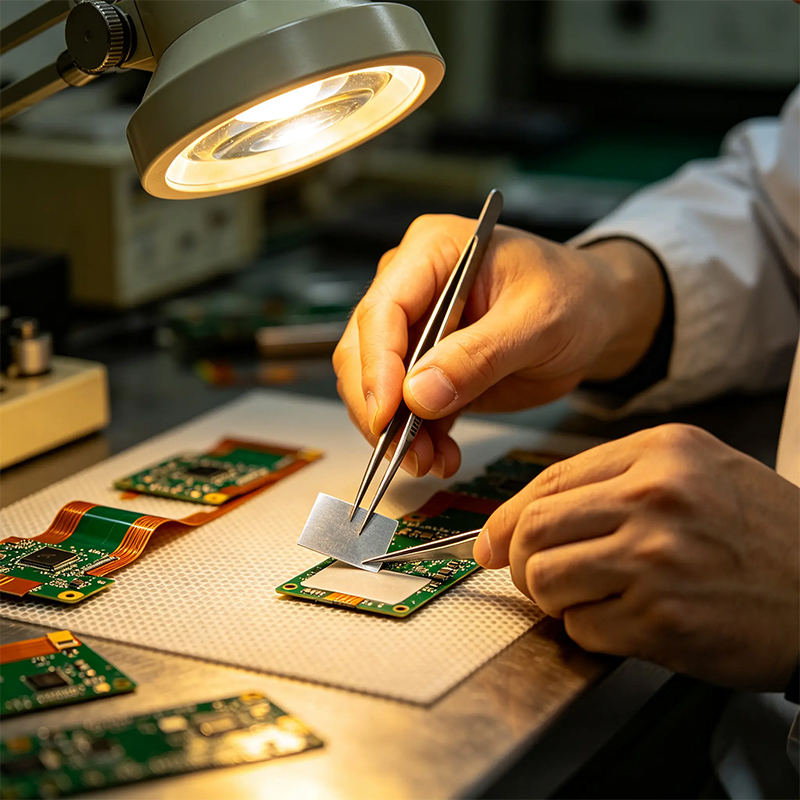
We are not just an assembly house. We are a one-stop custom manufacturer covering flexible PCBs, rigid-flex boards, HDI and high-frequency PCBs, and complete PCBA.
Flex PCBs : 1-6 layers, min trace/space 0.05mm, min mechanical drill 0.1mm.
Rigid-Flex : 2-10 layers, seamless transition between rigid and flex sections.
HDI & High-Frequency : Rogers, Taconic, PTFE materials. Ideal for 5G, radar, optical modules.
PCBA : Dedicated flex assembly line with laser carrier fabrication, high-speed placement, 3D SPI, AOI, and flying probe.
We've served customers in consumer electronics (smartwatches, fitness bands), automotive (sensors, cameras), medical (endoscopes, hearing aids), and industrial controls.
To give you an accurate price and assembly plan, please provide:
Gerber files (or native PCB files) – specify layer count, material, thickness
BOM – with part numbers, packages, tolerances, and preferred brands
Special requirements – bend cycles, impedance control, lead-free, etc.
Send your files to our team. You will receive:
Assembly feasibility feedback within 24 hours
Free DFM (design for manufacturing) check
Sample pricing and volume pricing
Flex PCB assembly isn't magic – it's engineering. With the right partner, your yield can go from 70% to 98%. With the wrong partner, you'll suffer rework, delayed shipments, and angry customers.

Kaboer manufacturing PCBs since 2009. Professional technology and high-precision Printed Circuit Boards involved in Medical, IOT, UAV, Aviation, Automotive, Aerospace, Industrial Control, Artificial Intelligence, Consumer Electronics etc..


 English



 Wechat
 +86 13670210335
 +86 13670210335
 E-mail