
Date: 2026-04-15
Let’s be honest: the world is getting smaller, and so is your hardware. Whether you’re developing a 5G communication module, an AI-powered wearable, or a high-frequency medical device, you’re likely fighting for every square millimeter of space. If you’re still trying to use traditional PCB design for these high-speed applications, you’re essentially trying to fit a V8 engine into a compact car—it just doesn't work.
This is where HDI PCB (High-Density Interconnect) technology changes the game. But as many engineers discover the hard way, choosing a manufacturer for HDI isn't like ordering standard boards. It requires a partner who understands the nuance of signal integrity and precision manufacturing.
Traditional PCBs use "through-holes" that go all the way through the board. This wastes massive amounts of space on every layer. HDI PCBs, however, use Microvias. These are laser-drilled holes so small they can be placed inside component pads (Via-in-Pad).
By using HDI, you can significantly reduce the number of layers while increasing component density. This doesn't just make the board smaller; it makes the electrical path shorter, which is a "no-brainer" for high-frequency signals.
In our facility, we see a lot of designs that look great on a screen but are a nightmare to manufacture. The magic of HDI lies in the stack-up:
Blind Vias: Connect the outer layer to an inner layer without going all the way through.
Buried Vias: Connect internal layers together, completely invisible from the outside.
Any-Layer HDI: The most advanced form, where connections can be made between any two layers.
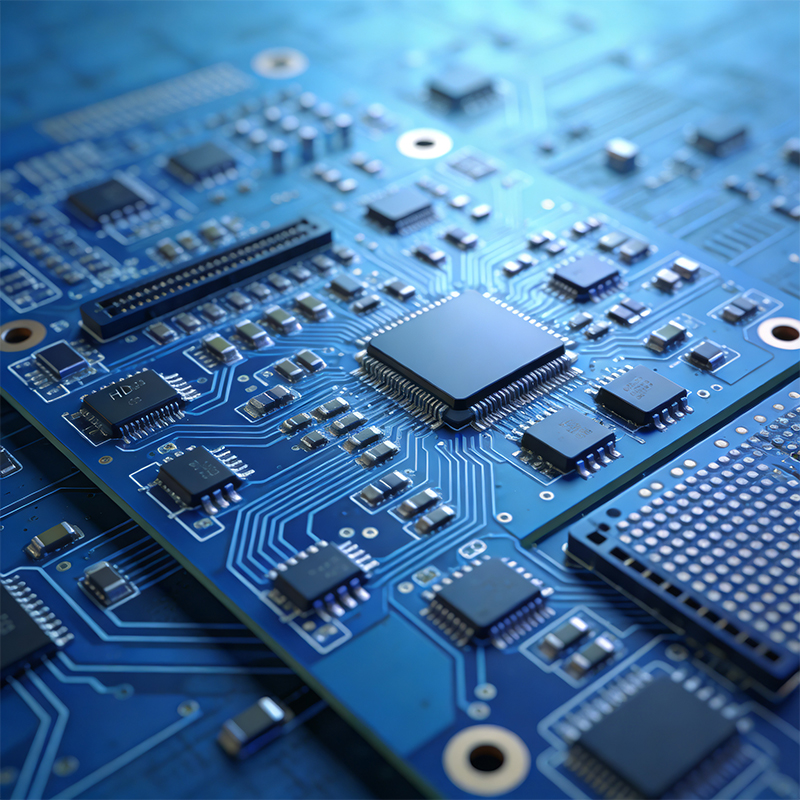
Manufacturing an HDI PCB is a chemistry and physics challenge. Because the holes are so small (often less than 0.1mm), the plating process is incredibly sensitive. If the copper plating inside a microvia is uneven, the board might work fine during testing but fail after a few months of thermal cycling in the field.
We prioritize 100% AOI (Automated Optical Inspection) and X-ray testing to ensure that every single via is structural sound. We’ve seen too many "budget" HDI boards fail because the factory skipped these critical steps.
Many of our clients are now asking for Rigid-Flex HDI. This is the "gold standard" for modern electronics. Imagine a high-density HDI section for your main CPU, connected seamlessly to a flexible tail that wraps around a battery or camera. By eliminating connectors, you reduce weight and remove the most common point of failure in portable electronics.
Designing a complex HDI board is only half the battle. Assembling it is the other. Components like BGAs with 0.4mm pitch require extreme precision during the SMT process. When you work with us for both HDI manufacturing and PCBA, we perform a "Full-Cycle DFM" (Design for Manufacturing) review. We catch layout errors before we ever hit the "print" button, saving you weeks of headache and thousands of dollars in re-spins.
The transition to HDI PCB technology can be daunting, but you don't have to do it alone. Whether you need an 18-layer any-layer prototype or a high-volume run of rigid-flex boards, our team is ready to talk technical.
Stop compromising on your design. [Contact us today for a technical consultation] and let's see how we can make your next project smaller, faster, and more reliable.

Kaboer manufacturing PCBs since 2009. Professional technology and high-precision Printed Circuit Boards involved in Medical, IOT, UAV, Aviation, Automotive, Aerospace, Industrial Control, Artificial Intelligence, Consumer Electronics etc..


 English



 Wechat
 +86 13670210335
 +86 13670210335
 E-mail