
Date: 2026-04-15
Let’s be real: in the world of electronics manufacturing, the smallest things usually cause the biggest headaches. You’ve designed a beautiful high-speed HDI board, the components are sourced, and then—boom—the final product fails. Why? More often than not, it’s a tiny bit of solder paste that didn't go where it was supposed to.
This is where Solder Paste Inspection (SPI) comes in. But what is it exactly, and why has it become a "deal-breaker" for professional PCBA?
At its simplest, solder paste inspection is a process used during SMT (Surface Mount Technology) to check the quality of the solder paste printed onto the PCB before the components are even placed.
Think of it as a high-tech "pre-check." After the solder paste printer applies that grey, toothpaste-like substance through a stencil, the SPI machine steps in to scan the board. It’s looking for mistakes before they become permanent (and expensive) errors.
An SPI machine isn't just taking a flat photo. Modern 3D SPI uses lasers or structured light to map the "topography" of the solder paste. It measures:
Volume: Is there enough paste to hold the component?
Height: Is the paste too thick or too thin?
Area & Shape: Is the paste a perfect brick, or a messy blob?
Offset: Is the paste centered on the pad, or is it leaning to one side?
If the machine sees a "cliff" where there should be a flat surface, it flags the board. The operator can then wipe the board clean and reprint it—saving a board that would otherwise have been trashed later.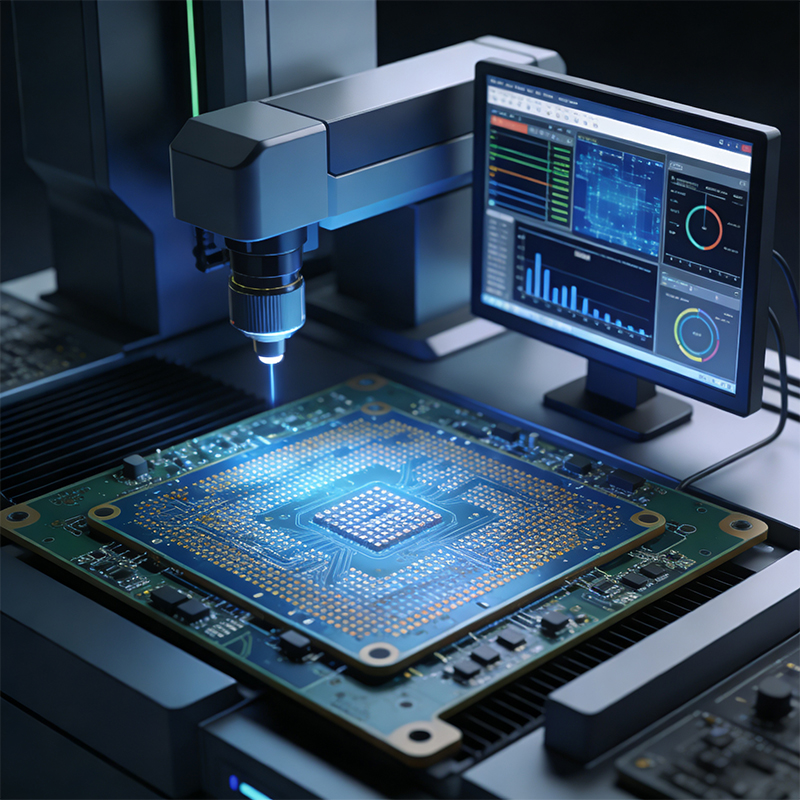
Here is a staggering stat: Over 70% of all PCB assembly defects are traced back to poor solder paste printing. If the paste is wrong, nothing else matters. You can have the most expensive pick-and-place machine in the world, but if the "glue" is bad, the joint will fail. By catching these errors at the SPI stage, you’re stopping defects at the source. It’s much cheaper to wash off some paste and try again than it is to de-solder a $500 CPU later.
In the old days, 2D SPI was common—it just checked if paste was there. But in 2026, with components getting smaller and smaller (we’re looking at you, 01005 chips), 2D isn't enough.3D SPI is now the standard because it measures volume. A 2D camera might see paste and say "Okay," but it won't know if that paste is too flat to make a solid connection. For HDI boards or BGA packages, 3D SPI is non-negotiable.
At our facility, we handle a lot of Rigid-Flex and high-speed HDI projects. These boards are unforgiving. Because flex circuits can warp slightly during the printing process, SPI is crucial to ensure the paste alignment is perfect. Without SPI, building these complex boards would be like throwing darts in the dark.
So, what is solder paste inspection? It’s the gatekeeper of quality. It’s the difference between a product that lasts five years and one that dies in five days. If you’re looking for a PCBA partner, one of the first questions you should ask is: "Do you have 3D SPI on every line?" If the answer is no, you might want to keep looking.

Kaboer manufacturing PCBs since 2009. Professional technology and high-precision Printed Circuit Boards involved in Medical, IOT, UAV, Aviation, Automotive, Aerospace, Industrial Control, Artificial Intelligence, Consumer Electronics etc..


 English



 Wechat
 +86 13670210335
 +86 13670210335
 E-mail