
Date: 2026-02-06
Imagine the circuit board inside your smartphone conducting a silent "conversation" at a rhythm of billions of times per second. This object that looks like just green plastic with metal lines is actually the beating heart and neural network of modern electronic devices.
Every electronic device—from a simple digital clock to a complex supercomputer—relies on circuit boards to coordinate the work of its internal "organs." Understanding how circuit boards work is like understanding the fundamental grammar of the entire digital world. It's not as mysterious as it seems, as long as you know how to read the "map" and "traffic rules" of this miniature city.
When you pick up a circuit board, what you're actually seeing is a carefully planned three-dimensional electronic city. Those copper traces are like the city's road system, while various electronic components are the buildings and functional facilities distributed throughout the city.
The foundation of the circuit board is the insulating substrate, usually glass-reinforced epoxy (FR-4), which is like the city's land, providing a stable and secure foundation. On this "land," planners (circuit designers) lay down copper "roads" (traces) that connect various "buildings" (electronic components).
These "roads" aren't laid randomly. Their width, length, and path are precisely calculated to ensure that electronic "vehicles" (current and signals) can reach their destinations efficiently and accurately, without "traffic jams" (signal delays) or "accidents" (signal interference).
The essence of circuit board operation is controlling and directing the flow of electrons. This might sound abstract, but you can think of it like a water supply system: the power source is like a water pump, the traces are like pipes, and switches and components are like faucets and various water-using devices.
When a circuit is powered, the power source (usually a battery or power adapter) creates a voltage difference in the circuit, much like a water pump creates water pressure. This pressure pushes electrons along the copper traces, forming current. The amount of current (how many electrons are flowing) and its direction are strictly controlled by various components in the circuit.
But circuit boards transmit more than just power—more importantly, they transmit information. By rapidly switching current on and off (creating digital signals of 0s and 1s), circuit boards can transmit complex instructions and data between different components. This digital conversation happens so fast that millions or even billions of signals can be transmitted in just one second.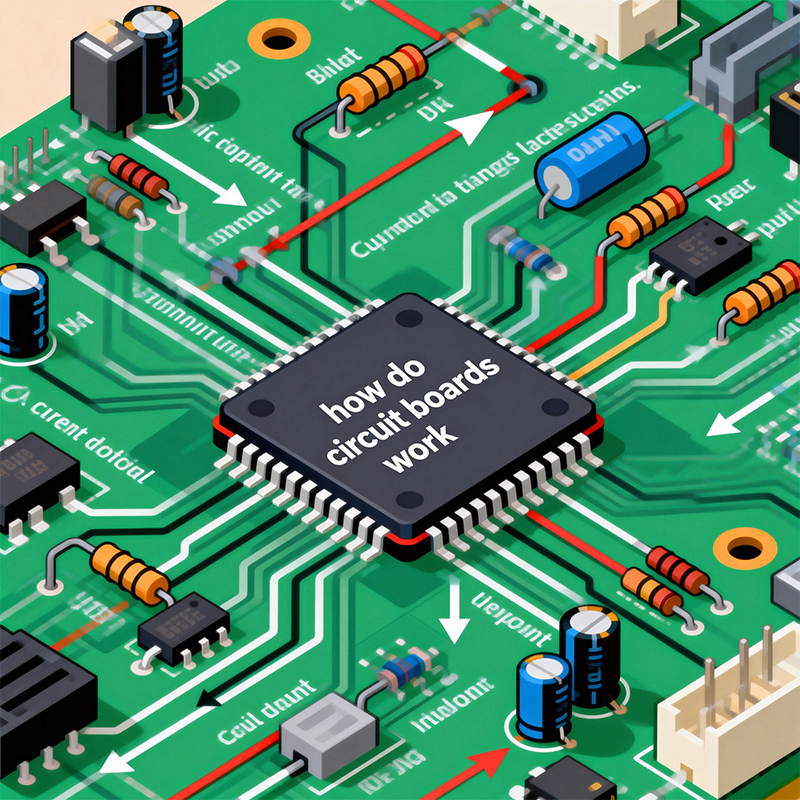
Every electronic component on a circuit board has its unique function, just like different buildings in a city have different purposes:
Resistors are like speed bumps or flow restrictors on roads. They control the flow of current, preventing too many electrons from rushing into sensitive areas.
Capacitors are like small water tanks or energy buffer zones. They can temporarily store electrical energy and release it quickly when needed, smoothing out current fluctuations and protecting the circuit from voltage spikes, much like shock absorbers.
Transistors are the miniature switches and amplifiers of circuits, forming the foundation of modern electronics. A chip the size of a fingernail might contain billions of transistors working together to perform logic operations, amplify signals, and control current.
Integrated circuits (chips) are highly specialized functional areas, like commercial districts or industrial parks in a city. These small black squares contain extremely complex microscopic circuits inside that can perform everything from simple timing to complex data processing tasks.
Modern circuit boards are rarely single-layer. Just as modern cities develop upward and underground, circuit boards also use multilayer designs. A standard smartphone motherboard might have 10 layers or more, each with its own unique circuit pattern, connected between layers by microscopic "elevators" (called vias).
This three-dimensional design greatly increases circuit density and complexity while reducing device size. Different layers can be dedicated to different functions: one layer might be专门 for power distribution, another for high-speed data signals, and another for grounding to prevent interference.
Connections between layers are achieved through precision drilling and plating. These "elevators" must be perfectly aligned to ensure signals can travel smoothly between different layers without getting "lost" or going to the "wrong floor."
A circuit board's work begins in the design phase. Engineers use specialized software (like Altium Designer or KiCad) to draw circuit schematics, much like urban planners drawing functional zoning maps.
Then, they transform these schematics into PCB layouts, precisely arranging the position of each component and the path of each trace. This process must consider hundreds of factors: signal integrity, thermal management, electromagnetic compatibility, manufacturing feasibility, and more.
After design is complete, a series of precision manufacturing processes turn the virtual design into physical reality:
Printing: Transferring the circuit pattern onto a copper-clad board
Etching: Using chemicals to remove unwanted copper, leaving behind the desired circuit
Drilling: Creating tiny holes for component pins and interlayer connections
Plating: Coating the inside of holes with copper to establish interlayer connections
Soldering: Mounting components onto the board and establishing electrical connections
In high-speed circuits, electrical signals behave more like waves than simple particle flows. These signal waves travel across circuit boards at接近光速, and their integrity is crucial.
Circuit board designers must consider impedance matching—ensuring the electrical characteristics of signal paths match the signal source and receiver to prevent signal reflections (like echoes). They also need to manage crosstalk—unintended interference between adjacent signal traces, much like how two people talking too close can interfere with each other's conversation.
To manage these challenges, high-speed circuit boards use special designs and materials, such as differential pairs (two closely coupled traces transmitting opposite-phase signals to improve noise immunity) and ground planes (complete copper layers providing stable reference points and shielding).
Circuit board technology has been continuously evolving. Early circuit boards used through-hole technology, with component pins going through holes in the board for soldering. Modern circuit boards primarily use surface-mount technology, with components soldered directly onto the board surface, enabling higher density and automated production.
Looking to the future, flexible circuit boards are changing the form factors of electronic products, allowing circuits to bend or even fold. Embedded component technology integrates passive components (like resistors and capacitors) directly inside the circuit board, further saving space and improving performance.
3D-printed electronics technology may completely revolutionize circuit board manufacturing, allowing circuits to be created on almost any surface, opening entirely new possibilities for electronic design.
Just as real cities experience traffic problems, circuit boards can also develop faults. Common issues include:
Open circuits: Interruption in the circuit path, like a road being cut off, preventing electrons from passing through.
Short circuits: Unintended connection between paths that shouldn't be connected, like roads mistakenly converging, causing current to take shortcuts.
Cold solder joints: Weak solder connections causing intermittent connections, like an unstable bridge.
Overload: Excessive current passing through a component, causing overheating and damage, like a road承受 traffic beyond its designed capacity.
Diagnosing and repairing circuit board faults requires a systematic approach and specialized tools like multimeters, oscilloscopes, and thermal imagers, much like how city engineers use various tools to inspect and maintain infrastructure.
Every time you use an electronic device, you're interacting with circuit boards. From waking up to a phone alarm, using a coffee maker to prepare breakfast, driving to work (modern cars contain dozens of circuit boards), to watching TV to relax in the evening—circuit boards are everywhere, working quietly and reliably, rarely demanding attention.
These unassuming boards are testaments to human engineering creativity, transforming abstract electrical principles into concrete functions, turning designers' imaginations into practical tools. Understanding how circuit boards work means understanding the fundamental architecture of our technological world, appreciating the tiny miracles that make modern life possible.
Next time you use an electronic device, take a moment to think about those carefully arranged components and traces inside, and the complex, coordinated "conversation" happening among them. This small circuit board is a perfect example of how human intelligence has tamed natural forces and given them purpose.

Kaboer manufacturing PCBs since 2009. Professional technology and high-precision Printed Circuit Boards involved in Medical, IOT, UAV, Aviation, Automotive, Aerospace, Industrial Control, Artificial Intelligence, Consumer Electronics etc..


 English



 Wechat
 +86 13670210335
 +86 13670210335
 E-mail