
Date: 2026-04-09
If you are asking "how do you use solder paste?", you might be dealing with a frustrating circuit shorting issue or a weak joint that just won’t hold. For a hobbyist, solder paste is just gray goop. But for a professional PCBA manufacturer, it is a high-precision chemical engine that drives the reliability of your entire device.
In 2026, as components shrink to the size of a grain of salt (hello, 01005 components!), the way you handle solder paste determines whether your product lasts ten years or ten minutes. Especially when dealing with High-Speed HDI or custom Flexible PCBs, you can't just "wing it."
Solder paste is a suspension of tiny solder alloy balls in a thick medium called flux. When people ask about its use, they often jump straight to the heat. But the real magic happens during the printing phase.
In our facility, we treat solder paste like a perishable luxury item. If it’s exposed to humidity for too long, it oxidizes. If it’s too cold, it won't release from the stencil. This is why many "cheap" factories fail—they don't respect the chemistry.
Here is a peek into how we do it on a professional SMT line:
Tempering (The "Warm-up"): We never take solder paste from the fridge and put it straight on the line. It needs to reach room temperature naturally to prevent water vapor condensation. Condensed water equals "popping" and solder balls during reflow.
Stencil Printing: This is the most critical 30 seconds in assembling circuit boards. For HDI designs, we use laser-cut, nano-coated stencils. The squeegee pressure and speed must be calibrated to the micron.
SPI (Solder Paste Inspection): How do we know the paste is perfect? We use 3D SPI machines to measure the volume and height of every single paste deposit. If it's 5% too low, the board is rejected before it even hits the pick-and-place machine.
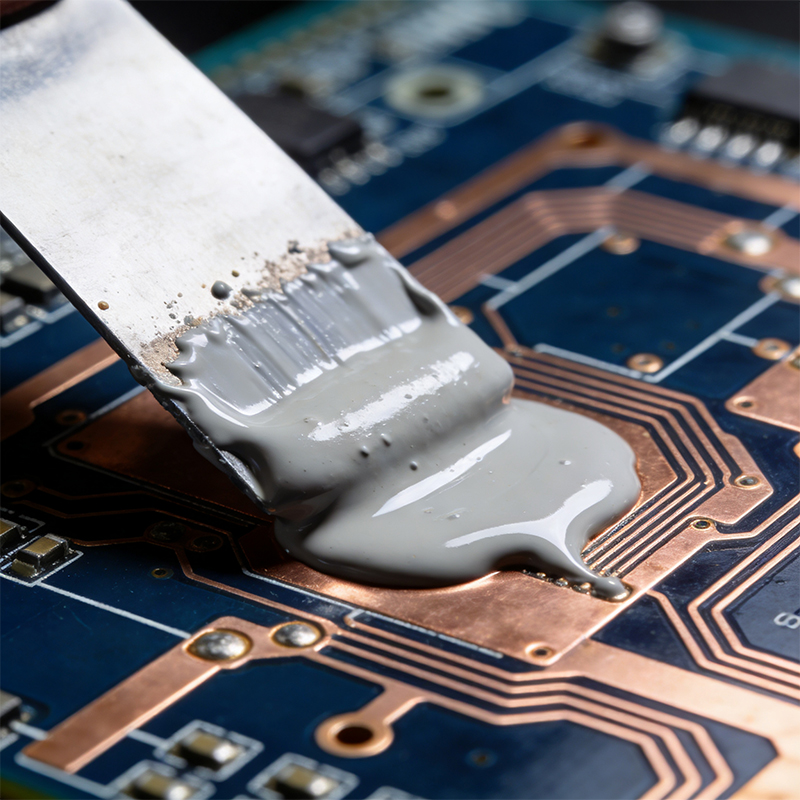
Flexible PCBs are tricky. Because the substrate is thin and can warp, using solder paste requires specialized "vacuum suction" fixtures to keep the board perfectly flat. If the board flexes during printing, the paste will smudge, leading to a catastrophic open circuit or bridge.
Furthermore, we only use paste that is 100% compliant with RoHS directive. Our lead-free processes ensure that your boards are ready for the EU and US markets without any legal or environmental headaches.
You might think, "Why do I care how you use solder paste as long as the board works?"
The answer is long-term reliability. Poorly managed paste causes "latent defects"—joints that look okay but crack after six months of vibration or temperature changes. In industrial PCB production, a field failure can cost you ten times the price of the board in shipping and reputation.
Knowing how do you use solder paste is the first step toward understanding quality. But for your commercial project, you shouldn't have to worry about viscosity, flux activation temperatures, or stencil wipe frequencies.
Let us handle the chemistry. Whether you are building a foldable medical sensor on a Rigid-Flex board or a high-performance server on an HDI stack-up, we bring the precision. Send us your Gerber files and BOM today, and let’s build a product that stays connected.

Kaboer manufacturing PCBs since 2009. Professional technology and high-precision Printed Circuit Boards involved in Medical, IOT, UAV, Aviation, Automotive, Aerospace, Industrial Control, Artificial Intelligence, Consumer Electronics etc..


 English



 Wechat
 +86 13670210335
 +86 13670210335
 E-mail