
Date: 2026-04-01
Let’s be honest: in a perfect world, we’d never have to clean a circuit board. Your PCBA process would be so pristine that no dust, flux, or "mystery gunk" would ever touch the copper. But in the real world of electronic manufacturing, things get messy.
Whether you’re dealing with excessive flux after a manual rework or a board that came back from the field looking like it lived in a swamp, knowing how to clean a circuit board is a survival skill. But if you’re building high-end gear—like HDI boards or custom flexible circuits—a bottle of alcohol and a toothbrush might actually do more harm than good.
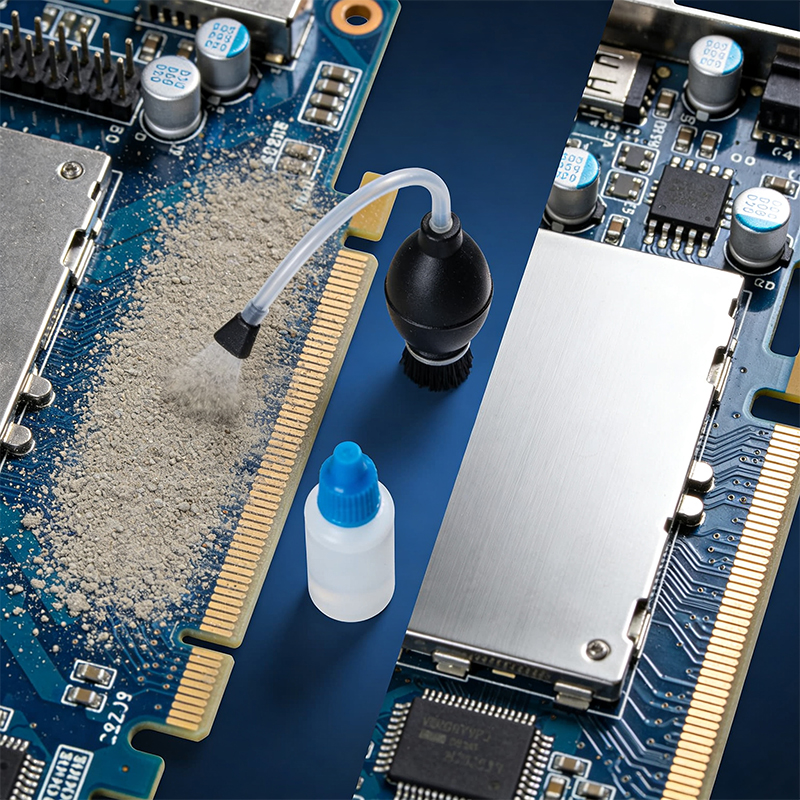
If you’re just cleaning a simple prototype, the standard move is 90% (or higher) Isopropyl Alcohol (IPA) and a soft-bristled antistatic brush.
Spot Clean: Dip the brush in IPA and gently scrub the residue.
Rinse: Use a little more IPA to wash away the loosened contaminants.
Dry: This is the big one. Use compressed air or let it sit in a drying oven. If moisture gets trapped under a BGA chip on an HDI board, you've just built a time bomb.
Why this fails for OEMs: Manual cleaning is inconsistent. It leaves "white residue" which is often just moved-around flux that can cause dendrite growth (tiny shorts) later on.
When we handle high-frequency or rigid-flex boards, we don't gamble with toothbrushes. We use industrial-grade cleaning because modern components are too small for manual labor.
Ultrasonic Cleaning: We use high-frequency sound waves in a specialized solvent. It "blasts" the contaminants out from under components that sit just microns above the board.
Aqueous Batch Cleaning: Think of it as a high-tech dishwasher for electronics. It uses deionized water and specific detergents to neutralize ionic contamination that causes corrosion.
If you are a manufacturer outside China looking for a PCBA partner, you need to ask: "How do you clean your flex boards?"
Flexible PCBs are porous and sensitive. If you use the wrong solvent, the polyimide can swell or delaminate. Similarly, for HDI boards with microscopic laser-drilled vias, any leftover salts or residues can lead to signal loss in 5G or high-speed applications. In these cases, "clean" isn't an aesthetic—it's a performance spec.
You’ve probably heard of "No-Clean" flux. It sounds great on paper—no washing needed! But even no-clean flux leaves a clear residue. For medical or aerospace devices, that residue can interfere with conformal coating or sensitive sensor readings.
At our facility, we often recommend a full wash even for no-clean designs, just to ensure that the printed circuit board layers stay protected for their entire lifespan.
Cleaning is the final step, but it’s the one that determines if your product lasts ten days or ten years.
If you’re tired of receiving boards with sticky residues or mysterious field failures, let’s talk. We specialize in custom flexible PCBs, rigid-flex, and high-precision PCBA. We don't just build the boards; we ensure they are chemically clean and ready for the toughest environments.
Got a complex project on your desk? Send us your Gerber files and let’s discuss how our precision manufacturing and cleaning processes can protect your reputation.

Kaboer manufacturing PCBs since 2009. Professional technology and high-precision Printed Circuit Boards involved in Medical, IOT, UAV, Aviation, Automotive, Aerospace, Industrial Control, Artificial Intelligence, Consumer Electronics etc..


 English



 Wechat
 +86 13670210335
 +86 13670210335
 E-mail