
Date: 2026-04-01
Let’s be honest: in an era dominated by microscopic SMT components and ultra-fine pitch HDI boards, wave soldering can sometimes feel like a "legacy" process. But if you’re building industrial controllers, high-reliability medical devices, or power supplies, you know that Surface Mount Technology (SMT) can’t do it all.
When you need the mechanical strength of a Through-Hole Technology (THT) joint, wave soldering is your best friend. But here’s the catch—doing it right on a complex, multi-layer, or rigid-flex board requires more than just a "solder fountain." It requires a partner who understands the physics of heat.
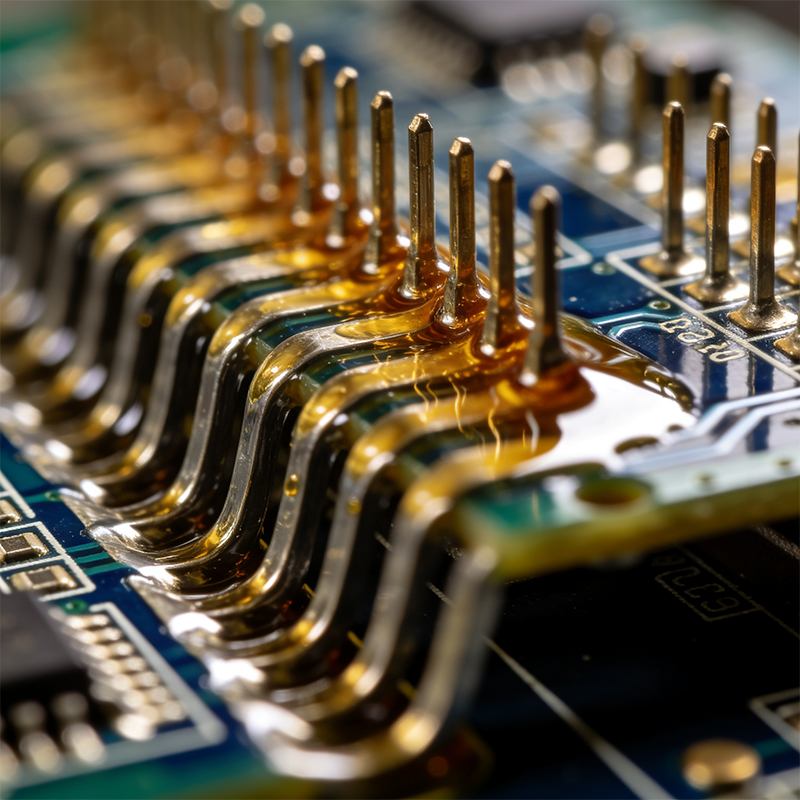
In simple terms, wave soldering is where a PCB passes over a standing "wave" of molten solder. It sounds straightforward, but for modern electronics, the margins for error have shrunk to nearly zero.
At our facility, we don't just "run the machine." We focus on the tiny details that prevent your project from becoming expensive scrap:
Flux Management: Too much flux leaves a sticky mess; too little leads to oxidation and the dreaded "cold joint."
Preheating Zones: If the board hits the solder wave while it's too cool, the thermal shock can crack ceramic capacitors or warp your delicate flexible PCB layers.
Nitrogen Blanketing: We use nitrogen to reduce dross and improve wetting, ensuring those solder fillets are textbook-perfect.
This is where most "cheap" factories fall apart. If you’re designing a rigid-flex board or a custom flexible circuit, you can't just toss it into a wave soldering machine. The flexible sections will flop around, and the heat can cause delamination.
How we solve it:
Custom Pallets & Fixtures: We design bespoke titanium or stone-composite carriers for every project. This keeps the flexible parts shielded and the rigid parts perfectly aligned as they hit the wave.
Selective Wave Soldering: For high-density HDI boards where SMT components are packed tight, we use selective soldering. This allows us to hit the through-hole pins without disturbing the tiny chips nearby.
We get it. Ordering PCBA from halfway across the world can feel risky. You're worried about "bridging" (solder shorts), poor communication, and lead times.
Here is how we bridge that gap:
DFM (Design for Manufacturing) Feedback: We review your Gerber files before we start. If your pad spacing is too tight for wave soldering, we’ll tell you and suggest a fix.
Traceability: From the solder alloy mix to the wave height, every parameter is logged.
Full Turnkey Service: We handle the bare board fabrication (Flex, Rigid-Flex, HDI) and the assembly under one roof. No more finger-pointing between the board shop and the assembly house.
Whether you are scaling up a rugged industrial sensor or a specialized aerospace component, the way your THT parts are soldered will define the lifespan of your product.
Ready for a technical deep dive? Send us your BOM and Gerber files today. Our engineers will provide a transparent quote and a manufacturing review that actually makes sense.

Kaboer manufacturing PCBs since 2009. Professional technology and high-precision Printed Circuit Boards involved in Medical, IOT, UAV, Aviation, Automotive, Aerospace, Industrial Control, Artificial Intelligence, Consumer Electronics etc..


 English



 Wechat
 +86 13670210335
 +86 13670210335
 E-mail