
Date: 2025-12-27
Cutting a PCB board refers to the process of separating individual printed circuit boards from a larger manufacturing panel, or cutting a board to a specific size and shape. This is a critical step in electronics manufacturing, as improper cutting can damage components, create electrical shorts via copper burrs, or introduce mechanical stress that leads to future failures. This guide explains the professional methods, tools, and considerations for clean, reliable PCB separation.
After assembly, multiple PCBs are typically produced on a single large panel for efficiency. "Cutting" or depanelization is the process of separating them. A poor cut can cause:
Physical Damage: Cracked boards, broken solder joints, or damaged components near the edge.
Electrical Defects: Lifted traces or conductive debris (burrs) causing shorts.
Mechanical Stress: Induced stress that may lead to latent cracks or reliability issues.
Poor Cosmetic Finish: Rough or uneven edges that hinder final assembly.
The choice of method depends on board design, volume, required edge quality, and investment.
| Method | Process Description | Best For | Pros | Cons |
|---|---|---|---|---|
| V-Scoring / V-Cut | A "V"-shaped groove is cut partway through the panel from top and bottom, leaving a thin web of material. Boards are separated by breaking along the score line. | High-volume, rectangular boards. Simple, fast, and low-cost per unit. | Very fast separation, low tooling cost, space-efficient on panel. | Only straight-line cuts. Creates stress during breakage. Leaves a slightly rough, angled edge. |
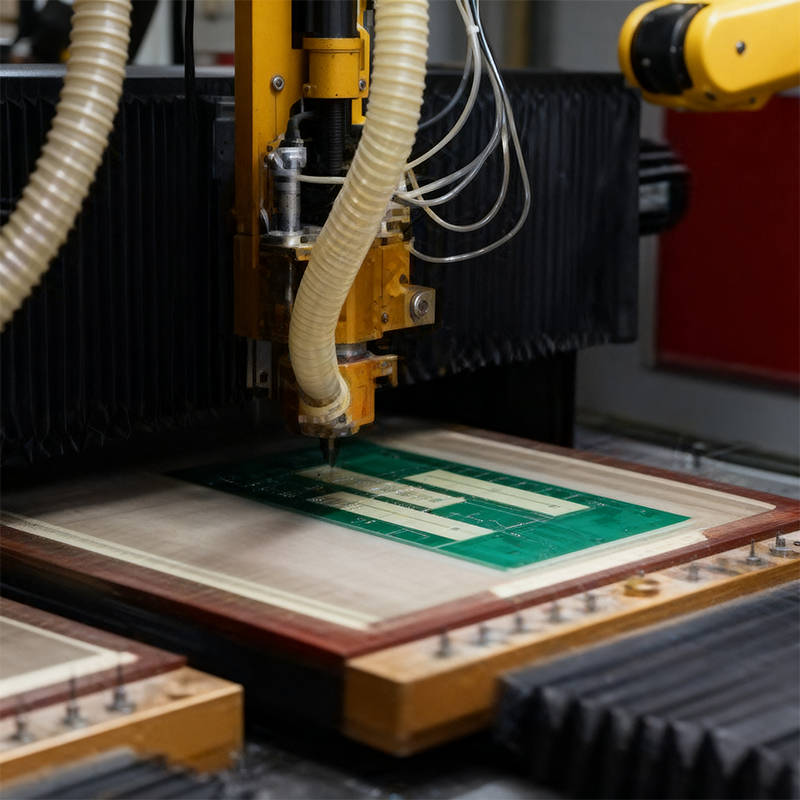
| PCB Routing / Milling | A CNC router with a spinning end mill bit follows the board's contour to cut it out completely. This is the most common professional method. | Any shape (complex outlines, curves, internal cutouts), prototypes, and medium/high-volume production. | Highly precise, clean edges, supports any complex shape, low stress on board. | Slower than V-scoring, higher machine cost, generates dust. |
| Punching / Die Cutting | A custom steel die (like a cookie cutter) is used to stamp out boards from the panel in one press. | Extremely high-volume production of simple, identical shapes (e.g., consumer electronics). | Fastest method at very high volumes, consistent edges. | Very high initial die cost and lead time. Only economical for massive quantities. |
| Manual Cutting (Hand Tools) | Using guillotine shearers, nibblers, or scoring knives for manual separation. | Prototyping, rework, or very low-volume production where investment in tools isn't justified. | Low initial cost, simple to set up. | Inconsistent quality, high risk of damage and delamination, labor-intensive. |
| Laser Cutting | A high-power laser beam vaporizes material along the cut path. A specialized, less common method. | Specialized materials (flex PCBs, ceramics) or extremely intricate shapes where mechanical force is unacceptable. | No mechanical contact (zero stress), high precision, complex shapes. | Very high equipment cost, slow, can char/burn edges (requires optimization), specific safety measures. |
A. Depanelizing V-Scored Boards:
Support the Panel: Place the panel on a flat surface with the V-groove aligned over a slight gap.
Apply Even Pressure: Press down firmly on both sides of the groove. Special breaking fixtures or hand-held breakers are used in production.
Clean the Edges: Use a fine file or sandpaper to remove any small fibers or burrs from the broken edge.
B. Depanelizing with a CNC Router:
Fixture the Panel: Securely clamp the assembly panel to the router bed.
Load Toolpath: Load the CNC program containing the board轮廓 cutting path.
Execute the Cut: The router bit spins at high speed and follows the path, cutting through the substrate. Dust collection is essential.
Unload & Inspect: Remove the individual boards and inspect edges for smoothness.
Design decisions directly impact the ease and quality of depanelization:
Panelization Design: Include mouse bites (small perforated tabs) or V-score lines in your panel layout. Specify a clear routing path with adequate clearance from components.
Clearance (Keep-Out): Maintain a component-free zone (typically 2-3mm minimum) from the board edge and cut lines to avoid damage.
Board Shape: Simple rectangles are easiest. For complex shapes, ensure your manufacturer has routing capabilities.
Material: Standard FR-4 routes cleanly. Flexible or rigid-flex PCBs require specialized laser or router setups to avoid delamination.
Always wear safety glasses to protect from flying debris or dust.
Use proper dust extraction when routing or milling to avoid inhaling fiberglass particles.
Secure the workpiece firmly to prevent slippage, which can ruin the cut and damage tools.
Use sharp, correct tools. A dull router bit or scoring blade will tear the material, creating burrs and delamination.
For manual methods, practice on scrap material first.
Q1: What is the difference between scoring and routing?
A: Scoring (V-Cut) creates a partial-depth groove for breaking; it's fast and for straight lines only. Routing uses a spinning bit to cut the board out completely; it's for any shape and provides a cleaner, more precise edge.
Q2: Can I use a regular woodworking saw or utility knife to cut a PCB?
A: It is strongly discouraged. These tools will almost certainly delaminate the layers, shatter the brittle fiberglass, and create massive amounts of hazardous dust and burrs, ruining the board.
Q3: How do I remove a single board from a panel held by mouse bites (breakaway tabs)?
A: Use a pair of fine-tipped pliers to twist and snap each tab. Follow up by carefully filing the small protruding nub flush with the board edge.
Q4: My PCB has sensitive components near the edge. What is the safest cut method?
A: CNC routing is the safest standard method, as it applies minimal lateral force. For the absolute minimum stress, laser cutting is optimal, though more expensive. Ensure you have designed sufficient clearance.

Kaboer manufacturing PCBs since 2009. Professional technology and high-precision Printed Circuit Boards involved in Medical, IOT, UAV, Aviation, Automotive, Aerospace, Industrial Control, Artificial Intelligence, Consumer Electronics etc..


 English



 Wechat
 +86 13670210335
 +86 13670210335
 E-mail