
Date: 2026-03-18
You've designed the board, picked the components, and sent the files off. But have you ever wondered what actually happens next? What goes on inside that factory after you hit "send" on your Gerber files?
I've been in this industry long enough to know that understanding making printed circuit boards isn't just interesting trivia. It helps you design better, spot potential problems before they happen, and know why some boards cost more than others.
Let's walk through the real process of how a bare sheet of material turns into the board sitting in your product. No fluff, just the straight story.
Before any copper gets etched, your files go through something called a Design for Manufacturing (DFM) check. This is where experienced engineers look at your design and ask: can we actually build this?
They're checking things like trace widths, hole sizes, spacing between pads—anything that might cause problems on the production line . A good DFM check catches issues before they become expensive. If your design needs tweaking, this is when you'll hear about it, not after your boards are already in production.
The raw material for most PCBs is called copper-clad laminate. Think of it as the foundation. It's a sheet of insulating material—usually FR-4 fiberglass—with a thin layer of copper bonded to one or both sides .
This material gets cut down to the exact size needed for production. The machines that do this are precise; if the cut is off by even a little, it can cause problems down the line.
For boards with more than two layers, we start with the inner circuits. This is where your design starts to become physical.
First, a light-sensitive film called photoresist goes onto the copper surface . Then, using a process called laser direct imaging, the circuit pattern from your design gets transferred onto the board. Think of it like taking a photograph of your circuit, but with lasers instead of light.
The areas that will become copper traces get hardened. The rest stays soft. Then the board goes through a chemical bath that washes away the soft parts, leaving behind the copper traces protected by the hardened resist .
After that, the remaining resist is stripped off, and you're left with bare copper circuitry on the inner layers.
Before anything gets stacked together, every inner layer goes through Automated Optical Inspection . High-resolution cameras scan the entire board, comparing what's actually there to your original design. This catches opens, shorts, or any other defects before they get buried inside the board where they'd be impossible to fix.
For multilayer boards, the individual layers need to become one solid panel. They're stacked with sheets of a special bonding material called prepreg between them .
This whole stack goes into a press under high heat and pressure. The prepreg melts, flows, and bonds everything together into a single, solid board . It's like making a very precise, very hot sandwich.
Now it's time to create the holes for vias and through-hole components. Computer-controlled drilling machines punch thousands of holes per panel, and they do it with micron-level accuracy .
For advanced boards, some holes are so small they need to be drilled with lasers. These microvias are what make HDI technology possible .
Right now, those holes are just holes in insulating material. To make them useful, they need to become conductive.
The boards go through a process called plated through-hole. First, a thin layer of copper gets chemically deposited on all surfaces, including inside every hole . Then more copper gets electroplated on, building up the thickness and creating solid conductive tubes that connect all the layers together .
The outer layers go through a similar process as the inner ones, with one extra step. After imaging and developing, the exposed areas get additional copper plating, then a thin layer of tin as an etch resist .
Then the unwanted copper gets etched away, and the tin gets stripped, leaving the final outer layer traces.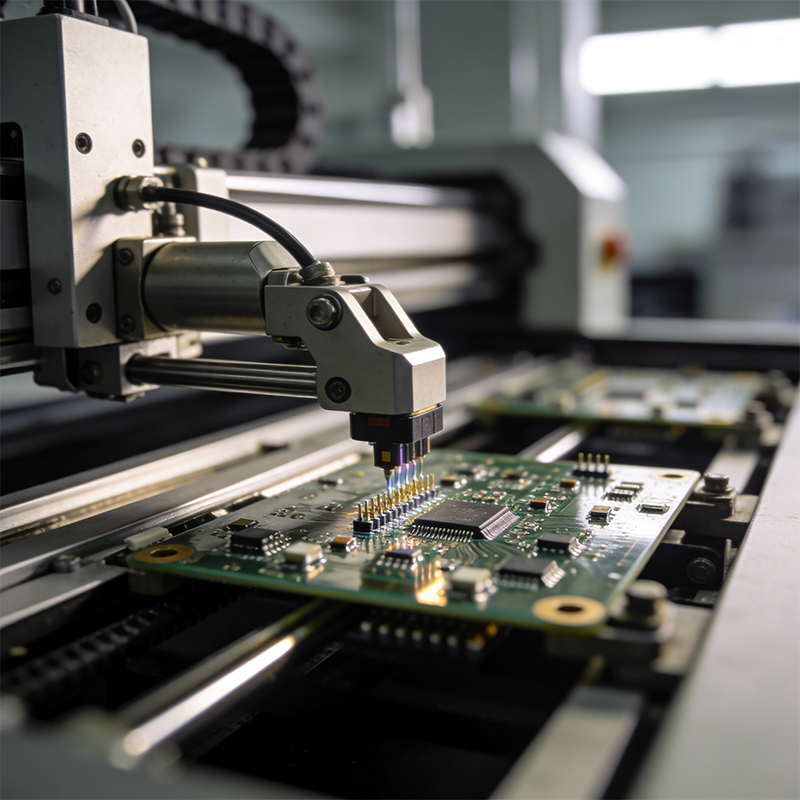
That familiar green coating—or whatever color you chose—is called solder mask. It's a protective layer that goes over the entire board, leaving openings only where components will be soldered .
The mask protects the copper from oxidizing and prevents solder bridges during assembly. It's not just for looks; it's essential for reliability.
The white lettering and component outlines you see on a board are added in this step. It's called silkscreen, and it prints important information like component identifiers, polarity markers, and logos . This is the map that guides assembly and makes troubleshooting possible.
The bare copper pads that will be soldered need protection. That's where surface finish comes in. Common options include:
HASL: The board gets dipped in molten solder and leveled with hot air. It's cost-effective and works for most applications .
ENIG: A layer of nickel followed by a thin layer of gold. It's flat, corrosion-resistant, and great for fine-pitch components .
OSP: A water-based organic coating that protects the copper until soldering. Simple and cheap, but shorter shelf life .
At this point, multiple boards are still connected in a single panel. They get cut apart using either a CNC router for complex shapes or V-grooves for simple rectangles .
The last step before shipping is electrical testing. Every board gets checked for shorts and opens. This is often done with a flying probe tester, which uses tiny moving probes to touch every single net on the board and verify its connection .
If a board doesn't pass, it doesn't ship.
Understanding how a bare board is made is one thing. Ensuring it's made right for your specific application is another.
At Kaboer, we've been making printed circuit boards since 2009. We're based in Shenzhen, and we handle the full range—from standard rigid boards to complex flexible circuits, rigid-flex boards, HDI high-frequency PCBs, and metal-core boards .
We have our own PCBA factory, which means we don't just make the boards—we can assemble them too. That's one partner, one quality standard, from bare board to finished, tested module .
We also offer fast prototyping so you can validate your designs quickly. And if you're ever in Shenzhen, you're welcome to visit our factory and see the process firsthand .
Send us your Gerber files or requirements. We'll review your design, give you honest feedback, and get back to you with a quote. We've been at this for over 15 years, and we believe the best partnerships start with straightforward conversations.

Kaboer manufacturing PCBs since 2009. Professional technology and high-precision Printed Circuit Boards involved in Medical, IOT, UAV, Aviation, Automotive, Aerospace, Industrial Control, Artificial Intelligence, Consumer Electronics etc..


 English



 Wechat
 +86 13670210335
 +86 13670210335
 E-mail