
Date: 2026-03-18
If you've ever held a circuit board and wondered what's actually inside it, you're not alone. That flat green board covered in tiny components and squiggly copper lines is basically the nervous system of every electronic device you use. But what is it made of? What are all those little parts, and what do they do?
Let's pull back the curtain and take a real look at what is in a circuit board. No overly technical jargon, just a straightforward explanation of the materials and components that make your products work.
First, let's talk about the board itself—the foundation that holds everything together. A circuit board isn't just a single piece of material. It's actually a carefully constructed sandwich of different layers, each with a specific job.
The foundation of any circuit board is called the substrate. This is the material that gives the board its strength and rigidity (or flexibility, depending on the type). For most standard boards, this is made from FR-4, which is a flame-retardant fiberglass material . It's strong, reliable, and cost-effective, which is why you see it everywhere.
For boards that need to bend, like in wearables or foldable phones, the substrate is made from flexible materials like polyimide . This allows the board to twist and flex without breaking.
Right on top of that substrate is a thin layer of copper. This is where the magic happens. The copper is etched away to leave behind little pathways called traces . Think of these as the roads that electricity travels on. They connect all the components together in exactly the right way.
Depending on how complex the board is, it might have copper on one side (single-layer), both sides (double-layer), or multiple layers stacked up (multilayer boards) .
That green coating you always see? That's called solder mask . Its job is to protect the copper traces from oxidation and prevent accidental solder bridges during assembly. It keeps the electricity flowing where it's supposed to and nowhere else. While green is the most common, you can get it in red, blue, black, or white too.
The white letters and boxes printed on the board are called silkscreen . This is the labeling system that shows where components go, what their values are, and which way they're oriented. It's basically the instruction manual printed right on the board.
Now let's look at the components themselves. These are the little parts soldered onto the board that do all the work. They generally fall into two categories: passive and active components .
Resistors are probably the most common thing you'll see. Their job is simple: control the flow of electric current . They're used to limit current, divide voltages, and protect sensitive parts from getting too much power.
Capacitors store and release electrical energy . Think of them like tiny rechargeable batteries. They smooth out power supplies, filter out noise, and help keep signals clean. You'll see them everywhere—little beige or gray blocks for ceramic capacitors, and bigger can-shaped ones for electrolytic capacitors.
Inductors store energy in magnetic fields . They resist sudden changes in current and are often used in power supplies and radio frequency circuits. They usually look like little coils or wound wire.
Diodes let current flow in only one direction . That simple property makes them incredibly useful for protecting circuits from reverse voltage and converting AC to DC. LEDs (light-emitting diodes) are a special type that gives off light.
Transistors act as switches or amplifiers . A small signal at one pin can control a much larger current flowing between the other two. This is what makes amplification possible and how processors create logic gates and memory.
Integrated Circuits are complete circuits—sometimes incredibly complex ones—packaged into a single chip . Microcontrollers, memory chips, power management chips, sensors… all of these are ICs. They're the black rectangles with lots of pins.
Connectors let your board talk to the outside world . Power comes in through them, signals go out through them, and other boards connect through them. Headers, USB ports, audio jacks—these are all connectors.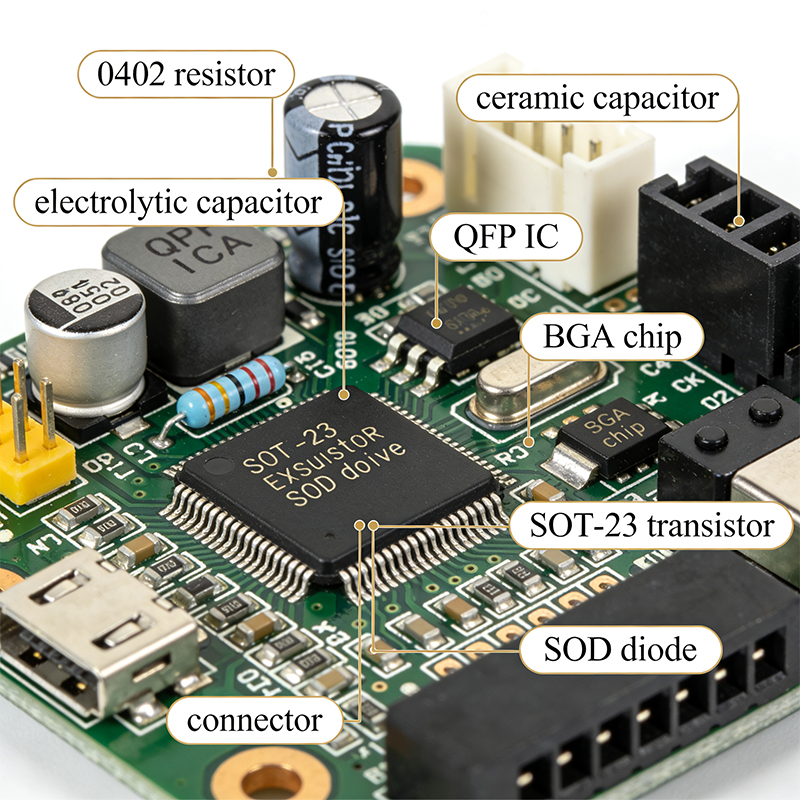
When electricity flows through the traces, each component interacts with the current in a specific way—storing, blocking, amplifying, or processing it . Together, they form a closed circuit that performs a complete function. Power enters the board and flows through the copper traces, hitting each component in sequence to make the device work.
This is why understanding what is in a circuit board matters. When you know what each part does and how they work together, you can make better decisions about design, sourcing, and troubleshooting.
Not every circuit board is the same. The type of board you need depends on what you're building.
Single-sided boards have components and traces on only one side. They're simple and cheap, used in things like calculators and power supplies .
Double-sided boards have traces on both sides, connected by small plated holes called vias. This allows for more complex circuits .
Multilayer boards have three or more layers of copper stacked together. These are used in high-performance devices like smartphones, servers, and medical equipment where space is tight and signal quality matters .
Flexible boards are made from bendable materials like polyimide, letting them twist and fold. They're essential for wearables, medical implants, and foldable phones .
Rigid-flex boards combine rigid and flexible sections in one design. They're used in aerospace, military gear, and high-end consumer electronics where durability and compactness are critical .
High-frequency boards use special low-loss materials for 5G, radar, and RF applications where signal integrity is paramount .
Aluminum-backed boards are built with a metal base for excellent heat dissipation, making them ideal for LED lighting and power electronics .
The quality of your circuit board directly affects the quality of your final product. A well-made board with the right materials will last for years. A poorly made board with cheap materials might fail in months.
That's why choosing the right manufacturing partner is so important. At Kaboer, we've been building custom circuit boards since 2009. We're based in Shenzhen, and we handle everything from standard rigid boards to complex flexible circuits, rigid-flex boards, HDI high-frequency PCBs, and metal-core boards. We have our own PCBA factory, which means we don't just make the boards—we can assemble them too. And we offer fast prototyping so you can validate your designs quickly. If you're ever in Shenzhen, you're welcome to visit our factory and see how we work.
Send us your Gerber files or requirements. We'll review your design, give you honest feedback, and get back to you with a quote. We've been at this for over 15 years, and we believe the best partnerships start with straightforward conversations.

Kaboer manufacturing PCBs since 2009. Professional technology and high-precision Printed Circuit Boards involved in Medical, IOT, UAV, Aviation, Automotive, Aerospace, Industrial Control, Artificial Intelligence, Consumer Electronics etc..


 English



 Wechat
 +86 13670210335
 +86 13670210335
 E-mail